The Nigeria Revenue Service (NRS) and the Joint Revenue Board (JRB) have issued comprehensive guidelines on the regulation and taxation of virtual asset peer-to-peer (P2P) marketplaces, ending years of regulatory ambiguity for Nigeria’s cryptocurrency sector.


On August 3, the NRS released the Guidelines on the Taxation of Virtual Assets, grounded in the Nigeria Tax Act 2025 and the Nigeria Tax Administration Act 2025. Parallel rules from the JRB, issued under the 2025 Virtual Assets Service Providers Licensing Regulation, impose licensing, compliance and consumer protection standards on P2P platforms that facilitate direct trades between buyers and sellers. Operators must secure official approval, enforce anti-money-laundering controls, and meet governance, risk management and transparency requirements before serving users.
The dual measures aim to bring informal crypto trading under formal oversight, reduce risks from unregulated platforms, protect investors and integrate digital assets more securely into the financial system while preserving space for innovation. Officials emphasised that the guidelines deliver clarity, certainty and consistency, promote voluntary compliance and support a fair tax framework for the rapidly evolving virtual asset ecosystem.
Under the tax rules, gains are calculated strictly on realised disposals. Merely holding assets, including unrealised appreciation, remains non-taxable. Gains are computed in US dollars (proceeds minus cost base), with only the net USD profit converted to naira at the prevailing NAFEM/CBN rate on the transaction date. This approach, according to experts, is designed to prevent traders from paying tax on fictitious naira gains driven purely by currency devaluation.
Virtual Asset Service Providers (VASPs) and P2P marketplaces must withhold 1 per cent of proceeds at source on the disposal of cryptocurrencies, exchange tokens, security tokens and NFTs. The naira equivalent is credited as an advance tax payment, which traders later offset against their annual self-assessment liability. Stablecoins such as USDT and USDC are exempt from the withholding tax, a significant concession given their dominance as digital dollars in the Nigerian market. A newly introduced 1.5 per cent stamp duty applies to token-to-fiat and fiat-to-token transfers. Staking rewards, mining income, airdrops and DeFi yields are taxed at 10 per cent. In an unusual provision, some tax may be remitted in the crypto tokens themselves.
Senator Ihenyen, Lead Partner at Infusion Lawyers and Founding Trustee of the Virtual Asset Service Providers Association (VASPA), said the framework turns registered exchanges into tax collectors. “VASPs and P2P escrows deduct the 1 per cent withholding tax directly from the gross originating token upon execution,” he explained in an interview with Technnext.
Traders reconcile the amount at year-end, resulting in either a balance due or a refund.
Ihenyen noted that the stablecoin exemption will likely prompt traders to route intermediate trades through USDT or USDC to minimise locked-up capital. However, the 1.5 per cent stamp duty could prove severe for high-frequency, low-margin P2P merchants and local exchanges, potentially pushing some activity back into informal channels. Penalties are steep: an administrative fine of ₦10 million in the first month of default, plus ₦1 million for each subsequent month, a 40 per cent penalty on unwithheld taxes and statutory interest.
Licence revocation by the Securities and Exchange Commission remains a further threat.
While centralised platforms face automatic enforcement, self-custody wallet and decentralised exchange users enjoy no legal exemption. Failure to declare on-chain income constitutes default, though practical enforcement is strongest when assets are off-ramped into the banking system or registered VASPs.
Stakeholders expect market consolidation toward well-capitalised domestic and international players as smaller startups grapple with compliance costs. The guidelines are available on the NRS website. Crypto and fintech operators have been urged to study the rules carefully and adjust operations accordingly in the months ahead.
“Order Justice Omolaye-Ajileye’s Electronic Evidence Books Now” — Essential Guides On Evidence Act, Case Law And Digital Proof
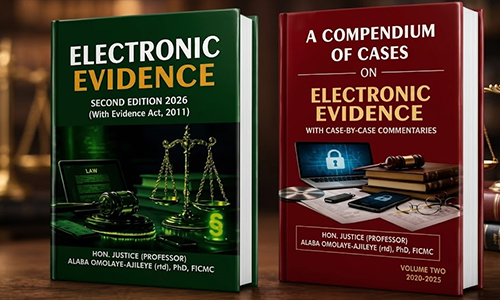
[A MUST HAVE] Evidence Act Demystified With Recent And Contemporary Cases And Materials

Available now for NGN 40,000 at ASC Publications, 10, Boyle Street, Onikan, Lagos. Beside High Court, TBS. Email publications@ayindesanni.com or WhatsApp +2347056667384. Purchase Link: https://paystack.com/buy/evidence-act-complete-annotation
______________________________________________________________________ “Enhance Legal Practice With Authoritative Reports” — Alexander Payne Offers Comprehensive Law Reports, Spanning Over A Century Of Nigerian Jurisprudence Interested buyers are encouraged to place their orders and enquiries via:
0704 444 4777, 0704 444 4999, 0818 199 9888
Website: www.alexandernigeria.com
Interested buyers are encouraged to place their orders and enquiries via:
0704 444 4777, 0704 444 4999, 0818 199 9888
Website: www.alexandernigeria.com
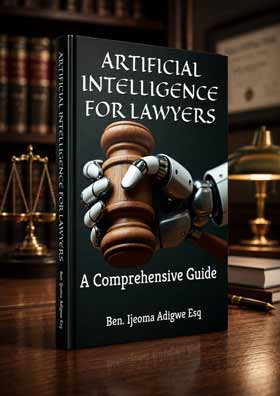 The book also examines Nigeria's legal ecosystem, focusing on the LPELR and NBA AI Guidelines. As a bonus, every purchase comes with a FREE eBook titled: How to Use the AI Features in LegalPedia and LawPavilion.
Ohio Books Ltd praises the publication, stating:
"....this is the only Nigerian book I know of on the topic."
How to Order:
📞 Call, Text, or WhatsApp: 08034917063 | 07055285878
📧 Email: benadigwe1@gmail.com
🌎 Website: www.benadigwe.com
Ebook Version: Access it directly online at https://selar.com/prv626
Authored by Ben Ijeoma Adigwe Esq., ACIarb (UK), LL.M, Dip. in Artificial Intelligence, Director at the Delta State Ministry of Justice, Asaba, Nigeria.
The book also examines Nigeria's legal ecosystem, focusing on the LPELR and NBA AI Guidelines. As a bonus, every purchase comes with a FREE eBook titled: How to Use the AI Features in LegalPedia and LawPavilion.
Ohio Books Ltd praises the publication, stating:
"....this is the only Nigerian book I know of on the topic."
How to Order:
📞 Call, Text, or WhatsApp: 08034917063 | 07055285878
📧 Email: benadigwe1@gmail.com
🌎 Website: www.benadigwe.com
Ebook Version: Access it directly online at https://selar.com/prv626
Authored by Ben Ijeoma Adigwe Esq., ACIarb (UK), LL.M, Dip. in Artificial Intelligence, Director at the Delta State Ministry of Justice, Asaba, Nigeria.