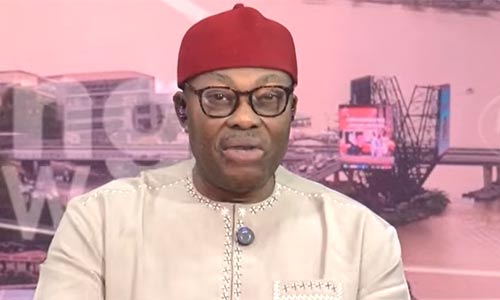
A Senior Advocate of Nigeria and human rights advocate, Dr. Monday Ubani, has said the Economic and Financial Crimes Commission’s restriction on an Osun State government account raises unsettled legal questions about how far the anti-graft agency’s powers stretch, particularly its authority to freeze the statutory account of a federating unit without a prior court order.

Speaking on Arise Television on Friday morning, Ubani examined both the commission’s action and President Bola Tinubu’s decision to direct the EFCC to return to court to vacate the freezing order, describing the episode as one that citizens are entitled to scrutinise in the light of the law and political expediency.
Ubani said the starting point was not the President’s directive but whether the EFCC can freeze an account at all. He explained that under Section 38 of the EFCC Act and the corresponding provision of the Money Laundering (Prohibition) Act, the commission can, as an interim measure where there is a risk that funds will be dissipated, ask a bank to place a restriction against dissipation for up to 72 hours for the purpose of investigation.
He drew a sharp distinction, however, where the account belongs to a federating unit. In his view, because a state’s money is guaranteed under Section 162 of the Constitution as a federal allocation meant for salaries and other responsibilities, it is genuinely arguable whether the EFCC can freeze such an account without first obtaining a court order that examines the reasons for the freeze. That, he said, is a matter the court would have to decide.
Ubani noted that the first letter written to First Bank, dated 5 August, did not contain or attach any valid court order, and that it only later became apparent that the commission may have obtained an order from a judge he identified as Justice Omar. Subsequently, he said, there was evidence that an order freezing the state’s statutory allocation account had in fact been obtained.
On the President’s power to revise the commission’s action, Ubani observed that the EFCC falls under the executive branch, of which the President is the chief executive officer where everything stops at his table. He said the President had described the situation as embarrassing, having been accused of interfering in Osun, and recalled that an earlier statement attributed to the President that “in politics all is fair” was being used against him.
Ubani said the President intervened by asking the EFCC to return to the same court to vacate the order, but added that this raised a debatable question of whether, by that action, the President had compromised the independence of the commission. While supervisory power lies with the presidency, he asked whether the President could also interfere with the operational competence of the agency, suggesting the directive exposed a tension around the EFCC’s independence.
Underlying all of it, Ubani said, was the principle that when those elected to govern take action, there are consequences, and citizens have a right to examine those actions in the light of the law and political expediency so that officials can correct rather than repeat them.
Asked whether the EFCC had ever frozen a state government’s account before, Ubani said he was not aware of any such recent action. He noted that there is a plethora of appellate decisions in which the commission froze the accounts of individuals and bodies without a prior court order and the courts condemned the practice, holding that where proprietary rights are concerned it is the court that the Constitution empowers to determine rights, liabilities and privileges. To take away those rights, he said, the EFCC must first present the facts of its investigation to a court, which may then authorise the freezing of an account. He said he knew of no instance involving a state.
On whether the President’s intervention was a political stunt or a statesmanlike act, Ubani declined to make excuses for the President but said he may genuinely have felt embarrassed. He questioned whether it was proper for the EFCC to freeze a state’s statutory account without prior notice to the chief executive of the country, given that such an action could precipitate a crisis and create insecurity in which the federal government would inevitably be involved.
He stressed the sensitivity of the timing, with the Osun governorship election only days away, warning that the freeze created an impression that federal agencies were being used to muzzle a unit controlled by an opposition party. The President, he said, chose to announce the reversal publicly rather than route it through the Attorney-General in order to make everyone aware that he was not involved, was embarrassed and was unhappy with the action, though whether that approach was right was left for the public to judge.
Going forward, Ubani urged the commission to obtain a court order before taking such steps and to properly evaluate timing and circumstances, because, in his words, some actions can be right but not expedient. Investigating crime, he said, may be a right action, but freezing a state account days before an election may not be expedient.
Ubani argued that whatever the arms and agencies of government do is ultimately attributed to the President at the federal level, so that even an operationally independent EFCC has its actions laid at the door of the Tinubu administration. That reality, he suggested, likely explained why the President moved publicly to distance himself from the freeze.
He maintained that there was nothing wrong in the EFCC investigating a state account that is being criminally dissipated, but insisted that administrative evaluations of the impact on governance, state funding and the payment of salaries must be carried out even when the commission is doing the right thing.
Reflecting on the wider pattern, Ubani said that security agencies the world over tend to exceed their powers, making a strong and fearless judiciary essential to check them. Recounting his own experience, he said the EFCC once detained him for 21 days in 2022 after he helped bring in a woman alleged to have committed a crime; when the commission declined to charge her and she left, he was asked to produce her again and did so through an Interpol red alert, only to be locked up himself, before a court held the detention absolutely wrong and awarded him damages. He said he had welcomed the appointment of a lawyer as the current EFCC chairman in the hope that such excesses would reduce, but noted that officers under him could still overreach, making judicial oversight indispensable.
Responding to the anchors on Osun State’s suit seeking ₦2 billion against the EFCC, Ubani said the case appeared to have been prepared and possibly filed before the President reversed the freezing order. While the state had every right to seek a remedy for a wrong, he said that, given the President’s intervention and his phone call to the governor, he would, if he were in the governor’s position, advise the Attorney-General to withdraw the suit in order to de-escalate tension and build a harmonious relationship with the federal government. He cautioned that the court would not simply award ₦2 billion but would first examine whether the EFCC had a legal right to act and whether it did so properly.
On whether the President’s strong words amounted to a vote of no confidence in the EFCC’s leadership, Ubani said they did not necessarily mean a loss of confidence, likening the President to a father who uses harsh words to correct a misbehaving son without discarding the child.
Pressed on the EFCC chairman’s association with Prince Adeniyi Adeyemi, the man at the centre of the fake presidential council scandal, Ubani initially cautioned that taking a picture with someone did not necessarily signify connivance or knowledge of the agency’s fictitious nature. Confronted with the point that it involved the exchange of an award to a man the presidency itself calls a con artist, and with concerns that cases against several former officials appeared to have stalled, he said he was not certain those cases were stalled, noting that the trial of the former Kogi governor was proceeding with witnesses. He insisted that if any cases had stalled through partisan consideration, the EFCC must ensure fairness and give no preference to anyone on account of political affiliation, while stressing that once a matter is before the court, it is the judiciary, not the commission, that controls its pace.
Ubani reserved some of his firmest words for financial institutions. He said it was wrong for a bank to place a “post no debit” restriction simply because a letter arrives from the EFCC, and that the first question any bank should ask is whether there is a court order. He urged banks to route such letters through their legal departments before complying, warning that they are frequently joined as defendants and ordered to pay damages for acting on unlawful directives.
While observing that “the fear of EFCC is the beginning of wisdom,” he insisted that the commission itself must operate under the law that created it, and put all banks on notice not to obey any freezing order that does not comply with the law.
[A MUST HAVE] Evidence Act Demystified With Recent And Contemporary Cases And Materials

Available now for NGN 40,000 at ASC Publications, 10, Boyle Street, Onikan, Lagos. Beside High Court, TBS. Email publications@ayindesanni.com or WhatsApp +2347056667384. Purchase Link: https://paystack.com/buy/evidence-act-complete-annotation
______________________________________________________________________ “Enhance Legal Practice With Authoritative Reports” — Alexander Payne Offers Comprehensive Law Reports, Spanning Over A Century Of Nigerian Jurisprudence Interested buyers are encouraged to place their orders and enquiries via:
0704 444 4777, 0704 444 4999, 0818 199 9888
Website: www.alexandernigeria.com
Interested buyers are encouraged to place their orders and enquiries via:
0704 444 4777, 0704 444 4999, 0818 199 9888
Website: www.alexandernigeria.com