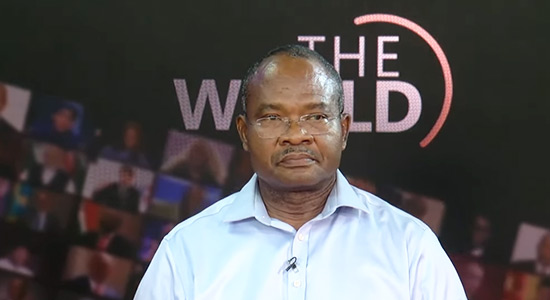
Prominent human rights defender and constitutional lawyer, Clement Nwankwo, has strongly condemned the National Assembly’s approval of President Bola Tinubu’s declaration of a state of emergency in Rivers State, describing it as unconstitutional and a dangerous precedent for Nigeria’s democracy.

In a recent interview, Nwankwo criticized both the president and the National Assembly for acting outside the provisions of the 1999 Constitution. He argued that the president lacks the authority to unilaterally declare a state of emergency in Rivers State and that the National Assembly’s approval via a voice vote was both unconstitutional and procedurally flawed.
According to Nwankwo, the constitution is explicit on the process for declaring a state of emergency and the limitations of presidential powers in such matters. “What has happened is absolutely unconstitutional. When the president of a country acts in violation of the constitution and the National Assembly stamps that unconstitutional act in an unconstitutional manner, it is distressing,” he stated.
He further pointed out that Section 11 of the Nigerian Constitution provides guidance on how disputes within a state House of Assembly should be resolved. “The constitution allows the National Assembly to take over the legislative functions of a state House of Assembly when it is unable to sit, but it does not give them the power to remove a governor,” Nwankwo explained.
He also referenced Section 305 of the constitution, which outlines the process for declaring a state of emergency, stating that no credible justification was provided for such a drastic measure in Rivers State. “What constitutes a state of emergency? A reported explosion? Yesterday, there was an explosion on the road from Abuja to Nyanya—should we declare a state of emergency in Abuja and remove the president?” he questioned.
One of Nwankwo’s strongest objections was the method used by the National Assembly to approve the emergency rule. “The National Assembly used a voice vote to pass this emergency rule—something that is not recognized by the constitution for such a serious decision. I am looking for the app or technology that can count voice votes into two-thirds, quarters, or even halves. It does not exist. So, how did the National Assembly determine that their voice vote met the constitutional requirement for a two-thirds majority?” he asked.
He dismissed the argument that the loudness of the “ayes” in the chamber indicated majority support, saying that in any democratic system, votes should be individually counted to ensure transparency. “If the entire chamber was in agreement, that should have been an even stronger reason to conduct a proper vote count—just to be sure,” he added.
Nwankwo also expressed deep concern about the role of the judiciary in the unfolding political crisis in Rivers State, arguing that Nigerians have lost faith in the courts. “Citizens want to see a judiciary that respects its constitutional responsibilities. As we speak, many Nigerians do not feel that the judiciary is living up to its duty. When two key arms of government—the National Assembly and the judiciary—fail to uphold democracy, what you have left is a dictatorship,” he warned.
He recalled the struggles against past military dictatorships in Nigeria and lamented that those who did not fight for democracy are now the ones dismantling it. “I worry that people who have no idea how much we fought against the brutality of General Sani Abacha, General Muhammadu Buhari, and General Ibrahim Babangida are now in power and are working tirelessly to destroy our democracy,” he said.
Addressing the political situation in Rivers State that led to the declaration of emergency rule, Nwankwo noted that the election that brought Governor Siminalayi Fubara to power was deeply flawed. However, he insisted that the proper legal procedures must still be followed.
“It is not about Fubara—I don’t care whether he remains governor or not. The real issue is that democracy can only survive on the basis of respect for the rule of law and constitutional order. Those in power today are destroying our democracy,” he declared.
He also criticized the Supreme Court’s recent ruling that upheld the legitimacy of the 27 defected lawmakers in Rivers State, questioning the rationale behind the judgment. “The constitution is clear: you can impeach a governor, but why are we not following the proper constitutional procedures?”
Nwankwo concluded by warning that Nigeria’s democracy is at risk if democratic institutions continue to fail the people. “When citizens lose confidence in the National Assembly’s ability to function as required under the constitution and when the judiciary is no longer seen as upholding justice, then we have lost our democracy,” he stated.
He called on Nigerians to remain vigilant and to demand accountability from their elected representatives. “This is not democracy, Charles. When leaders believe they can do whatever they want, regardless of what the constitution says, then we are in trouble.”
His final message was a sobering one: “I am extremely horrified that the National Assembly, which is supposed to check the executive, has failed woefully. And it is not just about the outcome of their decision—it is that there was no real vote. How do you count a voice vote? What app did they use to divide the voices into percentages?”
[A MUST HAVE] Evidence Act Demystified With Recent And Contemporary Cases And Materials

Available now for NGN 40,000 at ASC Publications, 10, Boyle Street, Onikan, Lagos. Beside High Court, TBS. Email publications@ayindesanni.com or WhatsApp +2347056667384. Purchase Link: https://paystack.com/buy/evidence-act-complete-annotation
______________________________________________________________________ “Enhance Legal Practice With Authoritative Reports” — Alexander Payne Offers Comprehensive Law Reports, Spanning Over A Century Of Nigerian Jurisprudence Interested buyers are encouraged to place their orders and enquiries via:
0704 444 4777, 0704 444 4999, 0818 199 9888
Website: www.alexandernigeria.com
Interested buyers are encouraged to place their orders and enquiries via:
0704 444 4777, 0704 444 4999, 0818 199 9888
Website: www.alexandernigeria.com