The Federal High Court sitting in Abuja, on Wednesday, declined to legalize prostitution in the country, even as it dismissed a suit that sought to enforce the fundamental rights of commercial sex workers in the Federal Capital Territory (FCT), Abuja.


The court, in a judgment delivered by Justice James Omotosho, described prostitution as an immoral act that is alien to the cultural values of all ethnic groups in the country. It stated that there was no reason to stop the Minister of the FCT, Nyesom Wike, and security agencies from arresting those involved in such illicit business.
According to the court, prostitutes have no legal rights under any known law or the Constitution of the Federal Republic of Nigeria, 1999, as amended.
The judgment followed a suit marked FHC/ABJ/CS/642/2024, filed by sex workers to bar the FCT Minister and the Abuja Environmental Protection Board (AEPB) from harassing, intimidating, arresting, and prosecuting them.
In addition to Wike and the AEPB, other respondents in the legal action initiated on behalf of Abuja-based prostitutes by a nongovernmental organization, the Lawyers Alert Initiative for the Protection of Rights of Children, Women, and Indigent, were the Federal Capital Territory Administration (FCTA) and the Attorney-General of the Federation (AGF).
Through their legal team led by Mr. Rommy Mom, the applicants prayed the court to enforce their right to prostitution in line with the fundamental human rights guaranteed by the 1999 Constitution, as amended.
Specifically, they urged the court to determine whether the duties of the AEPB under Section 6 of the AEPB Act, 1997, extend to the harassment, arrest, detention, and prosecution of women suspected of engaging in sex work on the streets of Abuja. They also sought a declaration that a charge entered by the AEPB before the FCT Mobile Court, which referred to arrested women suspected of engaging in sex work as “articles” and considered their bodies as “goods for purchase,” was discriminatory and violated Section 42 of the 1999 Constitution.
The applicants also sought a declaration that the AEPB’s duties did not extend to the harassment, arrest, and raid of women suspected of engaging in sex work on the streets of Abuja and that neither Section 6 of the AEPB Act, 1997, nor any extant laws authorized the board to arrest women suspected of engaging in sex work.
The applicants prayed the court to restrain the AEPB, its agents, or privies from harassing, arresting, and raiding women suspected of engaging in sex work on the streets of Abuja and to direct the respondents to ensure the proper application of the provisions of the Abuja Environmental Protection Act, 1997, by the AEPB.
However, in his judgment on Wednesday, Justice Omotosho held that under criminal law, also known as the Penal Code, commercial sex workers are liable to be arrested and prosecuted for a jail term of two years.
He held that their application was incompetent as it did not comply with the Fundamental Rights (Enforcement Procedure) Rules, 2009. The court also stated that the reliefs sought were not grantable and dismissed the case for lack of merit.
“This court wonders what kind of message the applicant was sending when it decided to bring an action to protect prostitutes. A reasonable person would have expected the applicant to focus on developing the girl child and protecting the sanctity of womanhood, instead of promoting immorality and the spread of sexual diseases,” Justice Omotosho remarked.
He further stated, “The women suspected of engaging in sex work on the streets of Abuja, or prostitutes, are committing an offense, and thus their fundamental rights can be legally breached by the respondents.”
He emphasized that holding a different opinion would mean that a person arrested while robbing others could claim entitlement to their fundamental rights to personal liberty and freedom, which would cause anarchy and chaos in society.
Justice Omotosho noted that even assuming prostitution was not an offense in the FCT, the rights of prostitutes could legally be violated under Section 45 of the Constitution, which allows the breach of a person’s right on grounds of defense, public safety, public health, public order, and public morality.
“It is a known fact that prostitutes are some of the clearest examples of indecency in society and are champions of immorality. Allowing prostitutes to have free reign on the streets of Abuja will, in no time, destroy the moral fiber of the city,” he added.
Justice Omotosho acknowledged that prostitution had been legalized in some Western nations, including the Netherlands, where prostitutes are entitled to pensions and other benefits. However, he stated that this is not the case in Africa, where prostitution is viewed as a deeply immoral act.
He held that the women the applicants sought to protect “are vagabonds,” and the AEPB is well within its right to arrest and prosecute them as they constitute a nuisance in the FCT.
The judge concluded, “I hold that this application filed by the applicant has no basis, and the rights claimed are unenforceable in light of the provisions of Section 45 of the Constitution of the Federal Republic of Nigeria, 1999 (as amended) and the Preamble to the African Charter on Human and Peoples’ Rights.”
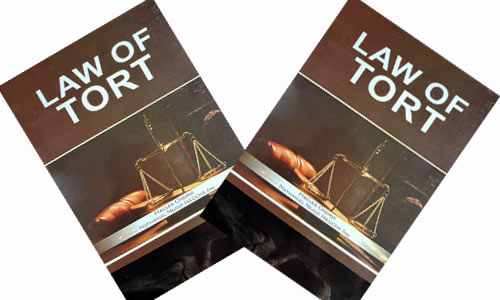 The book, titled The Law of Torts in Nigeria: A Functional Approach, authored by Professor Hagler Sunny Okorie Ph.D and Ikeocha, Nathaniel Ngozi Esq, offers law students, practitioners, and academics a comprehensive guide to understanding and applying tort law in Nigerian courts. Interested buyers can place orders via the following contact numbers: 08028636615, 08037667945, 08032253813, or +234 902 196 2209.
_______________________________________________________________________
The book, titled The Law of Torts in Nigeria: A Functional Approach, authored by Professor Hagler Sunny Okorie Ph.D and Ikeocha, Nathaniel Ngozi Esq, offers law students, practitioners, and academics a comprehensive guide to understanding and applying tort law in Nigerian courts. Interested buyers can place orders via the following contact numbers: 08028636615, 08037667945, 08032253813, or +234 902 196 2209.
_______________________________________________________________________
“Order Your Copy Now” — Basil Momodu, Esq. Unveils Second Edition Of His Book, "Civil Procedure In Nigeria"
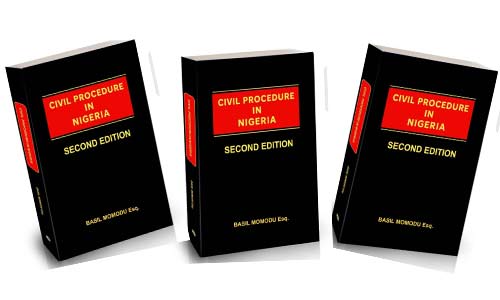 According to the learned author, Basil Momodu Esq. "Law review is a continuum. We will continue to track changes in the law to enrich future editions." Recommended Booksellers: Lagos: 08033855230, Abuja: 08035991379, and others.
______________________________________________________________________
[A MUST HAVE] Evidence Act Demystified With Recent And Contemporary Cases And Materials
According to the learned author, Basil Momodu Esq. "Law review is a continuum. We will continue to track changes in the law to enrich future editions." Recommended Booksellers: Lagos: 08033855230, Abuja: 08035991379, and others.
______________________________________________________________________
[A MUST HAVE] Evidence Act Demystified With Recent And Contemporary Cases And Materials

 Interested buyers are encouraged to place their orders and enquiries via:
0704 444 4777, 0704 444 4999, 0818 199 9888
Website: www.alexandernigeria.com
Interested buyers are encouraged to place their orders and enquiries via:
0704 444 4777, 0704 444 4999, 0818 199 9888
Website: www.alexandernigeria.com
 As an added bonus, every purchase comes with a FREE ebook titled: “AI in Legalpedia and Law Pavilion: A Research Guide.”
Ohio Books Ltd praises the publication, stating:
"....this is the only Nigerian book I know of on the topic."
How to Order:
📞 Call, Text, or WhatsApp: 08034917063 | 07055285878
📧 Email: benadigwe1@gmail.com
🌎 Website: www.benadigwe.com
Ebook Version: Access it directly online at https://selar.com/prv626
As an added bonus, every purchase comes with a FREE ebook titled: “AI in Legalpedia and Law Pavilion: A Research Guide.”
Ohio Books Ltd praises the publication, stating:
"....this is the only Nigerian book I know of on the topic."
How to Order:
📞 Call, Text, or WhatsApp: 08034917063 | 07055285878
📧 Email: benadigwe1@gmail.com
🌎 Website: www.benadigwe.com
Ebook Version: Access it directly online at https://selar.com/prv626