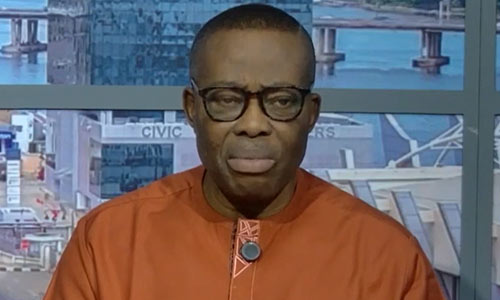
Senior Advocate of Nigeria, Dr Monday Onyekachi Ubani, SAN, has described the Federal High Court judgment voiding the N110 billion vehicle package for members of the National Assembly as “purely academic” since the money has already been spent, while raising fundamental legal questions about whether the court invalidated the act of appropriation itself or the procurement process, and calling for a clear government policy on the provision of vehicles to lawmakers that should include a shift to locally manufactured cars.

Ubani made the remarks during an interview DEJI 360 YouTube on Friday, June 13, 2026, where he offered a detailed legal analysis of the judgment while cautioning that a definitive assessment could only be made after the certified true copy of the judgment is obtained and studied.
Ubani identified what he described as the central legal question that must be resolved before the judgment can be properly assessed.
“There are certain things that are not too clear to me. Was it the act of appropriation that was invalidated or the issue of procurement? Because there are two issues,” Ubani stated.
He explained the distinction: the act of appropriation is the constitutional responsibility of the National Assembly, which has the power to make laws including the annual Appropriation Act. The procurement process, on the other hand, is the mechanism through which budgeted funds are expended, governed by the Public Procurement Act and related regulations.
“The act of appropriation lies with the National Assembly. They have that constitutional power to make laws. And when it comes to appropriation, it is one of their responsibilities. But it is actually the executive that sends the budgetary process, in which they now appropriate in terms of lawmaking,” Ubani explained.
The distinction is legally critical. If the court invalidated the procurement process, it would mean the vehicle purchase was improperly executed even if the budget allocation was valid. If the court invalidated the appropriation itself, it would raise more fundamental constitutional questions about whether a court can strike down a provision in an Appropriation Act on the grounds that the lawmakers who passed it were also its beneficiaries.
Ubani stated that the judgment’s precise reasoning could only be assessed once the certified true copy is available. “As I speak to you, we have not been able to get a certified true copy of that particular judgment so that one can really dissect and understand what the matter is all about,” he said.
Ubani addressed what he described as a public misconception about which set of lawmakers made the provision for the vehicle package.
“That particular budget was not even passed by the 10th Assembly. The case was initiated in 2023. It has been the practice that when the house is exiting, they usually make a provision for the incoming legislative house members that are coming. So it was actually the 9th Assembly that made that provision for the 10th Assembly,” Ubani clarified.
This point is significant because a central criticism of the vehicle package has been that lawmakers “allocated funds to themselves,” creating a conflict of interest. If the provision was made by the outgoing 9th Assembly for the benefit of the incoming 10th Assembly, the conflict-of-interest argument is weakened, since the lawmakers who appropriated the funds were not the same lawmakers who would benefit from the expenditure.
“I hear some people say that somebody should resign and all that. It wasn’t this house that enacted that particular Appropriation Act. It was actually done by the 9th Assembly,” Ubani stated.
Ubani directly addressed the court’s reported finding that lawmakers, as direct beneficiaries of the budget, should not have been the ones to pass it.
“When you say they allocated to themselves, no. They are the ones that will actually enact a law that involves all matters that border on Appropriation Act, Appropriation law. It is the National Assembly that does that, which is what they did. So there is no conflict of interest,” Ubani argued.
He grounded his position in the constitutional framework: “Issue of lawmaking, issue of appropriation, and issue of oversight is a principal function of the National Assembly. Now, unless when they enact that law or do anything that is contrary to the provisions of the Constitution, you cannot invalidate their act. But if all they have done is actually derived from the Constitution, it will be very difficult to fault it. It is very difficult to, in fact, invalidate it.”
The argument reflects a longstanding constitutional principle that the National Assembly’s power to appropriate public funds is a sovereign legislative function that courts should be reluctant to second-guess, provided it is exercised within constitutional limits.
When asked about the practical effect of the judgment given that the money has already been spent, Ubani described the ruling as purely academic but noted the court’s apparent intention to guide future practice.
“Purely academic. But I understand that he also said that this will guide the future provision by the public for the incoming legislative members that are coming, maybe in 2027. So if they want to make any such provision, they will take into cognisance this particular judgment that has actually been given,” Ubani stated.
He noted that the issue of the case being academic had been raised during proceedings but that the judge overruled the defendants’ objection, holding that the matter involved economic interest and public interest and therefore warranted adjudication regardless of whether the funds had already been expended.
Beyond the legal analysis, Ubani used the interview to advocate for a policy-driven approach to the question of lawmakers’ vehicles, making a notable call for the adoption of locally manufactured cars.
“I would even want a situation where we begin to use made-in-Nigeria cars, if you ask me. If we can concentrate, before you know it, we will become experts in the cars,” Ubani stated.
He drew a comparison with China’s automotive industry: “Look at Chinese cars now. They are becoming very popular. We are using most of the Chinese cars and they are very durable. Because over time we were calling them fake cars, but over time they have mastered the entire process. And today, most of the cars that you see on the road are Chinese cars.”
Ubani argued that the broader question of how lawmakers are provided with vehicles and other infrastructure should be addressed through clear government policy rather than through ad hoc judicial interventions.
“Let government come up with a policy. You can say, ‘This is the amount we target. This is the amount that each person must have, or this is the type of car, or we must concentrate on local cars.’ Let it come by way of policy,” Ubani stated.
He warned against making policy through sentiment: “I don’t like running on sentiment because I saw many sentiments when you discuss issues like this. But things in government work differently. Government must follow laid down procedure and policy.”
Ubani acknowledged the public frustration over lawmakers’ expenditures but argued that the focus should be on creating proper frameworks rather than denying legislators the tools they need to function.
“You must appreciate the fact that they also require these things to work with in order to ensure that they carry out the responsibility that has been given to them by the provisions of the Constitution. If they have that particular power to do that, then they must also have the infrastructure and things to work with. Those things must be in place. But let that be a proper policy,” Ubani stated.
He argued that the absence of a clear policy creates the conditions for controversy: “You cannot just come midstream and begin to make pronouncements over a thing where there is no government policy or where there is an absence of it. Rather, you advocate for a policy to be put in place so that nobody violates that government policy. That is how government operates and how things should work in a civilised manner.”
Ubani indicated that the legal team advising the National Assembly would study the certified true copy of the judgment once obtained and determine the appropriate next steps, which could include an appeal.
“Looking at the judgment will give us a clearer view and coherence, you know, of what to make out of that judgment. When you understand the tenor of the judgment, then you can now know how to advise on what to do in terms of steps,” Ubani stated.
He acknowledged that the judgment, whether appealed or not, would influence how future Assemblies approach the question of vehicle and infrastructure provision for incoming legislators, particularly as the 2027 election cycle approaches and the 10th Assembly will need to determine whether and how to make similar provisions for the 11th Assembly.
The interview was conducted on DEJI 360 YouTube on Friday, June 13, 2026. The certified true copy of the Federal High Court judgment has not yet been obtained by the National Assembly’s legal team as at the time of the interview.
[A MUST HAVE] Evidence Act Demystified With Recent And Contemporary Cases And Materials

Available now for NGN 40,000 at ASC Publications, 10, Boyle Street, Onikan, Lagos. Beside High Court, TBS. Email publications@ayindesanni.com or WhatsApp +2347056667384. Purchase Link: https://paystack.com/buy/evidence-act-complete-annotation
______________________________________________________________________ “Enhance Legal Practice With Authoritative Reports” — Alexander Payne Offers Comprehensive Law Reports, Spanning Over A Century Of Nigerian Jurisprudence Interested buyers are encouraged to place their orders and enquiries via:
0704 444 4777, 0704 444 4999, 0818 199 9888
Website: www.alexandernigeria.com
Interested buyers are encouraged to place their orders and enquiries via:
0704 444 4777, 0704 444 4999, 0818 199 9888
Website: www.alexandernigeria.com