*Says “1999 Constitution is Badly Fractured, Incapable of Delivering Justice”

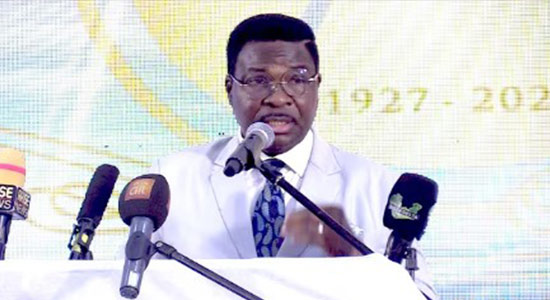
Renowned constitutional lawyer and Senior Advocate of Nigeria (SAN) Mike Ozekhome has raised alarm over Nigeria’s deepening political and security crises, warning that the country risks becoming a one-party state controlled by a few “state captors.” Speaking at a memorial event for Chief Edwin Clark, Ozekhome dissected Nigeria’s fractured nationhood, attributing its challenges to a flawed constitution, ethnic and religious intolerance, and a lack of transformational leadership. He urged for a new people’s constitution and systemic reforms to avert further decline.
Ozekhome questioned whether Nigeria has fulfilled the dreams of its founding heroes, citing the amalgamation of 1914 by Lord Lugard and the naming of the country by Flora Louisa Shaw in 1897. “Can we say we have achieved our nationhood?” he asked, referencing historical milestones like the 1922 Clifford Constitution, the 1960 Independence Constitution, and the 1999 Constitution, which he described as a schedule to Decree 24, enacted without public input. He argued that despite federal structures like the Federal Character Commission and judiciary, Nigeria operates a unitary system disguised as federalism, with states relying on monthly federal allocations.
He highlighted Lugard’s divisive prediction that the North and South are “like oil and water, they will never mix,” suggesting that Nigeria’s persistent disunity stems from colonial foundations. Ozekhome criticized the narrative of Western revisionism, such as claims that Mungo Park “discovered” the Niger River, which locals had long used, as emblematic of Nigeria’s struggle to shake off imperial stereotypes.
Ozekhome painted a grim picture of Nigeria’s security landscape, noting that Boko Haram, banditry, and separatist violence have spread from the Northeast to the Northwest, Niger, Edo, and Southeast. He referenced his 2013 kidnapping ordeal, during which he called for a state of emergency in seven sectors, including youth unemployment and education, none of which were heeded. “Many swaths of land have been taken over by bandits in Niger State… collecting taxes, giving identity cards,” he said, warning that unaddressed crises could engulf the nation.
Politically, he accused a small elite of holding Nigeria hostage, describing the system as an “electocracy” focused on elections rather than governance, a “judocracy” where courts decide leaders, and an “executocracy” dominated by the executive. “Political power is now in the hands of a few Nigerians… state captors,” he said, lamenting the failure to implement recommendations from the 2014 National Conference, led by Clark, which he attended as a South-South delegate.
Central to Ozekhome’s critique was the 1999 Constitution, which he called “badly fractured” and incapable of delivering justice. He advocated for a new constitution crafted through a people’s referendum, as done in countries like Algeria, Egypt, and Singapore, or the U.S. in 1787. “The constitution is supposed to be the birth certificate of any nation… Why are we afraid of setting for ourselves a new constitution?” he asked, proposing a national conference to address ethnic, religious, and structural divides, akin to the U.S.’s Philadelphia Convention.
He emphasized the need for a document that promotes egalitarianism, social justice, and mutual respect, warning that pretending unity exists is like “bandaging a gaping wound.” Ozekhome cited historical figures like Ahmadu Bello, who acknowledged Nigeria’s diversity, and Yakubu Gowon, who during the Civil War noted the absence of a basis for unity, to underscore the need for honest dialogue.
Ozekhome proposed a multi-pronged approach to Nigeria’s crises, including:
- Transformational Leadership: Emulating the Asian Tigers (South Korea, Taiwan, Singapore) by investing in infrastructure, education, and export-oriented industries.
- Constitutional Reform: Adopting a new constitution via referendum to reflect Nigerians’ aspirations.
- Economic and Energy Reforms: Supporting SMEs with affordable power and reforming the energy sector to reduce reliance on costly generators.
- Anti-Corruption and Moral Reorientation: Strengthening anti-corruption measures and rejecting the glorification of questionable characters with honors and titles.
- Youth Employment: Creating a national employment guarantee scheme to provide temporary jobs and incentives.
- Diaspora Engagement: Allowing Nigerians abroad to vote and invest in local development, recognizing their economic contributions.
He criticized Nigeria’s monoproduct oil economy, discovered in 1956, and its failure to diversify, contrasting it with India’s advancements since 1947. “We produce what we do not consume and consume what we do not produce,” he said, calling for economic nationalism and market reforms.
Quoting German cleric Martin Niemöller, Ozekhome warned against apathy, stating, “A blow to one should be a blow to all.” He urged Nigerians to hold leaders accountable, noting that even families suffer when followership fails to demand accountability. “Nigerians are the only creatures… rather than turn back to attack the aggressor, they would break down the barrier to still run,” he said, contrasting this with the resistance of even a cornered goat.
Ozekhome described Nigeria as a “big prison yard,” where both the elite and commoners live in fear, with leaders residing behind fortress-like walls. He reiterated warnings from a decade ago about escalating insecurity, urging immediate action to prevent further deterioration.
The event celebrated Chief Edwin Clark, a nationalist who led South-South delegations at the 2005, 2009, and 2014 national conferences. Ozekhome praised Clark’s role in advocating for unity and justice, lamenting the government’s failure to implement the 2014 conference’s 600 recommendations. He called for Nigerians to honor Clark’s legacy by addressing the structural flaws he fought against.
Ozekhome concluded with a plea for unity rooted in justice, not suppression, quoting Clark’s call for “peace imbued with egalitarianism” rather than “peace of the graveyard.” He urged Nigerians to embrace civic responsibility, reject election-centric governance, and demand a system that reflects their diversity and aspirations. “God bless Nigeria,” he declared, emphasizing that progress depends on collective action and divine guidance.
[A MUST HAVE] Evidence Act Demystified With Recent And Contemporary Cases And Materials

Available now for NGN 40,000 at ASC Publications, 10, Boyle Street, Onikan, Lagos. Beside High Court, TBS. Email publications@ayindesanni.com or WhatsApp +2347056667384. Purchase Link: https://paystack.com/buy/evidence-act-complete-annotation
______________________________________________________________________ “Enhance Legal Practice With Authoritative Reports” — Alexander Payne Offers Comprehensive Law Reports, Spanning Over A Century Of Nigerian Jurisprudence Interested buyers are encouraged to place their orders and enquiries via:
0704 444 4777, 0704 444 4999, 0818 199 9888
Website: www.alexandernigeria.com