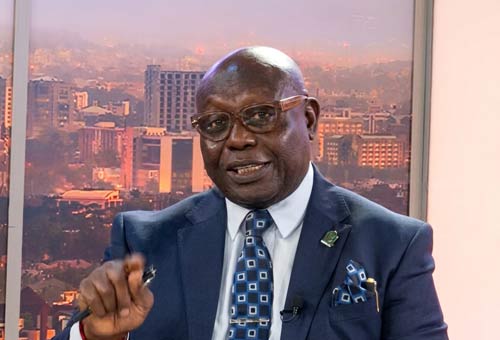
Mr. Festus Okoye, legal practitioner and until recently the National Commissioner of the Independent National Electoral Commission in charge of Information and Voter Education, has said that what happened to the presidential result upload in 2023 was a technological malfunction and not a failure to upload, and that the real problem in the public mind is a distinction nobody has ever properly explained.

Asked how life had been since leaving office, he said:
“I’m basically a leg[al] practitioner. I just returned to leg[al] practice. I just took a sabbatical from leg[al] practice to go into public office and that was it.”
Asked what went wrong in the 2023 presidential election, under the then Chairman Professor Mahmood Yakubu, he began with a framework.
“The conduct of election is a very, very complex affair. And when you are characterising an election, you must look at an election broadly: the pre-election phase, the election phase and the post-election phase.”
“In terms of preparation, the electoral management body prepared and prepared well. In terms of deployment, the electoral management body deployed and deployed well, and everything was going on well.”
“Now two issues arose during that particular period. First was the rise and influence of the social media. The second one was the gradual imputation of technology into the electoral process.”
“The Independent National Electoral Commission ha[d] promised Nigerians that the results of all the categories and phases of elections will be transmitted into the INEC result [viewing] portal for public view, for purposes of accountability, to enable Nigerians know what is going on at the level of the polling unit.”
“But [we also said] that the collation of results will still take place manually.”
“In other words, the moment elections are over at the level of the polling unit, the presiding officer and the assistant presiding officers will carry the [BVAS] physically, carr[y] Form EC8A, which is the polling unit level result, and all the other paraphernalia used in the conduct of the election, to the next level of collation, which is the registration area collation centre, or what you call the electoral ward.”
“That phase will take place manually, because that is the result that will be used for collation. But the one that goes into the [IReV] will be for purposes of public accountability, to enable people know what is going on.”
“Now in terms of what went wrong: technology can malfunction at any time. Technology can disappoint you.”
“We had planned and planned well. The upload of the election result was going on well. The upload of the results for the House of Representatives was going on well, but the upload for the presidential election results had challenges and had problem[s], so we couldn’t upload that particular aspect of the results in real time.”
“But by 8:55 the same day, the upload of the presidential election results started, and even some states like Kano had 100 per cent upload.”
“So the issue was that the presidential election results were not uploaded in real time. Not that they were not uploaded.”
“But you see, the perception was that they were not uploaded at all. And that perception created a very [serious] challenge in terms of the credibility of the election that was organised, and in terms of the election that we prepared and prepared so well in organising.”
“But the results were uploaded, and the upload started at around 8:55 p.m. the same day.”
Put to him that an independent analyst had audited the result viewing portal and found results that contradicted declared outcomes in Rivers State and elsewhere, that in one state results were said to have been uploaded before voting began, and that images were uploaded from smartphones rather than the accreditation device, he declined to engage on the technology and returned to the law.
“I’m not an expert in technology. My area of expertise is the law. Now, there is something I want you to understand, and if you separate it, we will have a very good narrative of what really happened.”
“You must separate the issue of collation of election results from what we have as upload of results to the INEC result viewing portal. The results that are uploaded to the INEC result viewing portal are not the results that go for purposes of collation.”
“The results that go for purposes of collation are the results that are carried physically by the presiding officer and the assistant presiding officers to the next level of collation.”
“At the next level of collation there’s a collation officer, mostly university lecturers. The collation officer will collect the original copy of Form EC8A from the polling unit, then look at the results of the election as captured in the physical [BVAS], and if there’s a discrepancy, the collation officer resolves that particular discrepancy.”
“Now at the level of the polling unit, if you recall, before the 2023 general election, all the political parties forwarded the names of their duly accredited polling agents.”
“The APC for instance had almost around 176,000 accredited polling unit agents. The [NNPP] had, the PDP had almost the same number. The Labour Party had around 134,000 accredited polling unit agents.”
“What that means is that at the level of the polling unit, these agents are given a copy of Form EC8A of the results that are declared at the level of the polling unit.”
“Not only that, the rules and regulations and guidelines of the Commission also say that a copy of that Form EC8A, which is the people’s copy, known as Form EC50, should be pasted at the level of the polling unit, so that anybody who is interested can also make a copy or photocopy of it or take a picture of it.”
“So if you separate these two, you will see that what goes on for collation is different from what goes into the [IReV].”
“The point I’m making is that yes, there were challenges. Yes, there were problems. Yes, the issue of not uploading the polling unit level results in real time created a perception issue. But the truth of the matter is that those results were uploaded to the INEC result viewing portal from 8:55 p.m., and almost all the states uploaded, and if you look at the portal you will see that over 84 per cent of the results were eventually uploaded.”
“But the present commission has said that they’re going to carry out an audit to find out exactly what happened.”
“What is important, what is crucial, what is fundamental, is for the country to keep on improving and also keep on deploying technology in our electoral process.”
“But more importantly, I think the media, civil society groups and organisations and the Nigerian people generally must focus attention on the activities of the political elite before, during and after the election.”
“And I say this because we are talking about INEC as a homogenous organisation. But the truth of the matter is that at the level of the polling unit, you will not see an INEC officially paid staff.”
“Those you are going to see at the level of the polling unit are Nigerians, all members and students of federal tertiary institutions in their penultimate years, serving as presiding officers and also serving as assistant presiding officers. These are the people who do the result upload at the level of the 8,838 registration areas we now have.”
“You are not going to see a paid INEC staff. Those you are going to see are university lecturers and professors at the level of supervisory presiding officers. Those you are going to see are people working in MDAs, ministries, departments and agencies of government.”
“So the role of INEC staff in the electoral process is very minimal. Those who conduct elections in Nigeria are Nigerians, and we must look at this election as a multi-stakeholder venture and find ways and means of making our elections more credible.”
Turning to vote buying, he interrupted himself to make a point he evidently regarded as more urgent.
“Before I answer your question on vote buying, I think that it is important and it is very crucial for the current commission to aggressively explain to Nigerians the provisions of section 60 subsection 3 of the Electoral Act and section 60 subsection 5 of the Electoral Act.”
“Section 60 subsection 3 of the Electoral Act still makes electronic transmission of results to the [IReV] portal mandatory. But these results that are transmitted to the [IReV] portal are not the results that go for collation. [They] will not be used for collation.”
“The results that will be used for collation are the results that are transmitted to the registration areas or electoral wards by the presiding officers and assistant presiding officers in accordance with section 60 subsection 5.”
“Section 60 subsection 5 says that at the close of poll the presiding officer shall transmit the results of elections to the next level of collation.”
“Now if you look at section 155 of the same Electoral Act, it defines ‘to transmit’ as either manually or electronically. So it is the responsibility of the commission to decide whether [it] wants to transmit the results of the election manually or electronically. But it is a different section altogether from section 60 subsection 3, which talks about uploading results to the [IReV] portal.”
“So I think that the commission should do a lot to educate people on some of these issues. If not, it will still [come] up [again].”
“On the issue of vote buying, I think that, and I’m saying it with all sense of responsibility: I led the Nigerian Bar Association election working group as the chairperson to the [Kogi] governorship election, and also led the same group to the [Osun] governorship election, and we saw vote buying concretely.”
“They had gone digital. They had upgraded their act. They have optimised the way they do vote buying.”
“Now the struggle is at the level of the cubicle. How the cubicle is positioned, and who controls the position of the cubicle, is very, very crucial.”
“The people who engage in vote buying want to control how the cubicle is positioned so that they can see how people vote before they give the people a tally to go and collect money from different issuing points.”
“In fact, some people even collected [and] counted it, [to] make sure that nobody cheated them, make sure that what they were promised was what was given to them.”
“So, unfortunately, the security agencies [were] deployed to the [Kogi] and [Osun] governorship elections, but I’ve not seen anybody arrested in terms of vote buying. I have not seen anybody prosecuted in terms of vote buying in both elections.”
“So I think that the political elite in this country really do not believe in free, fair and transparent election. They just want to buy the votes of the people. They want to replace the people as the sovereign[s], and it is very, very unfortunate.”
“The mark of a free, fair and transparent election is the ability of the people to go to the polling units [and] cast their votes without any form of intimidation, without any form of coercion and without any form of duress.”
“But in this country what we are now having is a situation where political parties have no ideology. Political parties are not campaigning on any issue. All they know is that on election day they will find a way of making sure that the votes of the people really does not count.”
Asked about three provisions which a retired former colleague has flagged as predisposing the coming elections to manipulation, he was dismissive of two of them.
“Other than section 138 relating to grants for election petitions, all the other provisions you’ve just mentioned have always been there in terms of our laws. Nothing has really changed.”
“What the commission does is that before printing ballot papers, the chairman of the electoral management body is in charge of making sure that the ballot papers are protected, and that you have watermarks on the ballot papers and you have security features in relation to the ballot papers.”
“So you may notice that the colour of the ballot paper that is assigned to a particular local government in Imo State may be different from the colour of the ballot paper that is taken to another local government. So that is the way some of these things are switched.”
“And I say it’s very, very unfortunate, because the challenge is that the Independent National Electoral Commission has to keep on hiding these sensitive materials and sensitive equipment from one place to the other to prevent the political elite from having access to them.”
“And that is why the [BVAS] is taken to the Central Bank. Ballot papers are taken to the Central Bank. Result sheets are taken to the Central Bank, and their movement from the Central Bank to the local government areas and also to the registration area centres is done under heavy security to prevent hijack and also to prevent manipulation.”
“So I think that one of the things we must do is to get the political parties, the aspirants and the candidates to develop the democratic spirit that allows elections and [the] election management body to do its work in a manner that will make for early opening of polls.”
“Because when you keep on hiding ballot boxes, ballot papers, result sheets and so on from one place to the other, it creates its own challenges. Sometimes it creates its own mixup.”
“And I remember in one of the elections the ballot papers arrived from outside the country. Some arrived at Port Harcourt airport. Some were arriving at Abuja airport, and some were in Lagos, and these things were being expected, and that led to the postponement of elections, because the ballot papers and other sensitive materials have to be printed outside the country to prevent them from being cloned within the country.”
He then described a contrast he had observed elsewhere in the sub-region.
“I have observed [an] election in one of the West African countries where the presiding officers came to the polling units from their houses. They had the ballot papers, the result sheets and all the paraphernalia for the conduct of elections with them at home.”
“And then on election day, they just brought them to the polling units, conducted the elections, finished counting of the votes, everybody signed, and they tied the things on their motorbikes and then left for the collation centres. Nobody questioned them. There were no issues.”
“But in this country, it is very, very difficult to do that type of thing.”
“So I think that the political elite must release the electoral process in terms of what they do before the election. You know that in some of our communities the voters cannot even come out because political thugs will take over the electoral environment, and sometimes the agencies are not able to cope.”
“So if the political elite releases the electoral environment, make[s] the electoral environment serene, refuses to create an atmosphere [of fear] at the level of the polling units, our elections will go well.”
“One of the things we need to [understand] is that the law alone cannot conduct elections. Even if you improve the law 100 times, it may not conduct elections. The human element is also very important, is very, very fundamental.”
“The Electoral Act 2010 is a good law. You can use it to conduct [a] free, fair and transparent election. The Electoral Act 2022 is a good law. You can use it to conduct a good election. The Electoral Act 2026 is a good law. You can use it to conduct a good election.”
“What is missing is that at each point those who benefit from election rigging and election manipulation want to manipulate the process, and they don’t want the people to be the sovereign. They don’t want the people to be the ones who exercise the choice. They want to choose for the people, and they want to determine the type of choices the people want to make.”
“And that’s what is [the] challenge[] in [the] electoral process. Not really some of the few issues and few gaps in the law.”
Asked finally about the omission of candidates from the final governorship list, and told that a deadline of 24 October had been given for parties to complain to the Commission, he restated his position and added a provision he had not previously cited.
“Section 77 of the Electoral Act makes it mandatory for political parties to maintain a membership register manually and digitally. Secondly, it makes it mandatory for every registered political party that wants to contest election to submit that particular register to the Independent National Electoral Commission 21 days before [its] primaries, conventions or meetings. And it also makes it mandatory that only those whose names are on that particular register have the right to contest primaries.”
“Now this matter has gone to court. The Supreme Court has given its judgment. My take and my own view is that if the electoral management body wants to implement the judgment of the Supreme Court, it must implement the judgment of the Supreme Court across board.”
“It must involve both presidential elections, senatorial elections, House of Representatives elections, governorship elections and State Assembly elections. It cannot implement it selectively.”
“And I also agree that section 32 of the Electoral Act says that if a candidate’s name has been omitted you have 14 days to complain. But that is immaterial.”
“If any political party feels genuinely aggrieved, and that its candidate’s name has been omitted, it has the right to go to court to challenge that particular omission, despite the 14-day window that has been given by the law.”
[A MUST HAVE] Evidence Act Demystified With Recent And Contemporary Cases And Materials

Available now for NGN 40,000 at ASC Publications, 10, Boyle Street, Onikan, Lagos. Beside High Court, TBS. Email publications@ayindesanni.com or WhatsApp +2347056667384. Purchase Link: https://paystack.com/buy/evidence-act-complete-annotation
______________________________________________________________________ “Enhance Legal Practice With Authoritative Reports” — Alexander Payne Offers Comprehensive Law Reports, Spanning Over A Century Of Nigerian Jurisprudence Interested buyers are encouraged to place their orders and enquiries via:
0704 444 4777, 0704 444 4999, 0818 199 9888
Website: www.alexandernigeria.com