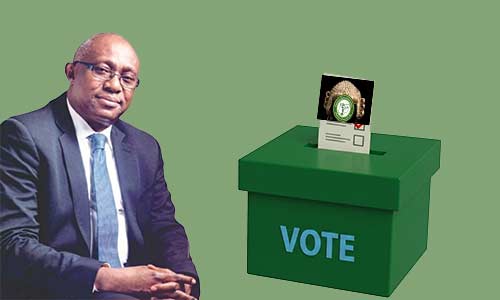
The Electoral Committee of the Nigerian Bar Association (ECNBA) is facing what lawyers and media practitioners have described as its most serious credibility crisis since its inauguration, with mounting criticism over what stakeholders say is a pattern of avoiding independent media scrutiny, attacking critical but factual journalism as “sponsored blogging” without producing evidence, spending nearly N170 million of lawyers’ Bar Practising Fee contributions without advertising a public tender for its most sensitive procurement exercise, and threatening lawyers who operate media platforms with professional conduct proceedings for reporting on documented facts drawn from public records.

The controversy, which has intensified in the weeks following the ECNBA’s June 12, 2026, press statement, has exposed a widening trust deficit between the committee and the NBA membership over transparency, procurement, media engagement, and accountability.
Refused Interviews, Granted Controlled Access
Some Legal media practitioners have disclosed that the ECNBA chairman, Aham Ejelam, SAN, repeatedly refused interview requests from independent legal media platforms that cover NBA affairs, while selectively engaging with a single national newspaper in what lawyers described as a “pre-written interview.”
According to accounts from multiple media practitioners, when independent legal media platforms requested interviews with the chairman, the committee initially asked that questions be submitted in writing. When the questions were sent, the committee reversed position and stated it was “not yet time,” promising that a comprehensive press statement would be issued and all media houses would be invited to a briefing.
That promised broad media briefing never took place.
What lawyers did see was an interview published in Th*sD*y newspaper on a Tuesday, which multiple lawyers on social media described as a pre-arranged, pre-written exchange where the questions appeared to have been sent to the chairman in advance and his responses published without the follow-up questioning that characterises genuine independent journalism.
“A committee handling elections for lawyers and spending lawyers’ money should not be picking and choosing which media platforms to engage and which to avoid,” one senior lawyer commented on social media. “If the ECNBA is confident in its processes, it should welcome scrutiny from any platform, especially the legal media that its voters read every day.”
Another lawyer stated: “Granting a controlled interview to one friendly platform while avoiding the legal media that asks difficult questions is not transparency. It is narrative management.”
“Sponsored Bloggers”: The Allegation Without Evidence
The centrepiece of the ECNBA’s media strategy has been a serious allegation contained in its June 12 press statement: that letters written to the committee by two presidential candidates were “deliberately handed over to sponsored bloggers well ahead of time to publish as news items” and that these bloggers published “slanted and jaundiced narratives” designed to “intimidate members of the Committee and discredit its efforts.”
The allegation is repeated in multiple sections of the press statement. In Section 7, the committee stated: “Letters written to the Committee are sent to sponsored online bloggers even before delivery to publish slanted and jaundiced narratives.”
In Section 9, the committee warned lawyers who operate blogs and social media platforms: “The publication of false, misleading, or inflammatory content whether on social media, online news platforms, WhatsApp groups, or any other channel does not cease to be a professional conduct matter by reason of the medium through which it is communicated. The professional obligations of a legal practitioner follow the person, not the platform.”
However, the ECNBA has not identified a single “sponsored blogger.” It has not named a single publication that contained false information. It has not cited a single specific statement that it considers “slanted,” “jaundiced,” or “misleading.” It has not produced a single piece of evidence of sponsorship, payment, or coordination between any candidate and any media platform.
Presidential candidate Lateef Omoyemi Akangbe, SAN, has denied the allegation “categorically, unreservedly, and on the record,” explaining that his letter was copied to the other two presidential candidates pursuant to a resolution at the May 25 candidates’ meeting and that he could not vouch for what any person copied on the email did with it. The ECNBA has not responded to his denial or produced evidence to support its claim.
Lawyers have pointed out the irony of the ECNBA, a committee constituted by and for lawyers who understand rules of evidence, making allegations of “sponsored blogging” without producing particulars, specific publications, or proof.
“In any court in Nigeria, if you allege that someone was sponsored to do something, you must plead the facts and prove the allegation. You cannot make a bare assertion and expect it to stand,” one lawyer observed. “The ECNBA knows this. Its chairman is a Senior Advocate. Yet the committee made the most serious allegation against the media without a single piece of evidence. That is not befitting of the Bar.”
“If the committee says a blog story is wrong, let it point to the exact error and the correct fact. Media coverage of a contested election process is not misconduct. The committee cannot avoid accountability by labelling criticism as sponsored,” another lawyer stated.
No Public Tender, No Media Advertisement
The ECNBA’s procurement process for the election’s most critical contract, the appointment of the Electronic Voting Service Provider and the Data Protection Officer, has come under scrutiny for an even more fundamental reason: the absence of evidence that the Request for Proposal was advertised through national media or any channel that would ensure the widest possible competition.
The committee issued its Request for Proposal (RFP/ECNBA/ESP/2026) on April 21, 2026, and received 19 bids by the May 5 deadline. However, the ECNBA has not disclosed where the RFP was published beyond its own website.
While the NBA as a professional association is not directly subject to the Public Procurement Act 2007 in the same manner as a federal government agency, it is bound by its own constitution, by fiduciary duties to its membership, and by the principles of transparency and accountability that govern the expenditure of collectively contributed funds. The NBA collects Bar Practising Fees from its members, and the ECNBA’s budget is funded from those fees. When an association spends members’ mandatory contributions, the procurement standards should reflect the members’ right to know that their money is being spent competitively and transparently.
Under established procurement practice, a contract of this significance, involving the digital infrastructure for an election affecting over 80,000 professionals, would ordinarily be advertised in national newspapers, on the association’s website, and through industry channels to attract the widest possible pool of qualified vendors. The ECNBA has not demonstrated that it did any of this beyond posting on its own website.
Multiple IT industry sources have indicated that many qualified technology companies were not aware of the ECNBA’s RFP until after the submission deadline had passed. Some have stated that they would have been interested in bidding but never saw any advertisement. Others have indicated that qualified companies avoid the NBA election contract because of what they describe as “the controversy and lobbying that go on in the background.”
If the ECNBA did not advertise its procurement exercise widely enough to attract the best available vendors, the entire procurement process is compromised from the outset, regardless of how thoroughly the 19 bids that were received were subsequently evaluated.
The N170 Million Question
The ECNBA’s budget, submitted by Chairman Ejelam SAN and Secretary Nassarawa on May 4, 2026, and approved by the National Executive Council (NEC), totals approximately N167.81 million in naira plus $25,000 in foreign currency.
The budget includes N40 million for a single Technical Support Consultant and Data Protection Officer, the largest non-travel line item. Travel and accommodation for seven ECNBA members account for nearly N60 million: N29.4 million for return flight tickets (approximately N4.2 million per person) and N30 million for accommodation (approximately N4.3 million per person). New equipment purchases include N4.9 million for seven laptops, N2.5 million for a Xerox printer, and N750,500 for a projector, despite previous electoral committees having purchased identical equipment that should remain available.
NBA-SPIDEL Financial Secretary Tosan Barbara Onwubiko, Esq., publicly questioned the budget: “With an ECNBA budget nearing N170,000,000, NEC members could not question its contents. Out of over 500 NEC members, not one questioned this budget?”
She asked what became of all the equipment purchased by the previous ECNBA for the 2024 elections: “Why is there a need to spend over N20,000,000 to secure another set of items?”
A committee that spends N170 million of members’ funds, does not advertise its most important procurement exercise through national media, and then attacks the independent media that questions its expenditure is a committee that wants to spend members’ money without members’ scrutiny.
The Mikrodigital Scandal
Independent investigation revealed that Mikrodigital Connect, the company appointed as the official e-voting provider, was listed as “Inactive” on the Corporate Affairs Commission portal. The company is registered as a business name with a single proprietor, Shamsuddeen Haruna, not as a limited liability company.
Mikrodigital had not filed annual returns for six consecutive years from 2020 to 2025. When the inactive status was first reported, the company paid all six years of arrears overnight, with timestamps showing payments on the evening of May 31 and the morning of June 1, 2026, in the hours surrounding the ECNBA’s announcement of its appointment.
The company has no functional website. Its CEO, when questioned about the non-compliance, responded: “I don’t understand.” No prior election engagement of comparable scale has been identified or disclosed by either the company or the ECNBA.
The ECNBA’s response to these documented facts was not to acknowledge the due diligence failure but to label the reporting as “sponsored blogging” and warn lawyer-media practitioners about professional conduct consequences. The committee chose to attack the messenger rather than answer the message.
Thanelinc: Hedged Answers
Thanelinc Nigeria Limited, appointed as the Data Protection Officer, maintains an active CAC status. However, its registered business activity is “Business Support/Development Services,” not data protection or election technology. When asked whether Thanelinc is registered with the Nigeria Data Protection Commission, the ECNBA used carefully hedged language: “NDPC registration or DPCO status where applicable.”
If Thanelinc possesses a current NDPC registration certificate, the committee could end the controversy by publishing the registration number. It has not done so. Akangbe SAN noted: “If Thanelinc has a current NDPC registration certificate, the committee should simply publish the registration number.”
Why Is the Committee Afraid of Media?
The question that lawyers across Nigeria are asking is simple: if the ECNBA’s processes are sound, why is it afraid of independent media scrutiny?
A committee conducting an election for over 80,000 legal practitioners, using nearly N170 million of their collectively contributed funds, is not a private family affair. It is a matter of the highest public interest to the legal profession. The legal media has not only a right but a duty to ask questions about transparency, procurement, voter verification, data protection, and credibility.
The ECNBA’s approach, refusing interviews, avoiding independent media, granting controlled access to a single platform, labelling critical journalism as “sponsored” without evidence, and threatening professional conduct proceedings against lawyer-media practitioners, creates the opposite of the confidence it claims to seek. It creates suspicion. It creates the impression that the committee has something to hide and is willing to use its institutional position to intimidate those who ask questions.
The committee cannot use media criticism as a shield against accountability. If it refuses interviews, delays answers, fails to hold promised media engagement, and then accuses independent media of misrepresentation, it only strengthens the belief that it is not doing enough to communicate transparently with lawyers.
As Akangbe SAN stated in his response to the committee: “If the Committee’s processes are sound, they will withstand scrutiny and emerge stronger for it. If they cannot withstand scrutiny, the answer is to strengthen the processes, not to silence the scrutiny.”
The Rules of Professional Conduct Apply Both Ways
The ECNBA reminded lawyer-bloggers that “the professional obligations of a legal practitioner follow the person, not the platform.” This is correct. Lawyers who operate media platforms are bound by the Rules of Professional Conduct and must not publish information they know to be false.
However, the Rules of Professional Conduct also apply to the members of the ECNBA. Making public allegations that impugn the integrity of colleagues or media practitioners, allegations of “sponsored blogging,” “slanted narratives,” and “jaundiced” reporting, without evidence is itself a professional conduct matter. The rules do not give an electoral committee a special licence to make unsubstantiated allegations against fellow lawyers simply because those lawyers publish on blogs rather than in courtrooms.
The media has reported documented facts: the CAC inactive status, the six years of non-filed annual returns, the overnight payment of arrears, the absence of a functional website, the hedged answers about NDPC registration, the abandonment of NIN authentication, the N170 million budget approved without scrutiny, and the refusal to disclose procurement documents. Every one of these facts is drawn from public records, official documents, or the ECNBA’s own admissions.
If any of these facts is wrong, the ECNBA should identify the error and provide the correction. What it should not do is label the reporting as “sponsored” and threaten the reporters with disciplinary proceedings. That is not how a committee of lawyers, for lawyers, should engage with accountability.
33 Days to the Election
The NBA election is scheduled for July 20, 2026, approximately 33 days away. The ECNBA has promised “further clarification on any outstanding issues” without specifying when, how, or through what channel.
Two of the three presidential candidates have formally challenged the committee’s procurement decisions and authentication framework in detailed letters. The committee has answered none of their specific questions on the record. The trust deficit between the committee and the membership continues to widen. And the committee’s strategy of attacking media scrutiny rather than answering substantive questions has produced the opposite of the confidence it claims to seek.
The legal media remains available for an interview with the ECNBA chairman at any time. The questions are ready. The only thing missing is the committee’s willingness to answer them in a format where follow-up questions are permitted and responses cannot be pre-scripted.
[A MUST HAVE] Evidence Act Demystified With Recent And Contemporary Cases And Materials

Available now for NGN 40,000 at ASC Publications, 10, Boyle Street, Onikan, Lagos. Beside High Court, TBS. Email publications@ayindesanni.com or WhatsApp +2347056667384. Purchase Link: https://paystack.com/buy/evidence-act-complete-annotation
______________________________________________________________________ “Enhance Legal Practice With Authoritative Reports” — Alexander Payne Offers Comprehensive Law Reports, Spanning Over A Century Of Nigerian Jurisprudence Interested buyers are encouraged to place their orders and enquiries via:
0704 444 4777, 0704 444 4999, 0818 199 9888
Website: www.alexandernigeria.com
Interested buyers are encouraged to place their orders and enquiries via:
0704 444 4777, 0704 444 4999, 0818 199 9888
Website: www.alexandernigeria.com