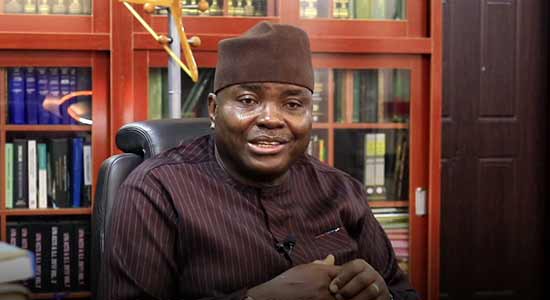
Prominent Nigerian lawyer and Senior Advocate of Nigeria (SAN), Jibrin Okutepa, has defended the United States’ recent designation of Nigeria as a “Country of Particular Concern” (CPC) over severe violations of religious freedom, saying the move reflects the federal government’s failure to protect citizens from widespread violence.

In a fiery post on X (formerly Twitter) on Tuesday, Okutepa dismissed critics of the U.S. action as “political vampires” and “sycophants,” invoking the United Nations’ Responsibility to Protect (R2P) doctrine to justify international scrutiny.
The U.S. State Department’s CPC announcement, made last week by President [Redacted for Hypothetical Context], flagged Nigeria for what it described as “systematic, ongoing, and egregious violations” of religious freedom, particularly affecting Christians amid rising banditry and insurgent attacks. The designation, under the International Religious Freedom Act, could trigger sanctions or aid restrictions unless corrective measures are taken.
Okutepa, known for his outspoken criticism of governance lapses, rejected the argument that the violence amounts to genocide solely against Christians. He said the killings target all Nigerians, regardless of faith. “The genocidal killings in Nigeria are directed at all Nigerians,” he wrote. “Those who are now speaking from both sides of their mouth were on record to have said before that Christians were the object of genocide in Nigeria. Those of them who suddenly found their voices are nothing but political prostitutes and fair-weather friends who play politics with the lives of Nigerians whether Christians, Muslims, or pagans.”
Expressing his concern as a Nigerian with no dual citizenship, Okutepa described the pervasive insecurity across the country. “The bandits are operating at will. They sack communities and villages. People are slaughtered in their homes. There are many IDP camps. Kidnappers have field days. Nigerians live in fear daily,” he lamented.
He accused the government and political elite of “playing politics with the lives of Nigerians,” tracing the current crisis to the rise of Boko Haram in 2009, which he described as the beginning of a “declining failure of governance.” According to him, the state’s inability to safeguard its citizens represents a serious breach that justifies international concern.
Okutepa cited the Responsibility to Protect (R2P) principle, a key international norm adopted by UN member states in 2005. The doctrine holds that while sovereignty is fundamental, it carries the obligation to protect citizens from genocide, war crimes, ethnic cleansing, and crimes against humanity. If a state fails, the responsibility shifts to the international community to act, possibly through humanitarian intervention.
“Nigeria is a member of the United Nations and an active one at that. Nigeria has been campaigning to be made a permanent member of the UN Security Council,” Okutepa wrote. “Given what has been happening in Nigeria, especially the daily slaughter of citizens and the inability of the state to fully take charge, will it be fair to blame the U.S. for stepping in where we have failed to protect our people?”
He added, “The principle of R2P states that while sovereignty is important, it comes with the responsibility for a state to protect its population from these crimes. If a state fails, the responsibility shifts to the international community to take action.”
His comments come amid escalating violence in northern and central Nigeria, where armed groups, herders, and extremists have displaced millions and killed thousands in recent years. The United Nations estimates that more than 3.5 million people are currently internally displaced in Nigeria, many of them in overcrowded camps with little government support.
Okutepa expressed doubt about the political will to end the crisis, saying only a small fraction of Nigerians enjoy state protection. “I do not believe that Nigerian politicians are interested in rooting out these bandits,” he said. “If they are, then they must stop their sycophantic arguments that the American President should keep out of Nigeria. What we need is the protection of lives and property in Nigeria.”
[A MUST HAVE] Evidence Act Demystified With Recent And Contemporary Cases And Materials

Available now for NGN 40,000 at ASC Publications, 10, Boyle Street, Onikan, Lagos. Beside High Court, TBS. Email publications@ayindesanni.com or WhatsApp +2347056667384. Purchase Link: https://paystack.com/buy/evidence-act-complete-annotation
______________________________________________________________________ “Enhance Legal Practice With Authoritative Reports” — Alexander Payne Offers Comprehensive Law Reports, Spanning Over A Century Of Nigerian Jurisprudence Interested buyers are encouraged to place their orders and enquiries via:
0704 444 4777, 0704 444 4999, 0818 199 9888
Website: www.alexandernigeria.com
Interested buyers are encouraged to place their orders and enquiries via:
0704 444 4777, 0704 444 4999, 0818 199 9888
Website: www.alexandernigeria.com