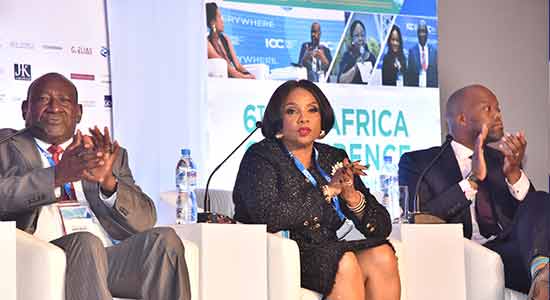
*Dorothy Ufot, SAN Says Arbitral Awards Can Be Vitiated By Reason Of Fraud
*Says State Who Enters Market Place Automatically Loses Sovereign Immunity
*Dr. Kabiru Duggal Says If An Award Is Set Aside By A Seat, Other Courts May Not Recognize The Award Anymore
*Says Both UK And US Lack Immunity When They Act As Commercial Bodies Or Agree To Arbitration

Experts in Arbitration have examined the various procedures for enforcing Arbitral Awards in the different African jurisdictions and enforcement of awards in other jurisdictions outside Africa concerning African cases, and an evaluation of enforcement of awards in France, US and the U.K.
This was done by Speakers at the just concluded 6th International Chamber of Commerce Africa conference International Arbitration, held on 2nd June, at Lagos.
The Speakers who are arbitration experts drawn from across the world also spoke on the challenges faced while enforcing awards gotten by fraud and how such fraud and corruption have been deemed to be vitiating elements that can affect the finality and enforcement of an arbitral award.
The Founding and Managing Partner, Dorothy Ufot & Co, Nigeria; Chair, ICC Nigeria Commission on Arbitration & ADR; Member, ICC International Court of Arbitration, Dorothy Ufot, SAN, speaking on the topic “Enforcement of Arbitral Awards: Challenges”, noted aptly, that International countries are against fraud and once it is established that an award was obtained fraudulently it vitiates such an award because it is against the public policy to enforce it.
According to her, many countries are signatories to the New York Convention.
She said: “When the Tribunal suspects fraud, it should not dive into it. Some argued that it should be reported to the Enforcement agency to investigate it while some said the tribunal has a duty to investigate any corruption.
“When the underline contract is obtained by fraud, it vitiates the agreement or the award”, she added.
To further illustrate her point, she gave an instance with the Kenyan Duty-Free Case.
On the issue of State immunity and sovereignty, she cited the court decisions by House of Lords in UK, in a case of importation of cements by CBN
She noted that if a state enters into a marketplace, such state loses its immunity and can therefore not plead Sovereign immunity.
“It is a universal principle. When you enter the market place the rule of the market is applicable to you irrespective of the Sovereign immunity or not. For instance, if Nigeria has an attachable asset in such a place Sovereign immunity will not save the country because it entered the market place. It is a fair principle,” she added.
A Lecturer, Columbia Law School, United States; Senior International Arbitrator Advisor, Arnold & Porter Kaye Scholer LLP. Dr. Kabiru Duggal, said the grounds for refusing to recognize an enforcement can be found in NEW YORK CONVENTION.
“If the award has been set aside by the seat, other courts may not give recognition to the award because it has been set aside. The grounds is under the new York
“If an award has been set aside and the tribunal in United states considers the set aside as repugnant, then the decision of the seat will not be followed. If an award was set aside in a seat of France, Geneva, and if New York makes an assessment under the US Policy and says the award should be enforced, they will go-ahead to do that.
“So have this in mind as you think of recognition and enforcement. You may have victory in one region but that does not imply victory all around. On the US, you may have to satisfy the judge.
Speaking on fraud Committed not by the Tribunal but an elected ‘Body,’ for instance a tribunal Secretary, he noted that, “If the fraud happened during the arbitration, then you will be confronting two possibilities.
“That’s If during the arbitration you knew of the fraud and you raised it before the Tribunal, in US, UK and France, they may refuse to recognize or enforce it if it would be contrary to public policy.”
“Secondly if you knew of the fraud but failed to raise It, you are likely to run into common law arguments. But if in good faith you are not aware of the fraud the next question should be did the fraud get to the goal of the award? The award will be very granular, if the award is outrageous it will be set aside in the interest of fairness and justice.”
Speaking on the issue of State and Sovereign Immunity, Duggal said Internationally, the rule in US and UK, is that it will grant immunity to sovereign assets. Meaning that foreign assets cannot be attached. “Both US and UK Sovereign Immunity Acts have exceptions. He said the two exceptions that allow foreign assets of a state to be attached is the Commercial and Arbitration exceptions.
“Commercial is when the state is acting in commercial body and secondly arbitration exception if you have agreed to arbitration you are waiving your rights of Sovereign immunity.
“These exceptions will allow foreign assets to be attached even if it may relate to a state. However, you cannot attach an embassy because embassies are protected. But if there are any commercial assets those can be attached.
“You can have very serious consequences and you need to think very carefully if you are a state, about what the assets are and where they are located.”
The session was moderated by Andrew Chukwuemerie, a Partner at Okibe Law House, Nigeria.
[A MUST HAVE] Evidence Act Demystified With Recent And Contemporary Cases And Materials

Available now for NGN 40,000 at ASC Publications, 10, Boyle Street, Onikan, Lagos. Beside High Court, TBS. Email publications@ayindesanni.com or WhatsApp +2347056667384. Purchase Link: https://paystack.com/buy/evidence-act-complete-annotation
______________________________________________________________________ “Enhance Legal Practice With Authoritative Reports” — Alexander Payne Offers Comprehensive Law Reports, Spanning Over A Century Of Nigerian Jurisprudence Interested buyers are encouraged to place their orders and enquiries via:
0704 444 4777, 0704 444 4999, 0818 199 9888
Website: www.alexandernigeria.com
Interested buyers are encouraged to place their orders and enquiries via:
0704 444 4777, 0704 444 4999, 0818 199 9888
Website: www.alexandernigeria.com