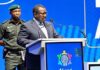
*Speaker Calls Emergency Closed-Door Meeting

A fierce battle for the leadership of the opposition caucus in the House of Representatives erupted into a dramatic confrontation on Thursday, as the chamber descended into a shouting match over allegations of forgery, bribery, and attempts to manipulate the race for the vacant position of Minority Leader, following the defection of former occupant Kingsley Chinda to the All Progressives Congress.
The drama began during plenary when Philip Agbese, representing Ado/Okpokwu/Ogbadibo Federal Constituency of Benue State, raised a matter of personal privilege, accusing fellow lawmaker Ikeagwuonu (Ikenga) Ugochinyere, representing Ideato North/Ideato South Federal Constituency of Imo State, of forging his signature on a document purportedly nominating Ugochinyere for the office of Minority Leader.
Ugochinyere, who belongs to the Action People’s Party (APP) and is one of the most vocal opposition figures in the National Assembly, countered by insisting that Agbese personally signed the document in the presence of multiple witnesses, describing the forgery allegation as “a treacherous lie” and claiming that 61 out of 81 opposition lawmakers had endorsed his candidacy.
The exchange provoked loud protests, repeated interruptions, and a shouting match between the rival camps, forcing Speaker Abbas Tajudeen to intervene multiple times before convening an emergency closed-door meeting of all minority lawmakers for 2 PM the same day to address the leadership crisis.
Agbese told the House he was stunned to discover a nomination document circulating online bearing his name and signature in support of Ugochinyere’s aspirations. While acknowledging that he had engaged in discussions with several lawmakers, including Ugochinyere, on issues affecting minority lawmakers and constituency projects, he categorically denied signing any document endorsing the Imo lawmaker.
“I feel that my legislative privilege has been breached because this amounts to forgery of my signature to be used for purposes for which it was not intended,” Agbese stated.
He also rejected social media reports alleging that some lawmakers received $50,000 to support a particular candidate in the minority leadership contest. “My constituents have been calling me. I have not received any amount of money from anybody and I will not do so. This is my integrity,” Agbese declared.
When Ugochinyere sought permission to respond, the chamber immediately tensed. The outspoken opposition lawmaker categorically denied the forgery allegation, maintaining that Agbese arrived at a meeting venue and voluntarily signed the nomination document in the presence of several lawmakers who could testify to what transpired.
His remarks provoked Agbese to repeatedly interrupt, shouting: “I never did that!” The chamber descended into chaos as lawmakers from both camps exchanged words, with some members moving physically to calm tensions while the Speaker called for order.
Despite the uproar, Ugochinyere pressed his case: “I understand that at the moment, the overwhelming majority of 61 members out of 81 opposition members elected me. It may not go down well with some people, but I never expected that their desperation would get to this level.”
He described the forgery allegation as “a treacherous lie” and vowed to produce witnesses present when the nomination document was signed.
Documents made available to journalists showed that 61 lawmakers drawn from various opposition parties had submitted a signed nomination backing Ugochinyere to Speaker Abbas Tajudeen ahead of an expected announcement on the minority leadership positions. The signatories were drawn from the APP, NDC, ADC, APM, PDP, LP, APGA, Accord, and SDP, reflecting support from nearly all opposition platforms represented in the chamber.
The 61 signatories represent approximately 75 per cent of the entire 81-member opposition bloc in the House, a commanding majority if the signatures are all valid.
However, Agbese’s public denial of signing the document raises the question of how many other purported signatories may similarly dispute their endorsement. If even a handful of the 61 names are contested, the claim of overwhelming support could be significantly weakened.
The minority leadership contest was triggered by the departure of Kingsley Chinda, who served as Minority Leader on the PDP platform before controversially defecting to the APC and emerging as the ruling party’s governorship candidate for Rivers State without formally announcing his defection on the House floor.
Chinda’s exit created a vacancy that has exposed sharp divisions within the opposition bloc, where multiple camps are claiming majority support and seeking recognition.
Ugochinyere’s primary rival for the position is Frederick Yeitiemone Agbedi, representing Sagbama/Ekeremor Federal Constituency of Bayelsa State, who serves as chairman of the PDP South-South caucus in the House. Agbedi’s camp argues that since Chinda, who held the position, is from the South-South zone, the replacement should come from the same zone to maintain regional balance.
Despite claiming majority support, several factors present potential obstacles to Ugochinyere’s emergence.
First, his party, the APP, is one of the smallest in the chamber with only two members, raising questions about whether the Minority Leader should come from a party with such minimal representation.
Second, the position was vacated by Chinda of the South-South zone, and parliamentary convention would suggest that the replacement should come from the same zone. Ugochinyere hails from the South-East, which already has George Ozodinobi serving as Deputy Minority Whip in the opposition caucus.
Third, the forgery allegation, regardless of its merit, has injected controversy into the nomination process that could provide grounds for the Speaker to delay or decline recognition pending a thorough investigation.
However, lawmakers who support Ugochinyere argue that they settled for him based on what they described as his legislative record and his ability to coordinate the minority caucus, particularly his visibility as one of the most vocal opposition voices in challenging government policies.
The emergence of the Minority Leader is governed by Order Seven, Rule 8 of the House of Representatives Standing Orders, which provides that “the Minority Leader, Deputy Minority Leader, Minority Whip and Deputy Minority Whip shall be nominated by the minority parties in the House.”
The provision places the responsibility for nominating minority principal officers squarely on the opposition parties, not on the Speaker or the majority caucus. The Speaker’s role is to formally recognise and announce the decision of the minority parties once it has been communicated to him.
The current contest tests how this rule is interpreted in a chamber where the opposition is fragmented across 10 political parties rather than being dominated by a single platform. The opposition bloc comprises NDC (24 members), ADC (15), APM (14), PDP (11), LP (8), Accord (6), APGA (4), APP (2), SDP (1), and PRP (1).
Before the session could return to calm, an unidentified lawmaker raised a point of order arguing that Ugochinyere’s claim of being elected by opposition lawmakers should be expunged from the official records. The member argued that only the opposition caucus could officially determine and communicate its leadership to the House, and that any declaration made during plenary amounted to a personal opinion rather than an official communication.
The point underscores a procedural reality: until the Speaker formally recognises a Minority Leader based on an official communication from the opposition caucus, no individual lawmaker’s claim to the position has any parliamentary standing, regardless of how many signatures they present.
The minority leadership contest extends beyond the Minority Leader position. Consultations are reportedly ongoing regarding the offices of Deputy Minority Leader, Minority Whip, and Deputy Minority Whip. One of the positions has reportedly been allocated to a member of the NDC from the North-West, while discussions on the remaining offices are being harmonised before a final list is forwarded to the Speaker.
The outcome of the Speaker’s closed-door meeting with minority lawmakers is expected to play a critical role in determining the eventual composition of the opposition leadership. The meeting was intended to provide a forum for the competing claims to be examined, the forgery allegation to be addressed, and a consensus position to emerge that the Speaker can formally recognise.
If the caucus meeting fails to produce agreement, the minority leadership crisis will continue to fester, potentially weakening the opposition’s ability to coordinate its legislative strategy, hold the government accountable, and present a unified front on policy issues at a critical point in the political calendar.
The confrontation also raises questions about the integrity of the nomination process itself. If lawmakers can publicly deny signing documents that bear their names, the entire system of paper-based nominations for internal parliamentary positions may need to be reconsidered in favour of more transparent and verifiable methods.
Neither Ugochinyere nor Agbese has publicly commented further on the confrontation as at the time of this report. The outcome of the Speaker’s closed-door caucus meeting has not been publicly announced.
[A MUST HAVE] Evidence Act Demystified With Recent And Contemporary Cases And Materials

Available now for NGN 40,000 at ASC Publications, 10, Boyle Street, Onikan, Lagos. Beside High Court, TBS. Email publications@ayindesanni.com or WhatsApp +2347056667384. Purchase Link: https://paystack.com/buy/evidence-act-complete-annotation
______________________________________________________________________ “Enhance Legal Practice With Authoritative Reports” — Alexander Payne Offers Comprehensive Law Reports, Spanning Over A Century Of Nigerian Jurisprudence Interested buyers are encouraged to place their orders and enquiries via:
0704 444 4777, 0704 444 4999, 0818 199 9888
Website: www.alexandernigeria.com
Interested buyers are encouraged to place their orders and enquiries via:
0704 444 4777, 0704 444 4999, 0818 199 9888
Website: www.alexandernigeria.com