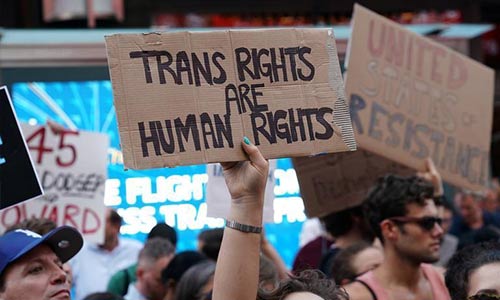
The United States Supreme Court has upheld state laws restricting transgender girls and women from participating in girls’ and women’s school sports teams, ruling that such bans do not violate federal civil rights law or the Constitution’s Equal Protection Clause.

In a 6-3 decision delivered on Tuesday, the apex court upheld laws from Idaho and West Virginia which require participation in girls’ and women’s sports to be based on biological sex.
The cases, known as Little v. Hecox and West Virginia v. B.P.J., involved challenges brought by transgender student-athletes who argued that the state bans unlawfully discriminated against them.
Writing for the majority, Justice Brett Kavanaugh held that states may maintain separate sports teams for girls and women based on biological sex, and that Title IX does not compel schools to allow transgender girls and women to compete on teams that align with their gender identity.
“Consistent with Title IX and the Equal Protection Clause, we hold that the States may maintain women’s and girls’ sports for biological females,” Kavanaugh wrote.
The court held that the Constitution and Title IX do not require what it described as an overhaul of women’s and girls’ sports across the United States.
The ruling overturned lower court decisions that had favoured transgender students in Idaho and West Virginia.
The Idaho case involved Lindsay Hecox, a transgender college student who challenged the state’s 2020 law barring transgender women and girls from female sports teams.
The West Virginia case involved Becky Pepper-Jackson, a transgender student who challenged the state’s Save Women’s Sports Act after she was barred from participating on girls’ sports teams.
Supporters of the bans argued that the laws were necessary to protect fairness, safety and competitive opportunities for female athletes.
They maintained that sports eligibility may lawfully be based on biological sex, especially in competitive athletics where physical differences can affect performance.
Opponents, including civil rights groups and the affected students, argued that the bans unfairly singled out transgender students and denied them equal educational and athletic opportunities.
They contended that the policies violated Title IX, which prohibits sex discrimination in federally funded education programmes, and the Equal Protection Clause of the 14th Amendment.
The Supreme Court rejected those arguments, holding that states have authority to structure school sports in a way that preserves female athletic categories.
However, the ruling does not require every state to impose such bans. It allows states to maintain them where enacted, while leaving room for other states to adopt different policies.
Justice Sonia Sotomayor, joined by the court’s liberal justices, dissented in part, warning that the decision could harm transgender students and prematurely resolve factual questions about whether individual athletes actually have competitive advantages.
The dissent argued that the court should not have adopted such a broad rule without allowing more detailed factual inquiry in specific cases.
The decision is expected to affect similar laws across the United States, where more than two dozen states have enacted restrictions on transgender girls and women participating in girls’ and women’s sports.
The ruling also comes amid wider legal and political battles over transgender rights, school policies, Title IX enforcement and the authority of states to regulate education and athletics.
Former President Donald Trump, who made opposition to transgender participation in women’s sports a major campaign issue, had also signed an executive order directing federally funded education programmes to restrict participation in women’s sports based on biological sex.
Following the ruling, supporters described the decision as a victory for women’s sports and state authority over school athletics, while LGBTQ rights advocates criticised it as a setback for transgender students.
The judgment now provides the strongest legal backing yet for state laws restricting transgender girls and women from competing in girls’ and women’s school sports.
[A MUST HAVE] Evidence Act Demystified With Recent And Contemporary Cases And Materials

Available now for NGN 40,000 at ASC Publications, 10, Boyle Street, Onikan, Lagos. Beside High Court, TBS. Email publications@ayindesanni.com or WhatsApp +2347056667384. Purchase Link: https://paystack.com/buy/evidence-act-complete-annotation
______________________________________________________________________ “Enhance Legal Practice With Authoritative Reports” — Alexander Payne Offers Comprehensive Law Reports, Spanning Over A Century Of Nigerian Jurisprudence Interested buyers are encouraged to place their orders and enquiries via:
0704 444 4777, 0704 444 4999, 0818 199 9888
Website: www.alexandernigeria.com
Interested buyers are encouraged to place their orders and enquiries via:
0704 444 4777, 0704 444 4999, 0818 199 9888
Website: www.alexandernigeria.com