*Kenya’s Chief Justice Calls for African Women Judges in ICC and International Tribunals
*First Lady Backs Gender Inclusion, Says Women On The Bench Add Value

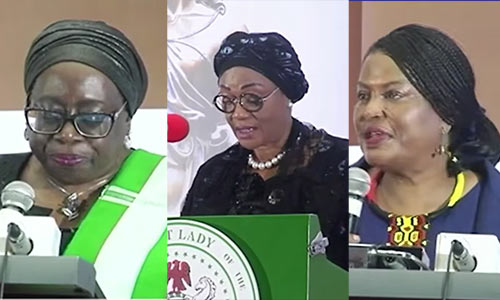
The Chief Justice of Nigeria (CJN), Justice Kudirat Kekere-Ekun, has called for the appointment of more women to leadership positions in the judiciary, declaring that the full and effective participation of women on the bench broadens jurisprudential perspectives, reduces unconscious biases, strengthens public confidence in legal institutions, and enriches the administration of justice in meaningful ways.
Justice Kekere-Ekun made the call on Tuesday at the opening ceremony of the International Association of Women Judges (IAWJ) African Regional Conference, held at the Body of Benchers Auditorium in Abuja, a gathering that brought together senior women judicial officers from across the continent, including from Kenya, Ghana, South Africa, Côte d’Ivoire, the Democratic Republic of Congo, and Nigeria, alongside government representatives, serving and retired Justices of the Supreme Court, Justices of the Court of Appeal, judges of various High Courts, and the President of the Nigerian Bar Association.
The conference, themed “Promoting Excellence in the Administration of Justice,” is being hosted by the National Association of Women Judges of Nigeria (NAWJN) and is scheduled to run until Friday, June 12, with technical sessions on judicial principles, the judiciary as a catalyst for social change, access to justice, and gender inclusion in judicial leadership across Africa.
“The Confidence of the People”
In her keynote address, CJN Kekere-Ekun framed the pursuit of judicial excellence in terms that went beyond efficiency and case disposal to encompass integrity, fairness, public confidence, and the fundamental legitimacy of the judiciary as an institution.
“The judiciary occupies a unique position within democratic governance. Unlike the Executive, it commands no army. Unlike the legislature, it controls no public purse. Yet its authority derives from something far more enduring, and that is the confidence of the people in its impartiality, integrity and fidelity to the law,” the CJN stated.
She defined judicial excellence not merely in terms of speed or output but in terms of quality and values: “Judicial excellence is not measured by speed of case disposal alone, but by the quality of reasoning, integrity of judges, fairness of process, and public confidence in the courts. Excellence is ultimately reflected in the ability of the judiciary to uphold the Constitution, protect the vulnerable, preserve the rule of law, and dispense justice without fear, favour, affection or ill will.”
“It is therefore incumbent upon all judicial officers to ensure that every action, every decision, and every interaction strengthens rather than diminishes that confidence,” she added.
Gender Equality as Institutional Legitimacy
The CJN’s most significant argument was her framing of gender equality within the judiciary not as a matter of representation alone but as a question of institutional legitimacy.
“The pursuit of gender equality within the judiciary is not merely a matter of representation; it is fundamentally a matter of institutional legitimacy. A judiciary that reflects the diversity of the society it serves is better positioned to command public confidence and to appreciate the varied experiences that come before it,” Justice Kekere-Ekun stated.
“Diversity strengthens judicial deliberation, enriches legal reasoning, and ultimately enhances the quality of justice delivered,” she added.
While acknowledging that encouraging progress has been made over the years, particularly at entry and intermediate levels, the CJN warned that “significant work remains to be done in ensuring equal representation within leadership positions and at the highest levels of judicial decision-making.”
She issued a pointed caution: “The judiciary, like many institutions, emerged from historical structures that offered limited opportunities for women. While considerable progress has been achieved, we must remain vigilant to ensure that our institutions are not constrained by the very inequalities they are called upon to remedy.”
“Ultimately, gender inclusion must be viewed as an indispensable component of the judiciary’s commitment to fairness, equality, and the rule of law,” the CJN declared.
Mentorship and Intergenerational Leadership
Justice Kekere-Ekun also addressed the responsibility of current judicial leaders to prepare the next generation, calling for “strategic and enduring mentorship initiatives that create pathways for continuity, sustainability, and intergenerational impact.”
“Those who have attained positions of leadership bear a responsibility to inspire, support, and guide those who follow. The success of any institution is not measured solely by the achievements of its present leaders but also by its capacity to prepare the next generation to surpass them,” she stated.
“We must therefore embrace a culture of collaboration and mutual support, recognising that the strength of the judiciary is built collectively rather than individually,” the CJN added.
She also stressed the importance of technology and judicial education in improving efficiency but warned that technology must not replace judicial wisdom and human judgment.
Kenya’s Chief Justice: Put African Women on International Courts
The Chief Justice and President of the Supreme Court of Kenya, Justice Martha Koome, EGH, represented at the conference by Justice Njoki Ndungu, CBS, of the Supreme Court of Kenya, called for stronger international representation of African women judges in global courts and tribunals.
Justice Koome’s message argued that African women judges are increasingly shaping jurisprudence and leading judicial institutions across the continent and that this leadership should extend to the international stage.
She called on African governments to support women judges seeking international judicial appointments, including at the International Criminal Court (ICC), noting that Kenya had already nominated a candidate and was willing to support other African candidates for international positions.
“A generation of women judges are mentoring others, shaping jurisprudence, and leading institutions,” the Kenyan Chief Justice stated, calling also for stronger regional judicial cooperation and alternative dispute resolution systems.
First Lady: Women on the Bench Add Value
First Lady Senator Oluremi Tinubu, attending as a special guest, described the conference theme as “timely and significant” and urged participants to continue building judicial systems that are “transparent, compassionate, and firmly anchored in the rule of law.”
“At a time when societies across the world are advancing through new legal, technological, and social developments, the pursuit of excellence within our justice system remains both an obligation and a moral imperative,” Mrs Tinubu stated.
She emphasised the contribution of women judges to the quality of justice: “The presence of women on the bench adds value to the judicial system by broadening perspectives and deepening understanding in the dispensation of justice. Across Africa, women judges have broken through long-standing barriers and, by their resilience and excellence, paved the way for future generations of women in the legal profession.”
Drawing from her own experience, the First Lady noted: “As a former senator of the Federal Republic of Nigeria, I understand the challenges women face while aspiring for leadership positions. This is why I remain committed to initiatives that promote equitable access to opportunities for women and girls and strengthen our democracy.”
AGF: Nigeria Has Broken the Glass Ceiling
The Attorney General of the Federation and Minister of Justice, Prince Lateef Fagbemi, SAN, whose speech was read by the Solicitor-General of the Federation, Mrs Beatrice Jedy-Agba, said the role of women judges extends beyond the courtroom and pledged Nigeria’s commitment to advancing judicial reforms that champion gender inclusivity.
The AGF argued that Nigeria had already broken the glass ceiling through the appointment of women into critical judicial positions, but acknowledged persistent challenges facing women in the justice sector, including “gender bias, economic hardship, and cultural stereotypes.”
“African women aspiring to enter and excel in the justice sector still face systemic gender biases and economic hardships,” Fagbemi’s statement read, calling for “bold reforms to deepen access to justice and strengthen institutions across the continent.”
He described women judges as no longer merely participating in jurisprudence but “actively shaping it across Africa,” and characterised judicial excellence as “the foundation of African democracy and essential for human rights protection and sustainable development.”
Wike: “We Are Not Playing Politics with Justice”
FCT Minister Nyesom Wike, in his goodwill message, said the Tinubu administration would continue to provide basic infrastructure that enhances the justice sector and lends dignity to the bench.
He disclosed that the federal government has built over 400 “befitting residences” for judicial officers in Abuja, insisting the gesture was not politically motivated but was done in furtherance of good governance.
“We are not playing politics with justice,” Wike stated, adding that judicial excellence must be supported with investment in infrastructure and institutional support.
“Without excellence there is no justice, and without justice there is no nation,” the FCT Minister declared, calling for increased use of technology, improved case management, and reforms to make justice faster and more accessible.
President of Court of Appeal: “A Sacred Public Trust”
The President of the Court of Appeal, Justice Monica Dongban-Mensem, who also serves as President of the NAWJN and is the host of the conference, set the tone for the proceedings by describing the administration of justice as “a sacred public trust.”
“As we commence this conference, let us remember that the administration of justice is ultimately a sacred public trust. The judgments we deliver today will shape lives, influence institutions, and contribute to the legal legacy we leave for future generations. We must therefore strive not merely to administer justice, but to administer it with wisdom, courage, integrity, and compassion,” Justice Dongban-Mensem stated.
She noted that in a rapidly evolving global landscape characterised by complex legal challenges, technological advancements, and increasing public expectations, the judiciary must continue to uphold the highest standards of integrity, competence, fairness, and accountability.
“The Women Judges of Nigeria, as host of this important regional gathering, remain firmly committed to advancing judicial capacity, promoting gender equality within the judiciary, and fostering collaboration among women judges across Africa and beyond,” she added.
She acknowledged that while women have made “remarkable strides” within the judiciary across many jurisdictions, “noticeable representation gaps still remain.”
IAWJ President: Strengthening Public Confidence
Mina Sougrati, the President of the International Association of Women Judges, described the conference as an important opportunity for women judges from across Africa to “share experiences, strengthen professional networks and exchange ideas on advancing justice, protecting human rights and promoting gender equality within the judicial system.”
She said the work being done by members of the association “contributes significantly to strengthening public confidence in the judiciary and advancing justice for women, children and vulnerable communities.”
The NAWJN, which is hosting the conference, was established in 1991 as a platform for collaboration and promoting judicial diplomacy among women judges across Africa.
The conference, which continues until Friday, June 12, will feature technical sessions and panel discussions on judicial principles and the foundations of excellence, the judiciary as a catalyst for social change, access to justice across African jurisdictions, gender inclusion in judicial leadership, and innovative solutions for strengthening public confidence in the courts.
The gathering aims to produce recommendations that will shape judicial practice across the continent and provide guidance for young female lawyers aspiring to judicial careers.
Among the dignitaries at the opening ceremony were heads of courts from different African countries, serving and retired Justices of the Supreme Court, Justices of the Court of Appeal, judges of High Courts, the President of the Nigerian Bar Association, and the wives of the governors of Abia and Imo states, Mrs Priscilla Chidinma Otti and Mrs Chioma Uzodimma, respectively.
[A MUST HAVE] Evidence Act Demystified With Recent And Contemporary Cases And Materials

Available now for NGN 40,000 at ASC Publications, 10, Boyle Street, Onikan, Lagos. Beside High Court, TBS. Email publications@ayindesanni.com or WhatsApp +2347056667384. Purchase Link: https://paystack.com/buy/evidence-act-complete-annotation
______________________________________________________________________ “Enhance Legal Practice With Authoritative Reports” — Alexander Payne Offers Comprehensive Law Reports, Spanning Over A Century Of Nigerian Jurisprudence Interested buyers are encouraged to place their orders and enquiries via:
0704 444 4777, 0704 444 4999, 0818 199 9888
Website: www.alexandernigeria.com
Interested buyers are encouraged to place their orders and enquiries via:
0704 444 4777, 0704 444 4999, 0818 199 9888
Website: www.alexandernigeria.com