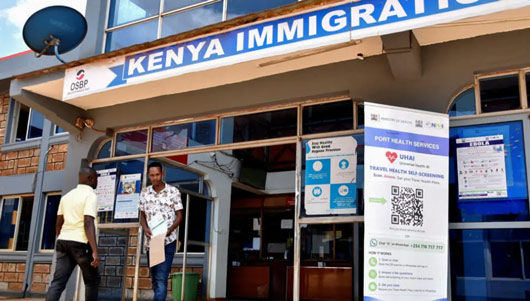
Kenyan health authorities are searching for a Ugandan national who had contact with the country’s first Ebola patient but has since become unreachable, as the number of confirmed cases linked to the initial cluster rises to nine.

Kenya’s Director-General of Health, Patrick Amoth, said authorities had been unable to locate the man despite having details of his passport and telephone numbers.
According to Amoth, officials suspect the Ugandan national may have crossed the Kenya-Uganda border through an unofficial route in an attempt to avoid routine border screening.
Ugandan authorities have been notified and are assisting efforts to trace him.
The search comes as Kenya continues to battle the spread of the rare Bundibugyo strain of Ebola following confirmation of the country’s first case earlier this month.
Kenyan authorities announced a ninth confirmed infection on Tuesday evening, saying the latest patient remained epidemiologically linked to the first cluster.
The patient has been placed in isolation.
Health authorities have also identified 129 persons as contacts connected to the outbreak and placed them under monitoring.
The development has heightened concern over possible cross-border transmission, particularly because of the movement of people between Kenya and Uganda.
The current outbreak originated in eastern Democratic Republic of Congo, where authorities declared an Ebola outbreak in May.
It has since spread to several countries in the region.
Kenyan authorities maintain that the situation remains under control, but their response has attracted criticism from political opponents and health professionals over the management of isolation and quarantine facilities.
Former Chief Justice David Maraga, who is also a candidate in Kenya’s 2027 presidential election, criticised the government’s handling of the outbreak.
“It is clear that quarantine centres are turning into incubation units for the Ebola virus,” Maraga said.
The criticism followed concerns that people placed together in quarantine facilities could face increased exposure if infection-control procedures were inadequate.
After several days of pressure, Kenya’s doctors’ union was included in the national Ebola response task force on Tuesday.
The outbreak has also prompted international concern.
Earlier this week, the United States State Department raised its travel advisory for Kenya and advised American citizens to reconsider travel to the country because of health risks associated with the outbreak.
The Ebola situation has become an increasingly regional public-health challenge.
Nigeria confirmed its first case on Tuesday after a woman who had recently travelled from Uganda was diagnosed with Ebola in Abuja.
Nigerian health authorities subsequently identified 44 contacts linked to the patient and commenced monitoring and tracing efforts.
Nigeria’s Coordinating Minister of Health and Social Welfare, Muhammad Pate, said authorities were doing everything possible to contain the infection.
The Nigerian patient was later confirmed to have the Bundibugyo strain of the virus.
The same strain is responsible for the ongoing outbreak in the Democratic Republic of Congo.
The Bundibugyo species currently has no approved specific vaccine or treatment.
The outbreak in the DRC has affected more than 9,500 people and caused at least 4,600 deaths.
Uganda had earlier recorded 20 cases and two deaths before declaring its outbreak over in late August.
The growing number of cases across the region has prompted the Africa Centres for Disease Control and Prevention to warn of what it described as an “extremely serious threat.”
Africa CDC Director-General Jean Kaseya called for stronger international mobilisation to support countries responding to the outbreak.
Despite the scale of the crisis, researchers have expressed cautious optimism over vaccine development.
Clinical trials involving potential vaccines have produced encouraging indications, while the World Health Organization has said the first clinical trial of a potential vaccine against the current Bundibugyo outbreak is expected to begin by the end of October.
The outbreak has also reached outside Africa.
France confirmed an Ebola infection in June involving a doctor who had returned from the Democratic Republic of Congo.
The patient later recovered following treatment, making France the only country outside Africa so far to record a confirmed case linked to the current outbreak.
Kenya’s immediate concern, however, remains containing transmission from its first cluster and locating the missing Ugandan contact before he potentially exposes others.
Authorities are continuing contact tracing, surveillance and isolation measures as health officials seek to prevent the nine confirmed cases from developing into a wider community outbreak.
[A MUST HAVE] Evidence Act Demystified With Recent And Contemporary Cases And Materials

Available now for NGN 40,000 at ASC Publications, 10, Boyle Street, Onikan, Lagos. Beside High Court, TBS. Email publications@ayindesanni.com or WhatsApp +2347056667384. Purchase Link: https://paystack.com/buy/evidence-act-complete-annotation
______________________________________________________________________ “Enhance Legal Practice With Authoritative Reports” — Alexander Payne Offers Comprehensive Law Reports, Spanning Over A Century Of Nigerian Jurisprudence Interested buyers are encouraged to place their orders and enquiries via:
0704 444 4777, 0704 444 4999, 0818 199 9888
Website: www.alexandernigeria.com