
The constitutional amendment seeking to establish State Police in Nigeria has crossed a major legislative hurdle after 25 of the 36 State Houses of Assembly approved the Constitution of the Federal Republic of Nigeria, 1999 (Sixth Alteration) Bill, 2026.

The approvals exceed the constitutional requirement that amendments of this nature must be supported by resolutions of at least two-thirds of the 36 State Houses of Assembly.
Eleven states — Lagos, Ondo, Ebonyi, Kogi, Niger, Borno, Bauchi, Jigawa, Katsina, Kano and Sokoto — have yet to approve the amendment.
With the required number of states now secured, the constitutional alteration process can proceed to its next stage.
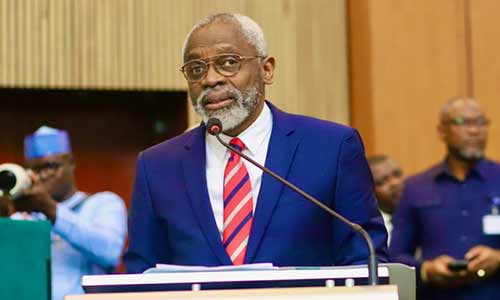
Chief of Staff to the President and Chairman of the Presidential Working Group on the National Policing Bill, Femi Gbajabiamila, disclosed the development, describing the state assemblies’ approvals as a major step towards establishing a dual policing structure in Nigeria.
He also commended the National Assembly for earlier passing the constitutional amendment in both chambers.
The development comes as the proposed National Policing Bill, 2026, and 29 consequential amendment bills are undergoing legislative drafting review and validation at the Federal Ministry of Justice.
Gbajabiamila explained that the approval of the constitutional amendment by 25 State Houses of Assembly provides the constitutional foundation upon which the proposed National Policing Bill is intended to operate.
“The approval gives constitutional backing to the policing framework that the Working Group’s draft National Policing Bill, 2026 is designed to implement,” he said.
According to him, the Presidential Working Group remains on schedule with the preparation of the supporting legislation.
“The Working Group’s efforts remain on track. The draft Bills are currently undergoing legislative drafting review and validation at the Federal Ministry of Justice and are expected to be returned on or before Friday, 30th October 2026. Thereafter, the Group will give them final consideration before presenting them to Mr President.
“The Working Group urges all stakeholders to support a smooth transition to a dual policing system that makes Nigerians safer,” Gbajabiamila added.
The Presidency had earlier disclosed that the draft National Policing Bill was ready, following the completion of the initial drafting process by the Presidential Working Group.
The proposed National Policing Bill, together with 29 consequential amendment bills, was submitted to the Attorney-General of the Federation and Minister of Justice on October 19, 2026, for legislative drafting review and validation.
Gbajabiamila said the review by the Federal Ministry of Justice was intended to ensure that the proposed laws complied with established legislative drafting standards and did not conflict with existing legislation.
The ministry is expected to return the validated bills to the Working Group on or before October 30, after which the group will undertake final consideration before presenting them to President Bola Tinubu.
Gbajabiamila explained that the proposed National Policing Bill seeks to provide the operational and legislative framework for a dual policing structure consisting of a Federal Police Service and State Police Services.
“The proposed National Policing Bill seeks to establish the constitutional and legislative framework for a dual policing structure, comprising a Federal Police Service and State Police Services,” he said.
He added that the Working Group remained committed to producing a comprehensive legislative proposal for consideration by the President and subsequent transmission to the National Assembly.
The preparation of the National Policing Bill has been proceeding alongside the constitutional amendment process because the Constitution must first provide the legal foundation for the establishment of State Police before the operational legislation can fully take effect.
Gbajabiamila had earlier described the proposed National Policing Bill as one of the most consequential legislative initiatives of the Tinubu administration.
Speaking after a steering committee meeting at the State House in Abuja, he said the legislation was already about 90 per cent complete.
“The National Policing Bill is more or less ready for transmission to the National Assembly. We will probably have one more meeting after this to cross the t’s and dot the i’s and make sure every area is covered. So, we are 90 per cent ready.
“The governors have one or two observations, and we should be ready in about a week or so,” he said.
At the time, concerns had been raised that the constitutional amendment could be delayed because only a few state assemblies had approved it.
Gbajabiamila, however, expressed confidence that the required number of states would eventually support the amendment, maintaining that there was broad national consensus on the need to reform Nigeria’s policing structure.
“I see no reason why anyone will want to have a rethink on it,” he said.
Those who participated in the steering committee meeting included Chairman of the Nigeria Governors’ Forum and Governor of Kwara State, AbdulRahman AbdulRazaq; Ogun State Governor, Dapo Abiodun; Kaduna State Governor, Uba Sani; Inspector-General of Police, Tunji Disu; and representatives of the Attorney-General of the Federation and Minister of Justice.
Also present were Chairman of the Policy Advisory Committee, Justice Abdullahi Liman (retd.); Head of the Nigeria Police Reform Secretariat, Professor Olu Ogunsakin; Special Adviser to the President on National Assembly Matters, House of Representatives, Dr Lanre Smart; and Senior Special Assistant to the President on Planning and Research and Secretary of the committee, Nnadubem Moghalu.
Representatives of the Nigerian Bar Association and the Office of the National Security Adviser also participated in the meeting.
President Tinubu inaugurated the Presidential Working Group on the National Policing Bill on July 7, 2026, with a mandate to prepare the legal framework required for the implementation of State Police.
The inauguration followed the passage by the National Assembly of the Constitution Alteration (State Police) Bill, 2026, which proposes a dual policing system comprising a Federal Police Service and State Police Services.
Tinubu had explained that while the constitutional amendment would create the legal foundation for State Police, a separate National Policing Bill would be required to establish the detailed framework for its operation.
“The Constitution Amendment Bill establishes the framework for dual policing, but it does not operationalise it. That work is left to the National Policing Bill,” the President said.
With 25 State Houses of Assembly now approving the constitutional amendment, the State Police proposal has crossed the required state-level threshold, bringing Nigeria closer to a dual policing system if the remaining legislative and constitutional processes are completed.
[A MUST HAVE] Evidence Act Demystified With Recent And Contemporary Cases And Materials
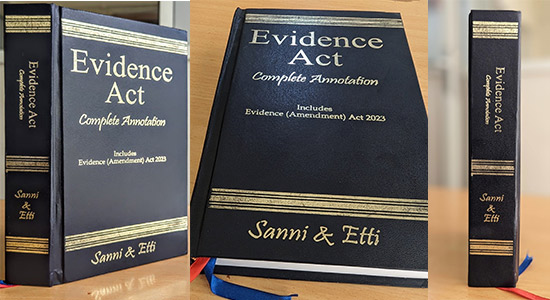
Available now for NGN 40,000 at ASC Publications, 10, Boyle Street, Onikan, Lagos. Beside High Court, TBS. Email publications@ayindesanni.com or WhatsApp +2347056667384. Purchase Link: https://paystack.com/buy/evidence-act-complete-annotation
______________________________________________________________________ “Enhance Legal Practice With Authoritative Reports” — Alexander Payne Offers Comprehensive Law Reports, Spanning Over A Century Of Nigerian Jurisprudence Interested buyers are encouraged to place their orders and enquiries via:
0704 444 4777, 0704 444 4999, 0818 199 9888
Website: www.alexandernigeria.com