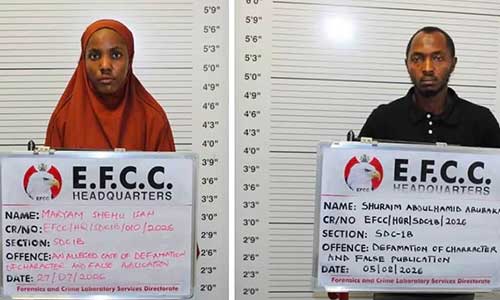
The Executive Chairman of the Economic and Financial Crimes Commission, Ola Olukoyede, has ordered the withdrawal of cybercrime charges filed against Maryam Isah Shehu, a final-year student of Bayero University, Kano, and Abubakar Shuraim Abdulhamad.


The directive came barely a day after the two defendants were arraigned before Justice Joyce Abdulmalik of the Federal High Court in Abuja and remanded in separate correctional centres over alleged cyberstalking and dissemination of information intended to damage the EFCC’s reputation.
The EFCC’s Head of Media and Publicity, Dele Oyewale, disclosed the withdrawal directive in a statement issued on Friday, August 21, 2026.
The commission said Olukoyede reconsidered the prosecution following passionate pleas and apologies from Shehu’s father, alongside appeals from other Nigerians urging the EFCC to show leniency.
“The Executive Chairman, nonetheless, considered the passionate pleas and apologies of Shehu’s father and appeals of well-meaning Nigerians for leniency,” the statement said.
“He has directed that charges filed against the two young Nigerians be dropped and warned that the EFCC would no longer tolerate any wilful attack on its image in any form, medium or platform.”
The development followed weeks of controversy surrounding Shehu’s arrest and detention.
Shehu, a Kano-based blogger and final-year student of Bayero University, was reportedly arrested in Kano and subsequently transferred to the EFCC’s custody in Abuja following a publication she made on Instagram.
Her lawyer and other advocates alleged that she spent about 35 days in EFCC custody before the commission filed a one-count charge against her and brought her before the Federal High Court.
The charge arose from a post allegedly published through her Instagram account, @maryam_shehu, on or about June 21, 2026.
The EFCC alleged that Shehu intentionally published a message claiming that officials of the commission assaulted one Ahmed Uthman on the instruction of an EFCC zonal director who allegedly collected ₦20 million from one Usman Iya Abbas.
The commission claimed that the publication was intended to damage its reputation and amounted to cyberstalking under Section 24(2)(c) of the Cybercrimes (Prohibition, Prevention, Etc.) Act, 2015, as amended in 2024.
The alleged offence was said to be punishable under Section 24(2)(c)(ii) of the amended legislation.
Shehu was arraigned on Thursday, August 20, on an amended one-count charge signed by Elizabeth Alabi of the EFCC’s Legal and Prosecution Department.
She pleaded not guilty when the charge was read to her.
Her counsel, C.O. Amalaha, informed the court that a bail application had been filed and urged Justice Abdulmalik to admit the student to bail on liberal terms.
The lawyer told the court that Shehu had already spent close to a month in detention before her arraignment. He also drew the judge’s attention to an examination she was expected to sit on Saturday and urged the court to consider the effect of continued detention on her academic programme.
The defence reportedly received the amended charge on the morning of the arraignment and immediately filed and served a bail application on the prosecution.
EFCC counsel Elizabeth Alabi objected to the immediate hearing of the application, maintaining that the prosecution needed sufficient time to study and respond to it.
Justice Abdulmalik consequently declined to hear the bail application on that date and ordered that Shehu be remanded at the Suleja Correctional Centre in Niger State.
Abdulhamad was arraigned separately before the same judge on a one-count charge arising from an image allegedly published through his account on X, formerly known as Twitter.
The commission alleged that Abdulhamad fabricated an image resembling an official EFCC arrest placard and depicted one Sadeeq Kabeer as a suspect arrested by the commission.
The image allegedly carried the inscription, “His only crime was selling laptops at affordable price to student,” as the purported reason for Kabeer’s arrest.
The EFCC alleged that the publication was intended to tarnish its reputation and constituted an offence under Section 24(2)(c) of the Cybercrimes Act, as amended in 2024.
Abdulhamad also pleaded not guilty to the charge.
His counsel, Adamu K. Adamu, informed the court that a bail application had been filed and asked that the defendant be held in EFCC custody pending its determination.
Justice Abdulmalik, however, ordered that Abdulhamad be remanded at the Kuje Correctional Centre in the Federal Capital Territory.
The court adjourned both cases until August 31, 2026, for the hearing of their bail applications and the commencement of trial.
The arrests, prolonged detention and subsequent remand attracted appeals from Shehu’s family, the National Association of Nigerian Students, lawyers and civil society organisations.
NANS expressed concern that Shehu’s continued detention could disrupt her examinations and academic progress, announcing that its leadership had contacted the EFCC to seek a resolution that would lead to the discontinuance of the case.
Human rights lawyer Abba Hikima also called on the Attorney-General of the Federation to intervene, alleging that Shehu was held for 35 days before the one-count charge was filed.
He questioned the proportionality of the detention and whether the allegation concerning the conduct of EFCC officials, which formed the basis of Shehu’s publication, had been independently investigated.
Civic technology organisation MonITNG similarly questioned whether using criminal proceedings to protect the EFCC’s reputation fell within the commission’s statutory mandate.
The organisation acknowledged that publishing false information or fabricating documents could constitute offences under applicable laws but argued that greater clarity was required where the central complaint involved alleged damage to the reputation of a public institution.
Following the public appeals and Shehu’s father’s apology, Olukoyede directed that the charges against both defendants be withdrawn.
The EFCC chairman, however, warned that the decision should not be interpreted as approval of deliberate efforts to circulate false or damaging information against the commission.
He said the EFCC would no longer tolerate wilful attacks on its image through social media or any other platform.
“The EFCC’s boss assured Nigerians that the commission would continue to function in line with its assigned mandate and in the best interests of the nation,” Oyewale said.
Although Olukoyede has directed the withdrawal of the charges, the criminal proceedings will be formally discontinued through the appropriate application before the Federal High Court.
 Interested buyers are encouraged to place their orders and enquiries via:
0704 444 4777, 0704 444 4999, 0818 199 9888
Website: www.alexandernigeria.com
Interested buyers are encouraged to place their orders and enquiries via:
0704 444 4777, 0704 444 4999, 0818 199 9888
Website: www.alexandernigeria.com

 The book also examines Nigeria's legal ecosystem, focusing on the LPELR and NBA AI Guidelines. As a bonus, every purchase comes with a FREE eBook titled: How to Use the AI Features in LegalPedia and LawPavilion.
Ohio Books Ltd praises the publication, stating:
"....this is the only Nigerian book I know of on the topic."
How to Order:
📞 Call, Text, or WhatsApp: 08034917063 | 07055285878
📧 Email: benadigwe1@gmail.com
🌎 Website: www.benadigwe.com
Ebook Version: Access it directly online at https://selar.com/prv626
Authored by Ben Ijeoma Adigwe Esq., ACIarb (UK), LL.M, Dip. in Artificial Intelligence, Director at the Delta State Ministry of Justice, Asaba, Nigeria.
_______________________________________________________________________
The book also examines Nigeria's legal ecosystem, focusing on the LPELR and NBA AI Guidelines. As a bonus, every purchase comes with a FREE eBook titled: How to Use the AI Features in LegalPedia and LawPavilion.
Ohio Books Ltd praises the publication, stating:
"....this is the only Nigerian book I know of on the topic."
How to Order:
📞 Call, Text, or WhatsApp: 08034917063 | 07055285878
📧 Email: benadigwe1@gmail.com
🌎 Website: www.benadigwe.com
Ebook Version: Access it directly online at https://selar.com/prv626
Authored by Ben Ijeoma Adigwe Esq., ACIarb (UK), LL.M, Dip. in Artificial Intelligence, Director at the Delta State Ministry of Justice, Asaba, Nigeria.
_______________________________________________________________________
“Order Justice Omolaye-Ajileye’s Electronic Evidence Books Now” — Essential Guides On Evidence Act, Case Law And Digital Proof