By C.K. Anyanwu, LL.M., Kelechi Onyekwere, Esq., C.K. Ezeaku, (Miss)


INTRODUCTION
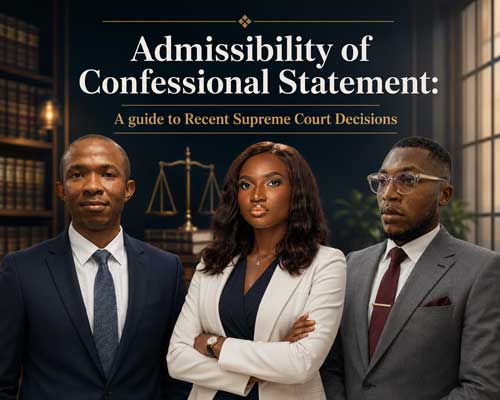
In criminal trials, a confessional statement is often the most powerful piece of evidence the prosecution can present. Because of its heavy impact, the law sets strict rules on how the police must obtain these statements and how courts should admit them. Over the last few years, the Administration of Criminal Justice Act (ACJA) of 2015 and similar state laws introduced new procedural safeguards, like the mandatory video recording of confessions, to protect suspects from forced statements. However, this led to a fundamental question in our courts: if the police fail to follow these new procedural steps to the letter, does it automatically mean the confession is thrown out? How do these procedural laws work alongside the Evidence Act, which has always been the main law on what evidence is admissible? Recent decisions from the Supreme Court have cleared up these grey areas. This article breaks down the current position of the law on video recordings, the use of interpreters, and what happens when key police officers fail to testify in court.
A) THE RULE ON VIDEO RECORDINGS OF THE DEFENDANT’S CONFESSIONAL STATEMENT
The landscape of confessional statements completely changed with the ACJA 2015. As the Supreme Court noted in Halilu v. Katsina State (2025) 6 NWLR (Pt. 1986) 289 S.C., Sections 15(4) and 17(1) of the ACJA require that when a suspect volunteers a statement, the police officer must ensure it is in writing and may be recorded electronically on a video compact disc or other audio-visual means. This position was also strongly emphasised in cases like F.R.N. v. Nnajiofor (2024) 10 NWLR (Pt. 1947) 443 and F.R.N. v. Akaeze (2024) 12 NWLR (Pt. 1951) 1.
But what happens if the police simply do not have a video recording?
The Supreme Court answered this directly in IWAH v. STATE (2026) LPELR-83365(SC). The Court held that laws requiring video recordings are procedural steps meant to guide the police. They do not override the Evidence Act. Under Sections 28 and 29 of the Evidence Act, the core test for admitting a confession is whether it was made voluntarily. Therefore, failing to record a confession on video does not automatically make the statement a nullity or inadmissible, as long as it passes the voluntariness test of the Evidence Act.
This Supreme Court decision backed up the earlier Court of Appeal position in IWAH v. STATE (2020) LPELR-51374(CA), which explicitly stated that non-compliance with the video recording rule does not inherently render a statement inadmissible. Earlier cases like KADIRI v. STATE (2019) LPELR-47714(CA) and IKE v. STATE OF LAGOS (2019) LPELR-47712(CA) also agreed that lawmakers did not intend for the absence of a video recording to automatically kill a confessional statement.
This issue was further elaborated in the case of EDUENOH v. STATE (2026) LPELR-83734(SC). In the instant case, the issue was whether evidence admissible under the Evidence Act can be rendered inadmissible under a State Law. The Supreme Court held:
“Under the Constitution, legislative competence in Nigeria is divided between the Federation and the States. Matters placed on the Exclusive Legislative List are reserved solely for the National Assembly, and the Houses of Assembly of the States lack authority to legislate on them. Significantly, ‘evidence’ appears as Item 23 on that List. The legal implication is that all rules governing the reception, admissibility, relevancy, and probative value of evidence in judicial proceedings fall within the exclusive law-making power of the National Assembly. Pursuant to that constitutional authority, the National Assembly enacted the Evidence Act, 2011, which is the uniform and supreme statutory regime regulating admissibility of documents and oral testimony in Courts across the Federation. Consequently, whenever a Court is invited to determine whether a document is admissible, whether in civil or criminal proceedings, the governing provisions must be those contained in the Evidence Act. The admissibility of evidence is therefore not a matter of procedural convenience but a question of substantive law fixed by federal legislation. It follows that a State House of Assembly cannot validly enact a law prescribing conditions for admissibility or exclusion of evidence in Court proceedings. Where any state law purports to regulate how documents are to be admitted, certified, tendered, or rejected in judicial proceedings, such provisions will be unconstitutional to the extent of inconsistency because they encroach upon a field exclusively occupied by federal legislation. By the doctrine of covering the field and the supremacy clause of the Constitution, the Evidence Act prevails, and any conflicting state provision becomes inoperative. Accordingly, in criminal proceedings before a trial Court, admissibility of documentary or other evidence cannot be governed by any state enactment or subsidiary regulation. The Court is bound only by the Evidence Act, 2011, and must disregard any attempt to rely on a state law to admit or exclude evidence. Any decision founded on such state provision would amount to applying an incompetent legal standard and would be liable to be set aside on appeal. This Honourable Court held in Benjamin v. Kalio (2018) 15 NWLR (Pt. 1641) 38, where it considered whether evidence admissible under the Evidence Act can be rendered inadmissible by a law enacted by a State House of Assembly: ‘… A piece of evidence pleadable and admissible in evidence by dint of the Evidence Act cannot be rendered unpleadable and inadmissible in evidence by a Law enacted by the House of Assembly of a State under the prevailing constitutional dispensation. In the instant case, the appellants’ contention that Section 20 of the Land Instruments (Preparation and Registration) Law, Cap. 74, Laws of Rivers State, 1999 rendered exhibit “L”, a land instrument, unpleadable and inadmissible in the proceedings at the trial Court went to naught. The admissibility of the exhibit “L” is governed by the Evidence Act, not the Land Instruments (Preparation and Registration) Law, Cap. 74 Laws of Rivers State, 1999.’ The Appellant’s complaint is predicated on the alleged non-compliance with Section 7(2) of the Cross River State Criminal Procedure Law (CPL) 2004, and he urges the Court to hold that such non-compliance renders his confessional statement inadmissible in evidence. However, it is clear from the authorities cited above that any provision of a state law which purports to prescribe conditions precedent to the admissibility of a confessional statement can only be regarded as directory in nature and cannot override or supplant the provisions of the Evidence Act. At best, such provision may touch on the weight to be attached to the statement, but never its admissibility. It follows therefore that even if Section 7(2) of the Cross River State CPL was not complied with, that fact alone cannot render the confessional statement inadmissible once it satisfies the requirements of the Evidence Act regarding voluntariness and relevance. The Appellant’s submission to the contrary is therefore legally untenable.”
The courts understand that police stations may lack video facilities. To address this, the Supreme Court in ENANG v. STATE (2025) LPELR-81504(SC) ruled that where video facilities are absent, taking the statement in writing is still valid. Expanding on this alternative, the Court of Appeal in DEJI v. STATE (2025) LPELR-82620(CA) clarified that if there is no video recording, taking the written statement in the presence of a legal practitioner of the accused person’s choice serves as a proper safeguard.
B) THE MODE OF OBTAINING CONFESSIONAL STATEMENTS AND THE VITAL ROLE OF INTERPRETERS
Generally, the mode of obtaining confessional statements by the police is to first administer the customary words of caution to the suspect/accused, informing the suspect/accused of his right to keep silent, as his words may be used against him. If the suspect/accused speaks or writes in a language other than English, the suspect/accused will make his statement in the language he understands. If he can write in the vernacular, he should be allowed to write. If he cannot write, the Investigating Police Officer (IPO), who understands the said native language, will write it down on his behalf. The statement will be read over to him; he will confirm it and sign or put his mark or signature. Thereafter, an interpreter (usually the same IPO) will translate the statement into the English language.
See: Usman v. State (2025) 12 NWLR (Pt. 2000) 261 S.C.
The Roles of Interpreters
Nigeria is a multilingual country, and suspects often give their statements in their native language, which is then translated into English. The law is very strict about how this is handled in court.
If a statement is obtained through an interpreter, that interpreter must come to court to testify. The Supreme Court made this very clear in Auwalu v. Kano State (2025) 5 NWLR (Pt. 1984) 459 S.C. The Court held that if a conviction relies purely on a confessional statement, and the person who interpreted it does not testify, that statement is mere hearsay. Because the court and defence lawyers cannot cross-examine an absent translator to verify whether they translated accurately, the statement is inadmissible, and the accused person is entitled to an acquittal.
However, does the police always have to record the statement in the native language first before translating it into English? According to Umar v. State (2025) 13 NWLR (Pt. 2001) 65 S.C., while it is highly desirable to record it in the native language first, failing to do so does not automatically make the statement inadmissible. As long as the recorded English statement is read and interpreted back to the maker in a language they understand, and the maker confirms that it is accurate, the court will admit it.
C) WHAT HAPPENS WHEN THE SUPERIOR POLICE OFFICER WHO RECORDED IT DOES NOT TESTIFY
During trials, defence lawyers often object to confessional statements if the exact police officer who recorded them or the Superior Police Officer who endorsed them is not called to the witness box.
The Supreme Court addressed this in Bala v. C.O.P. (2025) 9 NWLR (Pt. 1994) 495 S.C. The Court ruled that failing to call the specific officer who recorded the statement does not affect its admissibility, though it might affect the weight the judge attaches to it. If there is a good reason for the officer’s absence, for instance, if the officer has left the police force, the statement can still be admitted through another witness, provided the court looks out for corroborative evidence.
Similarly, in Iregu v. State (2025) 13 NWLR (Pt. 2002) 189 S.C., the defence argued that a statement should be thrown out because the Superior Police Officer before whom the accused was taken to confirm the confession did not testify. The Supreme Court rejected this, holding that the failure to call the Superior Police Officer only impacts the weight of the evidence, not its admissibility.
Finally, there are situations where a police officer testifies during the ‘trial-within-trial’ (the mini-trial to check if the statement was voluntary) but is unavailable to testify during the main trial. Does this ruin the case? In Iliyasu v. Kano State (2025) 6 NWLR (Pt. 1985) 65 S.C., the Supreme Court ruled that the rationale behind bringing the recorder or interpreter to court is already satisfied if they testify during the trial-within-trial. Their appearance in the mini-trial cures the defect of their being absent in the main trial, keeping the confessional statement admissible.
CONCLUSION
The recent decisions from the Supreme Court show a clear balancing act. The courts are fully aware of the procedural safeguards placed in the Administration of Criminal Justice Act and state laws to prevent police brutality and forced confessions. However, the courts have drawn a firm line: procedural rules do not override the Evidence Act. While the police should always aim to record confessions on video and use proper interpreters, missing a video recording or failing to call a specific superior officer will not automatically destroy the prosecution’s case. As long as the core requirement of voluntariness is met and the defence is not unfairly prejudiced by hearsay, the courts will focus on the substance of the evidence over mere technicalities.
“Order Justice Omolaye-Ajileye’s Electronic Evidence Books Now” — Essential Guides On Evidence Act, Case Law And Digital Proof
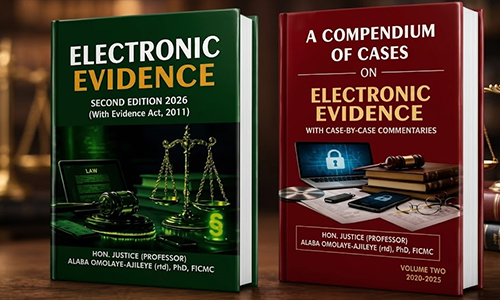
[A MUST HAVE] Evidence Act Demystified With Recent And Contemporary Cases And Materials

Available now for NGN 40,000 at ASC Publications, 10, Boyle Street, Onikan, Lagos. Beside High Court, TBS. Email publications@ayindesanni.com or WhatsApp +2347056667384. Purchase Link: https://paystack.com/buy/evidence-act-complete-annotation
______________________________________________________________________ “Enhance Legal Practice With Authoritative Reports” — Alexander Payne Offers Comprehensive Law Reports, Spanning Over A Century Of Nigerian Jurisprudence Interested buyers are encouraged to place their orders and enquiries via:
0704 444 4777, 0704 444 4999, 0818 199 9888
Website: www.alexandernigeria.com
Interested buyers are encouraged to place their orders and enquiries via:
0704 444 4777, 0704 444 4999, 0818 199 9888
Website: www.alexandernigeria.com
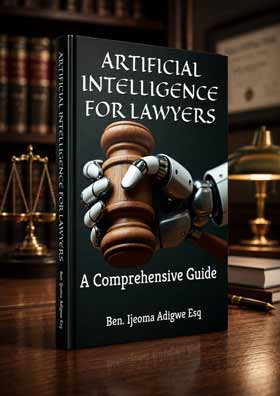 The book also examines Nigeria's legal ecosystem, focusing on the LPELR and NBA AI Guidelines. As a bonus, every purchase comes with a FREE eBook titled: How to Use the AI Features in LegalPedia and LawPavilion.
Ohio Books Ltd praises the publication, stating:
"....this is the only Nigerian book I know of on the topic."
How to Order:
📞 Call, Text, or WhatsApp: 08034917063 | 07055285878
📧 Email: benadigwe1@gmail.com
🌎 Website: www.benadigwe.com
Ebook Version: Access it directly online at https://selar.com/prv626
Authored by Ben Ijeoma Adigwe Esq., ACIarb (UK), LL.M, Dip. in Artificial Intelligence, Director at the Delta State Ministry of Justice, Asaba, Nigeria.
The book also examines Nigeria's legal ecosystem, focusing on the LPELR and NBA AI Guidelines. As a bonus, every purchase comes with a FREE eBook titled: How to Use the AI Features in LegalPedia and LawPavilion.
Ohio Books Ltd praises the publication, stating:
"....this is the only Nigerian book I know of on the topic."
How to Order:
📞 Call, Text, or WhatsApp: 08034917063 | 07055285878
📧 Email: benadigwe1@gmail.com
🌎 Website: www.benadigwe.com
Ebook Version: Access it directly online at https://selar.com/prv626
Authored by Ben Ijeoma Adigwe Esq., ACIarb (UK), LL.M, Dip. in Artificial Intelligence, Director at the Delta State Ministry of Justice, Asaba, Nigeria.