By Ismail Salif, Esq.,


The judiciary has long been described as the last hope of the common man. That reputation is sustained not merely by the judgments courts deliver, but by the integrity, transparency, and credibility of the judicial process itself. The public should never be left with the impression that a court’s judgment can be altered, manipulated, or compromised after it has been delivered in open court.
The recent proceedings in Hon. Chief Athanasius Uche Ogah v. The Governor of Imo State & 2 Ors. have brought to light a purported Certified True Copy of the judgment which materially differs from the judgment read and delivered in open court, raising grave concerns about the integrity of the judicial process and warranting immediate institutional scrutiny
THE SUMMARY OF THE FACT OF THE CASE
the Plaintiff/Applicant, on 24 June 2025, His Lordship Hon. Justice M. E. Nwagboso delivered a considered judgment in Suit No. HOR/98/2019, granting the Plaintiff/Applicant’s claims and entering judgment in his favour.
However, the Applicant/Plaintiff contends that the Certified True Copy (CTC) of the judgment issued to him on 23 July 2025 was fundamentally different from the judgment delivered in open court. Rather than reflecting the judgment allegedly pronounced in his favour, the CTC reportedly dismissed his entire suit.
To substantiate this allegation, the Applicant relied on the Court’s cause list and several affidavits deposed to by senior legal practitioners and other counsel who were physically present in court during the delivery of the judgment. These deponents unanimously maintained that the judgment read in open court granted the plaintiff’s reliefs.
Perhaps even more striking was the Applicant’s reliance on the Defendants’ own Notice of Appeal, filed on 26 June 2025, just two days after the judgment was delivered. The Applicant argued that the filing of an appeal by the Defendants strongly supports the assertion that they had, in fact, lost the case as delivered in court. After all, it would be illogical to appeal a judgment that was already in one’s favour.
The Defendants/Respondents on the other hand denied the allegation and maintained that the CTC accurately represented the judgment delivered by the court. They further argued that their Notice of Appeal had been filed in error, explaining that it was prepared in anticipation of an unfavourable judgment and mistakenly filed due to counsel’s illness.
The State Counsel also raised a jurisdictional objection, contending that the trial court had become functus officio and that the application constituted an abuse of court process.
Appearing as amicus curiae, Chief M. I. Ahamba, SAN, argued that the application did not seek to review or vary the judgment but merely asked the court to set aside a document (CTC) that was allegedly not the judgment delivered in open court. He submitted that a court retains jurisdiction to set aside a nullity. Chief Chris Ihentuge Who also appeared as amicus curiae adopted the same position.
THE COURT’S DECISION
“The court agreed with the amici curiae. It held that the application was competent, that it possessed jurisdiction to entertain it, and ultimately declared that the CTC issued on 23 July 2025 was not the judgment delivered on 24 June 2025. The court consequently set aside the CTC as a nullity.”
If these findings are allowed to pass without thorough investigation, they raise profound questions about the integrity of our judicial system. The suggestion that a judgment delivered in open court could differ from the certified version subsequently issued strikes at the very foundation of the rule of law.
This is no longer merely a matter concerning one litigant or one State Counsel. It raises fundamental questions about the integrity of the Ministry of Justice and other prosecutorial authorities, and, more broadly, about public confidence in the administration of justice. The sanctity of a judgment delivered in open court must be inviolable. Every genuine, transparent and institutional effort must therefore be made to reassure Nigerians that judicial decisions are securely preserved, accurately certified, and incapable of post-delivery alteration or manipulation.
I therefore respectfully call upon the National Judicial Council (NJC) and the Nigerian Bar Association (NBA) to commence an immediate and transparent investigation into the circumstances surrounding this case.
If any judicial officer, court official, or legal practitioner is found to have participated in the production, circulation, or defence of a judgment inconsistent with that read and delivered in open court, appropriate disciplinary and legal sanctions should follow. Accountability is not an attack on the judiciary; it is the very mechanism through which the judiciary preserves its honour.
At a time when public trust in our justice system is increasingly fragile, silence is not an option. The NJC and the NBA must demonstrate that the integrity of the courts is non-negotiable. Only then can the judiciary truly remain the last hope of the common man.
Ismail Salif, Esq., is a legal practitioner that practices in Kano and Abuja and a lecturer at Baba Ahmed University, Kano. He can be reached at salif.ismail@yahoo.com or 08171238117, 09136315775.
“Order Justice Omolaye-Ajileye’s Electronic Evidence Books Now” — Essential Guides On Evidence Act, Case Law And Digital Proof
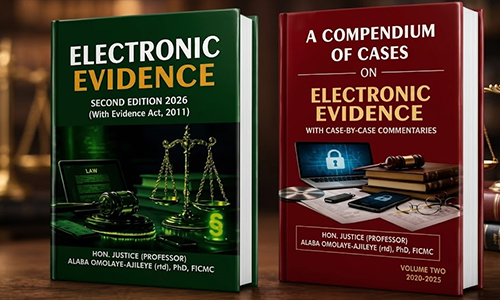
[A MUST HAVE] Evidence Act Demystified With Recent And Contemporary Cases And Materials

Available now for NGN 40,000 at ASC Publications, 10, Boyle Street, Onikan, Lagos. Beside High Court, TBS. Email publications@ayindesanni.com or WhatsApp +2347056667384. Purchase Link: https://paystack.com/buy/evidence-act-complete-annotation
______________________________________________________________________ “Enhance Legal Practice With Authoritative Reports” — Alexander Payne Offers Comprehensive Law Reports, Spanning Over A Century Of Nigerian Jurisprudence Interested buyers are encouraged to place their orders and enquiries via:
0704 444 4777, 0704 444 4999, 0818 199 9888
Website: www.alexandernigeria.com
Interested buyers are encouraged to place their orders and enquiries via:
0704 444 4777, 0704 444 4999, 0818 199 9888
Website: www.alexandernigeria.com
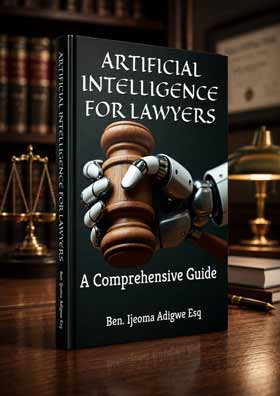 The book also examines Nigeria's legal ecosystem, focusing on the LPELR and NBA AI Guidelines. As a bonus, every purchase comes with a FREE eBook titled: How to Use the AI Features in LegalPedia and LawPavilion.
Ohio Books Ltd praises the publication, stating:
"....this is the only Nigerian book I know of on the topic."
How to Order:
📞 Call, Text, or WhatsApp: 08034917063 | 07055285878
📧 Email: benadigwe1@gmail.com
🌎 Website: www.benadigwe.com
Ebook Version: Access it directly online at https://selar.com/prv626
Authored by Ben Ijeoma Adigwe Esq., ACIarb (UK), LL.M, Dip. in Artificial Intelligence, Director at the Delta State Ministry of Justice, Asaba, Nigeria.
The book also examines Nigeria's legal ecosystem, focusing on the LPELR and NBA AI Guidelines. As a bonus, every purchase comes with a FREE eBook titled: How to Use the AI Features in LegalPedia and LawPavilion.
Ohio Books Ltd praises the publication, stating:
"....this is the only Nigerian book I know of on the topic."
How to Order:
📞 Call, Text, or WhatsApp: 08034917063 | 07055285878
📧 Email: benadigwe1@gmail.com
🌎 Website: www.benadigwe.com
Ebook Version: Access it directly online at https://selar.com/prv626
Authored by Ben Ijeoma Adigwe Esq., ACIarb (UK), LL.M, Dip. in Artificial Intelligence, Director at the Delta State Ministry of Justice, Asaba, Nigeria.