The Independent Corrupt Practices and Other Related Offences Commission has uncovered cases of ghost workers allegedly inserted into government payrolls, including an official who enrolled 14 members of his family and another who allegedly collected 13 salaries.

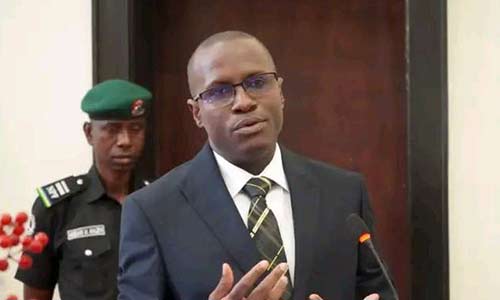
The ICPC Chairman, Musa Aliyu, disclosed this on Thursday in Abuja while delivering the keynote address at the 2026 Economic Confidential Lecture and National Spokespersons Award, organised by Image Merchants Promotions Limited.
Aliyu said the commission’s investigation into ghost workers had exposed how individuals manipulated government payroll systems to receive multiple salaries.
He said, “We discovered that one person enrolled 14 members of his family. He lived in a religious hotel, a hotel at the public office, receiving salaries.”
The ICPC chairman added that another individual allegedly enrolled his wife, daughter, son and other family members and received 13 salaries.
“Another person enrolled his wife, his daughter, his son, and others and was receiving 13 salaries. ” he said.
Aliyu said the commission had also identified about 900 suspected ghost workers and published their names, challenging them to prove that they were genuine employees.
“We now secured income of about 900 ghost workers, which we published their names in papers,” he said.
He explained that the commission subsequently spent about a year investigating the suspected ghost workers, uncovering the methods used to insert fictitious names into government payrolls.
“We spent one year, one single year, on ghost workers,” Aliyu said.
According to him, in some cases, the names of the alleged ghost workers appeared on official payrolls with email addresses, while the bank account details were linked to other individuals.
“When they insert their names, you will see their name in the payroll. You will see their email. But when you check the account number, you will see the name of the person. So, that is how these things have been done,” he explained.
Aliyu warned that the consequences of ghost workers extended beyond salaries, saying fraudulent entries could also result in ghost pensions, housing, health insurance and other benefits.
“Because, you know, once there is a ghost worker, there is ghost pension, there is ghost mortgage, there is ghost housing fund, there is ghost health insurance,” he said.
He said the commission’s intervention was aimed at protecting public resources and strengthening the economy, noting that fraudulent payroll practices imposed additional costs on the country.
The ICPC chairman also disclosed that the commission recovered more than N24bn in ghost pension funds in 2024.
“In 2024, we recovered over N24 billion ghost workers pension,” Aliyu said.
He said the commission had adopted cross-agency collaboration and other preventive measures to tackle corruption and recover government resources.
Aliyu stressed that the commission was increasingly focusing on preventing corruption and ensuring that government projects were properly executed rather than relying solely on criminal prosecution.
He said, “It is better for us to do that than to engage in filing criminal charges. How many charges can we file?.”
The ICPC chairman said the commission had recovered or secured government resources through interventions in projects and other areas, stressing that the ultimate objective was to ensure that Nigerians benefited from public expenditure.
He also called for greater use of data and technology in combating corruption, saying effective communication and access to reliable information were essential to building public confidence in anti-corruption efforts.
Earlier, the Chief Executive Officer of IMPR, Yusha’u Shuaib, said the lecture was organised to promote stronger governance through transparency, accountability and professional communication.
“We are honoured to host yet another gathering of leaders, professionals, scholars, and communication experts committed to strengthening governance, promoting transparency, and advancing excellence in public communication,” Shuaib said.
[A MUST HAVE] Evidence Act Demystified With Recent And Contemporary Cases And Materials

Available now for NGN 40,000 at ASC Publications, 10, Boyle Street, Onikan, Lagos. Beside High Court, TBS. Email publications@ayindesanni.com or WhatsApp +2347056667384. Purchase Link: https://paystack.com/buy/evidence-act-complete-annotation
______________________________________________________________________ “Enhance Legal Practice With Authoritative Reports” — Alexander Payne Offers Comprehensive Law Reports, Spanning Over A Century Of Nigerian Jurisprudence Interested buyers are encouraged to place their orders and enquiries via:
0704 444 4777, 0704 444 4999, 0818 199 9888
Website: www.alexandernigeria.com
Interested buyers are encouraged to place their orders and enquiries via:
0704 444 4777, 0704 444 4999, 0818 199 9888
Website: www.alexandernigeria.com