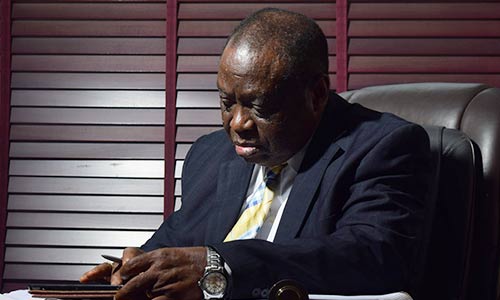
Former President of the Nigerian Bar Association, Chief T.J. Onomigbo Okpoko, SAN, has urged the Attorney-General of the Federation and Minister of Justice, Prince Lateef Fagbemi, SAN, to reject in its entirety the report of the three-member committee headed by Chief Wole Olanipekun, SAN, warning that relying on it could undermine the NBA’s constitutional and democratic structure.
Okpoko, the 18th President of the NBA, made the call in a six-page letter dated July 10, 2026, titled, “Chief T.J. Onomigbo Okpoko, SAN’s Brief Reaction to ‘Directions and Outcomes of the Honourable Attorney-General of the Federation, Prince Lateef O. Fagbemi, SAN, on the Report of the 3-Man Committee’ Headed by Chief Wole Olanipekun, SAN.”
He said his intervention was intended to draw the Attorney-General’s attention to what he described as fundamental errors in relying on the committee’s report as a basis for issuing directions or taking decisions concerning the NBA and its 2026 national election.
Okpoko acknowledged that he could not independently confirm who sent the document described as the AGF’s “Directions,” but maintained that it would be unsafe for the Attorney-General to rely on the Olanipekun committee’s report in resolving the controversy surrounding the election.
The former NBA President questioned the premise upon which the committee was established, particularly the reference to a “present conflict within the Nigerian Bar Association.”
According to him, he repeatedly reviewed the document but could not identify any dispute between the NBA and any person or organisation that would justify the intervention.
He argued that no party appeared to have a legitimate grievance against the NBA itself, adding that anyone claiming otherwise should clearly identify the conflict reflected in the documents.
Okpoko recalled that the AGF’s statement indicated that, following discussions with participants, Babatunde Ogala, SAN, counsel to the Incorporated Trustees of the NBA, proposed the establishment of a committee headed by Olanipekun and including Prince Lanke Odogiyon and former NBA President Paul Usoro, SAN.
The committee’s mandate included examining the causes of the disputes that led to the institution of court cases and recommending a way forward to the Attorney-General.
Okpoko, however, maintained that the choice of Olanipekun as chairman fundamentally compromised the committee’s work.
Okpoko argued that Olanipekun ought not to have accepted the appointment because of his membership and leadership role in Egbe Amofin O’odua, the association whose interests were at the centre of the controversy.
He noted that Egbe Amofin was the claimant in two suits filed before the Oyo State High Court and maintained that any action instituted by or on behalf of the association was binding on its members.
According to him, Olanipekun’s position as a member and leader of Egbe Amofin gave him an interest in the subject of the committee’s assignment and disqualified him from participating, much less presiding over it.
He invoked the established principle that nobody should be a judge in his own cause, arguing that Olanipekun should have declined the appointment.
“The appointment of Chief Wole Olanipekun, SAN, as a member and chairman of the committee involves conflict of interest,” Okpoko maintained.
He consequently argued that a report produced by a committee chaired by an interested party could not validly support any directive affecting the NBA election.
Okpoko also questioned the legal and constitutional status of Egbe Amofin within the NBA.
He said he searched through NBA records and minutes of meetings but found no evidence that Egbe Amofin was an accredited, affiliated or formally recognised organ of the association.
He therefore questioned the basis upon which the organisation sought to interfere in the NBA’s internal affairs and election process.
Addressing Egbe Amofin’s reliance on Paragraph 4, Part III of the Second Schedule to the NBA Constitution, Okpoko said the provision requiring positions zoned to a geographical region to rotate among the groups or sections within that zone did not transform Egbe Amofin into a constitutional NBA zone.
He maintained that Egbe Amofin was not a geographical zone within the meaning of the NBA Constitution and therefore lacked the standing to dictate who should contest an NBA national election.
According to him, any decision taken by Egbe Amofin in 2019 or 2020 to adopt a consensus arrangement was binding only on its members and had nothing to do with the NBA or its electoral process.
Okpoko explained that the objective of zoning was to rotate the office of NBA President among the recognised geographical zones, not to restrict the number of qualified candidates who could contest from a zone.
He said zoning was never designed to prevent an eligible lawyer from contesting merely because the person was not the preferred candidate of a regional association.
The former NBA President rejected the proposition that once a presidential office was zoned to a region, a particular organisation within that region could select a sole candidate and exclude all others.
According to him, Egbe Amofin’s decision to endorse a preferred aspirant was an internal arrangement without constitutional force over the NBA.
He argued that eligible lawyers must remain free to contest, while members of Egbe Amofin could campaign and vote for whichever candidate they preferred.
Okpoko also rejected the committee’s finding that the zoning of the NBA presidency began around 2000 when O.C.J. Okocha, SAN, from the South-East, contested against Olanipekun from the South-West.
He described that historical account as incorrect.
According to him, the zoning policy developed during the presidency of J.B. Daudu, SAN, and there was no South-West zone in the form suggested by the committee at the relevant time.
He explained that the former Western Zone comprised the five Yoruba states of the old Western Nigeria together with the former Bendel State, now Edo and Delta states.
Okpoko recalled that when former NBA Presidents Augustine Alegeh, SAN, and Olumide Akpata sought office, the fact that they came from the Western Zone did not prevent other candidates from the zone from contesting against them.
He said NBA members nationwide were allowed to choose their preferred candidates, with no regional association empowered to prevent participation in the election.
The Olanipekun committee had stated that Egbe Amofin traditionally invited expressions of interest from South-West aspirants, constituted a committee to engage them and eventually adopted one aspirant as its preferred candidate.
The report also stated that Egbe Amofin had developed a micro-zoning arrangement and, for the 2026 election, allocated the presidency to a sub-zone comprising Oyo and Osun states.
It listed four aspirants from the South-West as Aare Muyiwa Akinboro, SAN; Lateef Omoyemi Akangbe, SAN; Professor Foluke Dada-Lawanson; and Oyinkansola Badejo-Okusanya, SAN.
According to the committee’s account, Egbe Amofin constituted a six-member committee to interact with the aspirants and select its preferred candidate.
Okpoko, however, maintained that the practice was neither recognised by the NBA Constitution nor one the association could lawfully adopt.
He stressed that Egbe Amofin could not function as the machinery for selecting the NBA President and observed that no NBA presidential candidate had ever automatically been returned unopposed merely because a regional organisation endorsed that person.
Okpoko further challenged the description of Egbe Amofin as an umbrella body representing all lawyers in the South-West.
He explained that lawyers practising within the region were not limited to persons of Yoruba extraction but included Igbo, Northern, Edo, Urhobo, Isoko and other Nigerian lawyers.
He maintained that an organisation made up principally of lawyers of Yoruba extraction could not dictate who should contest an election in the broader Western Zone, which also included the old Mid-West.
According to him, the elections that produced Alegeh and Akpata demonstrated that a regional preference had never prevented other candidates from seeking the same office.
He accused the Olanipekun committee of attempting to prevent three of the four presidential aspirants from contesting, thereby infringing on their rights and the rights of Nigerian lawyers to elect their national president.
“This is unjust and unacceptable under any circumstances,” he said.
Okpoko questioned the authority under which Egbe Amofin could compel all other eligible candidates to withdraw simply because the organisation had adopted one aspirant.
He declared that “Egbe Amofin is not and cannot be the nominating and voting authority in the NBA election.”
Okpoko urged the Attorney-General not to allow his name and office to be associated with recognising Egbe Amofin as the nominating authority for NBA national elections.
He said the appropriate course was for Egbe Amofin members to support their preferred candidate through campaigning while allowing the other aspirants to pursue their ambitions freely.
According to him, recognising Egbe Amofin as the NBA’s nominating authority would amount to oppression and create a dangerous precedent for future elections.
“The NBA must not allow itself to be pushed into a pit dug by Egbe Amofin without knowing the depth of the pit and the danger it poses to the NBA, the largest Private Bar in Africa,” he warned.
Okpoko said the association should not be persuaded by the actions of Egbe Amofin and its leaders, insisting that every qualified lawyer should have the opportunity to contest national office as had historically been the practice.
He warned that permitting a regional body to control nominations could produce unforeseen consequences capable of destroying the association.
Drawing from his experience as a former NBA President, Okpoko recalled the institutional crisis that engulfed the association following its 1992 conference in Port Harcourt.
He said the legal profession endured a difficult period between 1992 and 1998 before stability was eventually restored.
Okpoko recalled that he became the 18th President of the association and participated in the difficult rehabilitation and revival of the Bar, committing his time, energy and personal resources to the effort.
He acknowledged the contributions of those who worked with him during that period, particularly Chief Afamogbo, SAN, whom he credited with bringing the NBA branches together as Chairman of Chairmen.
He also recognised senior lawyers and stakeholders from different parts of the country who helped provide records and support the association’s recovery.
The former NBA President cautioned the Attorney-General against endorsing any arrangement capable of returning the association to institutional instability.
He urged Fagbemi to take a second look at the controversy and reject the Olanipekun committee’s report in its entirety.
Okpoko concluded by praying that the Attorney-General would receive the wisdom and guidance required to examine the matter carefully and protect the NBA from what he described as the dangerous path being charted by Egbe Amofin.
 Interested buyers are encouraged to place their orders and enquiries via:
0704 444 4777, 0704 444 4999, 0818 199 9888
Website: www.alexandernigeria.com
Interested buyers are encouraged to place their orders and enquiries via:
0704 444 4777, 0704 444 4999, 0818 199 9888
Website: www.alexandernigeria.com

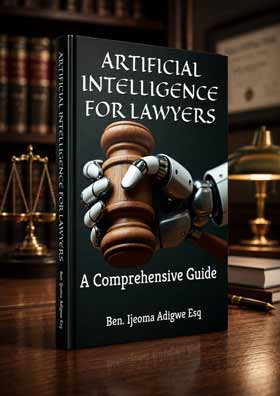 The book also examines Nigeria's legal ecosystem, focusing on the LPELR and NBA AI Guidelines. As a bonus, every purchase comes with a FREE eBook titled: How to Use the AI Features in LegalPedia and LawPavilion.
Ohio Books Ltd praises the publication, stating:
"....this is the only Nigerian book I know of on the topic."
How to Order:
📞 Call, Text, or WhatsApp: 08034917063 | 07055285878
📧 Email: benadigwe1@gmail.com
🌎 Website: www.benadigwe.com
Ebook Version: Access it directly online at https://selar.com/prv626
Authored by Ben Ijeoma Adigwe Esq., ACIarb (UK), LL.M, Dip. in Artificial Intelligence, Director at the Delta State Ministry of Justice, Asaba, Nigeria.
_______________________________________________________________________
The book also examines Nigeria's legal ecosystem, focusing on the LPELR and NBA AI Guidelines. As a bonus, every purchase comes with a FREE eBook titled: How to Use the AI Features in LegalPedia and LawPavilion.
Ohio Books Ltd praises the publication, stating:
"....this is the only Nigerian book I know of on the topic."
How to Order:
📞 Call, Text, or WhatsApp: 08034917063 | 07055285878
📧 Email: benadigwe1@gmail.com
🌎 Website: www.benadigwe.com
Ebook Version: Access it directly online at https://selar.com/prv626
Authored by Ben Ijeoma Adigwe Esq., ACIarb (UK), LL.M, Dip. in Artificial Intelligence, Director at the Delta State Ministry of Justice, Asaba, Nigeria.
_______________________________________________________________________