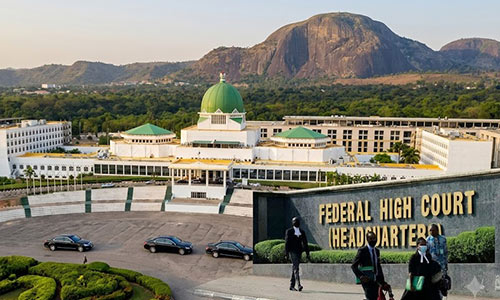
A young legal practitioner, who does not want his name to appear in the media for fear of being victimised, said Nigeria encourages such conduct by calling it smart politics rather than seeing it as a good opportunity for strengthening Nigerian institutions. He has been closely monitoring proceedings at the Federal High Court and the National Assembly and has raised a question that is increasingly being asked across Nigeria’s legal community: has the Federal High Court been hijacked, and has the National Assembly abandoned its constitutional responsibility to the Nigerian people?

The question is not rhetorical. It is grounded in three developments that occurred within a single tumultuous period: Justice Peter Lifu of the Federal High Court, Abuja, delivering a judgment ordering the deregistration of five opposition parties despite a subsisting Court of Appeal stay order; the National Assembly rushing the State Police Bill through passage without conducting the public hearings that constitutional amendment processes demand; and the Federal High Court in Lokoja setting aside its own earlier judgment that had directed INEC to register the Nigeria Democratic Congress (NDC) as a political party, in what Senior Advocates have described as a violation of the fundamental principle that a court of coordinate jurisdiction cannot set aside the judgment of another court at the same level.
But the young lawyer’s sharpest disappointment is reserved not for the judges or the legislators but for the senior lawyers who have defended these developments, some describing Justice Lifu’s defiance of the Court of Appeal as the “enrichment” of a judgment, others arguing that the judgment is “in order” and should simply be appealed, and still others insisting that judges cannot be “punished” for their judgments and that the appellate process is the only proper remedy.
“I Was In Justice Lifu’s Courtroom”
The young lawyer, who asked that the focus remain on the issues rather than on identity, described being present in Justice Lifu’s courtroom and witnessing firsthand a judge deliver a judgment that ordered the deregistration of five political parties despite a subsisting order from the Court of Appeal staying proceedings in the very same suit.
“I was in court. I watched Justice Lifu override the Court of Appeal despite the hierarchy. The Court of Appeal had granted a stay of proceedings on May 22. That means stop everything. Stop the hearing. Stop the judgment. Stop everything. But he went ahead,” the lawyer stated.
The lawyer noted a detail that has become one of the most discussed aspects of the controversy: “Law students from the Nigerian Law School were sitting in that courtroom to learn the law. They were there to observe how the judicial process works. And on that very day, what they witnessed was a judge openly violating the basic principle that a lower court must obey the orders of a superior court. What lesson did those students take away?”
The Court of Appeal subsequently described Justice Lifu’s conduct as “the highest form of judicial impertinence” and invoked the Supreme Court’s characterisation of judges who act in such manner as “unfit for the bench.” Okutepa SAN called it “judicial insubordination” and compared it to “a child looking at his father directly in the face and saying, ‘Daddy, you are stupid.'” Lawyer Liberous Oshoma noted that INEC itself had filed a counter-affidavit stating the affected parties met the constitutional threshold. Analyst Frank Tietie described Justice Lifu as being “on a mission to cause anarchy.”
Civil society organisations, including the Tap Initiative for Citizens’ Development, have petitioned the CJN and NJC demanding investigation and disciplinary action. The National Youth Wing of the ADC and other groups have demanded that Lifu be removed from the bench.
Prof. Chidi Anselm Odinkalu, CGoF, delivered a forensic three-point demolition of the judgment itself, identifying Justice Lifu’s use of the word “trial” in an originating summons proceeding, his invention of a defection exception to Section 225A that does not exist in the constitutional text, and his invocation of “arrest of judgment” authorities that have no application to a Court of Appeal stay order. Odinkalu described the judgment as evincing “a degree of criminal dishonesty that points to something extraordinarily pathological.”
Senior Advocate Ubani SAN questioned whether the judgment went beyond the Supreme Court’s position, raising concerns about the standing of the plaintiffs, whether INEC’s constitutional duty is self-executing or requires prior institutional determination, and whether the court’s order constituted an impermissible judicial substitution of administrative discretion.
State Police: “Where Was the Public Hearing?”
The young lawyer’s concern extends beyond the judiciary to the National Assembly, which passed the Constitution Alteration Bill establishing state police without conducting the public hearings that are a standard and expected component of constitutional amendment processes.
“A constitutional amendment is the most serious legislative act a National Assembly can undertake. It changes the fundamental law of the land. It affects every Nigerian. The convention, the practice, the expectation, is that before you amend the Constitution, you hold public hearings where citizens, legal experts, civil society organisations, traditional rulers, security professionals, and all stakeholders can come and express their views, raise concerns, and help shape the legislation,” the lawyer stated.
“That did not happen. The House of Representatives and the Senate rushed this bill through without giving Nigerians the opportunity to participate. On a matter as consequential as creating state police forces that will be controlled by governors, the National Assembly decided that the views of 200 million Nigerians were not worth hearing.”
The concern is not academic. High-profile figures have warned that rushing the legislation without public input fuels fears that governors will weaponise state police to suppress opposition, control elections, and harass political rivals. Senior Advocate Ubani SAN, while welcoming the passage of the bill as “a historic milestone,” cautioned that the reform cannot succeed without functional local government administration, independent oversight mechanisms, and professional recruitment insulated from partisan political interference.
“The question is not whether Nigeria needs state police. Many people agree that we do. The question is whether a constitutional amendment of this magnitude should be rushed through without hearing from the people it will affect. If the National Assembly cannot even follow its own processes on something this important, what confidence can Nigerians have that the bill itself contains the safeguards needed to prevent abuse?” the young lawyer asked.
Justice Isah Dashen “Is This What They Taught Us in Law School?”
The young lawyer described the Federal High Court Lokoja ruling with a mixture of bewilderment and professional concern, focusing on the legal principle rather than the political consequences.
On June 26, 2026, Justice Isah Dashen of the Federal High Court, Lokoja, set aside a previous judgment of December 10, 2025, that had directed INEC to register the NDC as a political party. Justice Dashen held that the original proceedings were constitutionally defective because they were conducted without hearing the Peace Movement Party (PMP), which asserted ownership over the party logo used by the NDC to secure its registration. The court ordered that the status quo be restored to what it was before the December 2025 judgment and directed that the substantive suit be heard completely afresh, with INEC, the PMP, and the NDC all properly joined as parties.
“In law school, we were taught a fundamental principle: a court of coordinate jurisdiction cannot set aside the judgment of another court of the same level. A Federal High Court judge cannot overrule or set aside the judgment of another Federal High Court judge. Only the Court of Appeal, which sits above both of them in the constitutional hierarchy, has the authority to do that. That is not a debatable proposition. It is elementary. Every law student learns it,” the young lawyer stated.
“So when I saw that a Federal High Court in Lokoja set aside a judgment that had already been delivered, acted upon, and complied with by INEC, I had to ask myself: is this what they taught us? Because what I learned says this is wrong. A party that believes it was affected by a judgment it was not part of has a remedy: apply to be joined as an interested party and file an appeal at the Court of Appeal. You do not go back to a court of the same level and ask it to vacate a judgment already delivered. That is not how the hierarchy works.”
Senior Advocates have confirmed the young lawyer’s understanding. John Olusola Baiyeshea, SAN, stated categorically that if a Federal High Court set aside a previous order for the registration of the NDC by another judge of the Federal High Court, “that is abominably wrong.” Dayo Akinlaja, SAN, argued that where a judge acts outside the permissible circumstances to set aside a judgment, such decisions could be regarded as improper. The NDC’s own National Secretary, Ikenna Enekweizu, a lawyer, stated that there are only two recognised grounds upon which a court can set aside its own judgment: where the judgment is a nullity or where it was obtained through fraud or false representation.
“What concerns me is not the politics of it. I am not here to defend any political party or any candidate. What concerns me is the principle. If a Federal High Court can set aside the judgment of another Federal High Court, or even its own earlier judgment outside the two recognised grounds, then no judgment of any Federal High Court is safe. Any judgment can be reopened, revisited, and vacated by any judge at the same level at any time. That destroys the finality of judgments, which is one of the pillars of the entire legal system,” the young lawyer stated.
“Since the December 2025 judgment, the NDC was registered by INEC, conducted nationwide membership registration, held ward, local government, state, and national congresses, held a national convention, conducted primary elections, participated in senatorial by-elections in Nasarawa and Enugu states, and nominated candidates for all elective offices. All of that happened on the strength of a subsisting judgment. And now a court of coordinate jurisdiction has vacated that judgment and ordered a return to the status quo ante. The question is not whether the PMP had a legitimate grievance. Maybe it did. The question is whether the Federal High Court was the right court to address it, or whether the PMP should have gone to the Court of Appeal. Based on everything I was taught, the answer is the Court of Appeal.”
“I Am Disappointed in the Senior Lawyers”
The young lawyer reserved particular criticism for senior members of the profession who have defended the controversial judicial actions, describing their positions as the “most disappointing aspect” of the entire crisis.
“Some senior lawyers are calling what Justice Lifu did the ‘enrichment’ of a judgment. Enrichment? He delivered a judgment in defiance of a Court of Appeal stay order. The Court of Appeal itself called it ‘the highest form of judicial impertinence’ and ‘judicial rascality.’ The Supreme Court’s own precedents say a judge who does this is ‘unfit for the bench.’ And some of our senior colleagues are calling it ‘enrichment’? What are they enriching? The destruction of judicial hierarchy?” the lawyer stated.
“Others are saying the judgment is ‘in order’ and should simply be appealed. That the appellate process will correct any errors. That judges should not be punished because of their judgments. With respect, this is not about punishing a judge for making an error of law. Every judge makes errors. That is what appeals are for. This is about a judge who was shown a Court of Appeal order and chose to ignore it. That is not an error. That is defiance. That is insubordination. That is a judge telling a superior court that its orders do not matter.”
The lawyer continued: “When senior lawyers defend this, what message are they sending to young lawyers? To law students? To the public? That the hierarchy of courts is optional? That a lower court can ignore a superior court’s order whenever it feels like it? That judicial accountability is only for judges who rule against the powerful?”
“I follow these senior lawyers. I read their opinions. I study their arguments. They are the people whose careers we aspire to build. And when they stand up and defend what the Court of Appeal itself called ‘judicial rascality,’ I am not just confused. I am disappointed. Deeply disappointed.”
“What Is Left of Democracy?”
The young lawyer summarised the cumulative effect of the three developments.
“In the space of one legislative session, the Federal High Court in Abuja has ordered the deregistration of five opposition parties in defiance of a superior court’s order. The Federal High Court in Lokoja has vacated the registration of a sixth opposition party in apparent violation of the coordinate jurisdiction principle. The National Assembly has passed a constitutional amendment on state police without a public hearing. And senior lawyers are defending all of it,” the lawyer stated.
“So I ask the question again: has the Federal High Court been hijacked? Has the National Assembly been hijacked? When lower courts ignore superior courts, when a court of coordinate jurisdiction sets aside a judgment it has no authority to touch, when the legislature skips public hearings on constitutional amendments, when six opposition parties face judicial elimination in a single period, and when the senior bar defends it all, what is left of the institutions that are supposed to protect democracy?”
“I am a young lawyer. I went to law school. I was taught that the hierarchy of courts is inviolable. That a court of coordinate jurisdiction cannot set aside the judgment of another court at the same level. That the Constitution is supreme. That public participation is essential to democratic governance. That the judiciary is the last hope of the common man. I believed all of it. I still want to believe it. But when I watch what is happening, I struggle.”
The Questions That Demand Answers
The young lawyer posed a series of questions that encapsulate the concerns of a generation of legal practitioners watching Nigeria’s institutions under stress.
Why did Justice Lifu proceed to deliver judgment despite a subsisting Court of Appeal stay order? Why has the NJC not acted on the petitions filed against him? Why did the National Assembly pass the State Police Bill without conducting public hearings? Why did the Federal High Court in Lokoja set aside a judgment of coordinate jurisdiction that had led to the registration and full operational activation of a political party with candidates, conventions, and by-election participation? Why are some senior lawyers defending judicial conduct that the Court of Appeal itself described as making the judge “unfit for the bench”? Why are other senior lawyers calling the violation of coordinate jurisdiction principles merely a matter for appeal rather than a systemic threat? And why does every controversial judicial action in this period benefit the same political interest?
“I do not have all the answers. But I know that when a young lawyer cannot trust the courts, cannot trust the legislature, and cannot trust the senior bar to call out what is wrong, something is fundamentally broken. And if we do not fix it now, before 2027, the consequences will be borne not by the judges who delivered the judgments, not by the legislators who skipped the hearings, and not by the senior lawyers who defended it all, but by ordinary Nigerians who depend on these institutions for justice, security, and democratic governance,” the lawyer concluded.
“The question is not whether the Federal High Court has been hijacked. The question is whether anyone is willing to do anything about it.”
[A MUST HAVE] Evidence Act Demystified With Recent And Contemporary Cases And Materials

Available now for NGN 40,000 at ASC Publications, 10, Boyle Street, Onikan, Lagos. Beside High Court, TBS. Email publications@ayindesanni.com or WhatsApp +2347056667384. Purchase Link: https://paystack.com/buy/evidence-act-complete-annotation
______________________________________________________________________ “Enhance Legal Practice With Authoritative Reports” — Alexander Payne Offers Comprehensive Law Reports, Spanning Over A Century Of Nigerian Jurisprudence Interested buyers are encouraged to place their orders and enquiries via:
0704 444 4777, 0704 444 4999, 0818 199 9888
Website: www.alexandernigeria.com
Interested buyers are encouraged to place their orders and enquiries via:
0704 444 4777, 0704 444 4999, 0818 199 9888
Website: www.alexandernigeria.com