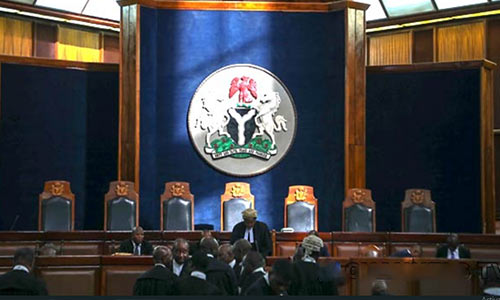
The Supreme Court of Nigeria has laid down an important principle on the recoverability of interest on money wrongfully withheld, holding that where a party holds on to the money of another for a long time without justification and thereby deprives the other party of the use of such funds, the withholding party should be liable to pay compensation by way of interest, even where interest was not expressly claimed in the action or provided for in the contract.

The decision was delivered in the case of Units Environmental Sciences Limited v. Revenue Mobilization, Allocation and Fiscal Commission, in a judgment by a five-member panel comprising Justices Ariwoola, Okoro, Augie, Aboki, and Agim, JJ.SC.
The Supreme Court overturned the Court of Appeal’s decision which had set aside both an arbitral award and the Federal High Court order enforcing it, holding that the Court of Appeal erred in finding that the award of pre-award interest by the sole arbitrator constituted misconduct and in setting aside the entirety of the award on that ground.
Units Environmental Sciences Limited (the appellant) and the Revenue Mobilization, Allocation and Fiscal Commission (the respondent) entered into a consultancy agreement in 2001 for the provision of consultancy services in respect of the commission’s staff housing development project at Mabushi, Abuja.
Under the agreement, professional fees for pre-contract services were to be paid immediately upon completion of such services, while fees for post-contract services were to be paid periodically as the work progressed. The agreement also contained an arbitration clause providing for the resolution of disputes through arbitration.
A dispute arose when the appellant claimed entitlement to the sum of N65,790,663.84 as outstanding professional fees and accrued interest. The evidence established that the appellant had rendered full services which were accepted by the respondent and from which the respondent derived benefit, but that the respondent made only a derisory payment of N4 million and thereafter failed to meet its obligations.
Pursuant to the arbitration clause, the dispute was referred to arbitration. At the conclusion of the arbitral proceedings, the sole arbitrator awarded the appellant N47,179,820.15 as outstanding fees, N33,934,139.53 as interest up to the date of the award, together with post-award interest at the rate of N982,912.92 per month (or N32,312.95 per day) until liquidation of the award, and N8,176,973.02 as costs.
The Lower Courts
Dissatisfied with the award, the respondent applied to the Federal High Court, Abuja, seeking to set it aside on the ground, among others, that the arbitrator had exceeded the scope of the parties’ agreement in computing the sums awarded. The appellant opposed the application and in a separate motion sought recognition and enforcement of the award. The Federal High Court struck out the respondent’s application to set aside the award and granted the appellant’s application for recognition and enforcement.
On appeal, however, the Court of Appeal reversed the Federal High Court’s decision. The appellate court held that the arbitrator lacked the power to award pre-award interest in the absence of an express contractual provision or evidence of a relevant trade custom. Since no agreement to that effect existed in the contract, the Court of Appeal held that the award of pre-award interest amounted to misconduct by the arbitrator. The appellate court consequently allowed the appeal and set aside both the arbitral award and the order granting leave to enforce it in their entirety.
The appellant appealed to the Supreme Court.
The Arguments
The appellant’s senior counsel argued that the Court of Appeal’s finding that the award of pre-award interest lacked factual and legal foundation was perverse and erroneous. He submitted that the evidence clearly established the appellant’s entitlement to interest on the ground that the appellant was deprived of the use of its money, which constituted damage naturally flowing from the respondent’s breach of its contractual obligations and within the reasonable contemplation of the parties.
He contended that the claim for pre-award interest was properly pleaded and proved by evidence that was not specifically controverted or challenged, and which the sole arbitrator duly accepted. He also relied on the fact that the contract stipulated the time for payment, arguing that damages for wilful and deliberate withholding of monies due under a contract may attract interest as damages in accordance with mercantile customs, even in the absence of an express agreement on interest.
The appellant’s counsel further submitted that even if the Court of Appeal was justified in setting aside the award of pre-award interest, it was not entitled to set aside the entirety of the arbitral award on that basis, as the issue of pre-award interest was severable from the other heads of the award. He maintained that the proper course would have been to remit the matter to the sole arbitrator rather than set aside the award, and that it was wrong for the Court of Appeal to interfere merely on the ground of error where such error did not appear on the face of the record.
The respondent’s counsel argued that the sole arbitrator acted in excess of jurisdiction by awarding pre-award interest. He submitted that the consultancy agreement did not contemplate any form of pre-award interest and that there was no credible evidence supporting it. He argued that the award of pre-award interest had no legal or contractual basis and was rightly set aside on the ground of misconduct. He also contended that since the appellant had sought enforcement of the entirety of the award before the Court of Appeal, it was no longer open to it to seek severance of the impugned portion on appeal.
The Supreme Court’s Decision
The Supreme Court resolved the issue in favour of the appellant, laying down several important principles on the award of interest in contractual disputes.
Interest as Compensation for Wrongful Withholding
The Supreme Court held that where a party holds on to the money of another for a long time without any justification and thereby deprives that other party of the use of such funds for that period, such party should be liable to pay compensation by way of interest, even where interest is not claimed in an action filed for the recovery of monies that were due and payable.
This principle establishes that the liability to pay interest in such circumstances does not depend on whether interest was expressly claimed in the originating process or expressly provided for in the contract. The wrongful deprivation of the use of money is itself the basis for the liability. The person who withholds money owed to another derives the benefit of using that money during the period of withholding, while the person entitled to the money suffers a corresponding loss. Interest compensates for that loss.
Equitable Jurisdiction to Award Interest
The Supreme Court further held that where there is a breach of a contract to pay money as and when due under a contract involving a breach of fiduciary duty, a court can exercise its equitable jurisdiction to award interest on the amount due and payable, even in the absence of an express provision in the contract for the payment of such interest as a consequence of the breach.
This principle extends the basis for awarding interest beyond statutory or contractual provisions to the court’s inherent equitable jurisdiction. Where a contractual relationship involves fiduciary duties, meaning duties of trust and confidence, and one party breaches those duties by failing to pay money when due, the court has the equitable power to award interest as a form of compensation, regardless of what the contract expressly provides.
Judicial Discretion on Interest Rate
The Supreme Court also addressed the practical question of what rate of interest should apply where interest is claimable but the exact rate has not been proved by evidence.
The court held that where interest is claimable or awardable in law or equity but the exact rate of interest is not proved by evidence, the court has the discretion to award a minimal or nominal rate of interest that meets the justice of the case, provided such discretion is exercised judicially and judiciously.
This principle gives courts flexibility to award interest at a rate that is fair and reasonable in the circumstances, rather than declining to award interest altogether simply because the claimant has not proved a specific rate. The court’s discretion must be exercised within the bounds of what is just, not arbitrarily.
Damages for Loss of Use of Money
The Supreme Court added a further dimension, holding that in situations where interest cannot be claimed or awarded on conventional grounds, damages or sums of that nature may still be granted as compensation for the loss of use of money due and not paid as and when due in breach of contract. Such loss, the court held, naturally flows from the breach and is within the reasonable contemplation of the parties.
This principle provides an alternative route to compensation even in cases where the strict requirements for awarding interest may not be met. Under the general law of damages, a claimant can recover compensation for losses that are a natural and probable consequence of the breach and that were within the reasonable contemplation of the parties at the time they entered into the contract. The loss of the use of money that should have been paid but was withheld is precisely such a loss.
Severability of Arbitral Awards
While the full details of the Supreme Court’s reasoning on the severability point were not set out in the available report, the court’s resolution of the issue in favour of the appellant implies that it accepted the argument that even if the Court of Appeal had been correct on the pre-award interest question (which the Supreme Court found it was not), setting aside the entire arbitral award was disproportionate when the interest component was severable from the principal sum awarded.
The Significance
The judgment carries significant implications for commercial and contractual disputes in Nigeria.
First, it establishes with Supreme Court authority that a party who withholds money owed under a contract for a prolonged period cannot escape the obligation to pay interest simply because the contract is silent on interest. The wrongful withholding itself generates the liability.
Second, it confirms that courts exercising equitable jurisdiction can award interest on money withheld in breach of fiduciary duty, even without an express contractual provision, broadening the circumstances in which interest can be recovered.
Third, it provides guidance to trial courts and arbitrators on how to handle claims for interest where the rate has not been specifically proved, empowering them to exercise judicial discretion to award a rate that meets the justice of the case.
Fourth, it reinforces the principle that arbitral awards should not be lightly interfered with by courts, and that where an objectionable component of an award is severable from the remainder, the proper course is to address the objectionable component without destroying the entire award.
For government agencies and public bodies that contract with private sector service providers and then delay or refuse payment, the judgment serves as a warning: the money owed does not remain static. Every day of unjustified withholding generates a potential interest liability that compounds over time. In the present case, the commission’s failure to pay N47 million in outstanding fees generated over N33 million in pre-award interest alone, with post-award interest continuing to accrue at nearly N1 million per month.
The Parties
The appellant, Units Environmental Sciences Limited, was represented by Dr Olumide Ayeni, SAN, Olutunde Abegunde, Esq., Olawale Oyebode, Esq., Favour Leonard Goin, Esq. (Mrs), and Adeniyi Olominu, Esq.
The respondent, Revenue Mobilization, Allocation and Fiscal Commission, was represented by Y. Garuba, Esq., and Austin Mwana, Esq.
The judgment is fully reported at (2022) 4 CLRN in association with ALP NG & Co.
[A MUST HAVE] Evidence Act Demystified With Recent And Contemporary Cases And Materials

Available now for NGN 40,000 at ASC Publications, 10, Boyle Street, Onikan, Lagos. Beside High Court, TBS. Email publications@ayindesanni.com or WhatsApp +2347056667384. Purchase Link: https://paystack.com/buy/evidence-act-complete-annotation
______________________________________________________________________ “Enhance Legal Practice With Authoritative Reports” — Alexander Payne Offers Comprehensive Law Reports, Spanning Over A Century Of Nigerian Jurisprudence Interested buyers are encouraged to place their orders and enquiries via:
0704 444 4777, 0704 444 4999, 0818 199 9888
Website: www.alexandernigeria.com
Interested buyers are encouraged to place their orders and enquiries via:
0704 444 4777, 0704 444 4999, 0818 199 9888
Website: www.alexandernigeria.com