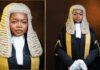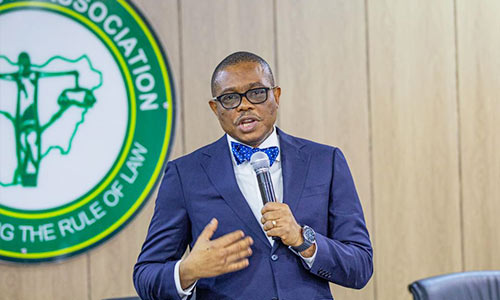
The President of the Nigerian Bar Association, Mazi Afam Josiah Osigwe, SAN, has declined calls from lawyers to issue an official NBA statement condemning the publicity stunt by Lagos socialite Pretty Mike of Lagos, who attended a 50th birthday celebration with 50 men and women dressed in full legal attire including wigs, gowns, and legal collars, stating that the NBA is “guided by laws not morals” and cannot condemn an issue that the law does not prohibit.

Osigwe made his position known in a detailed response to a member who had urged the NBA to issue a formal statement condemning Pretty Mike’s theatrical entrance, which had divided the legal community between those who viewed it as a creative tribute and those who saw it as a mockery of the legal profession and the Nigerian justice system.
Rather than issuing the condemnation that some lawyers had demanded, the NBA President posed six pointed rhetorical questions that systematically dismantled the case for official NBA action before delivering his conclusion in characteristically direct terms.
Osigwe structured his response around six questions that he used to guide his reasoning and explain why the NBA would not be issuing a statement.
First, he asked whether the stunt did not fall within the bounds of creative or even theatrical expression, framing the issue as one of artistic liberty rather than professional affront.
Second, he asked whether Pretty Mike used the robes or outfit to falsely claim official authority, mislead people, or impersonate a lawyer or court officer in a manner that could cause harm or confusion. The implied answer was that he did not, since the context was a birthday party, not a courtroom or a legal proceeding.
Third, he asked whether the context was not unmistakably one of entertainment rather than impersonation of actual lawyers, pointing to the obvious theatrical nature of the event as evidence that no reasonable person could have been misled into believing the 50 costumed individuals were actual legal practitioners.
Fourth, and perhaps most critically, he asked whether there is any law that bars or prohibits non-lawyers from wearing lawyers’ robes. “In other words, what power do we have to regulate the use of lawyers’ robes by non-lawyers for theatrical purposes or as a form of expression?” Osigwe asked. The question highlights the fundamental limitation on the NBA’s regulatory jurisdiction: the Rules of Professional Conduct for Legal Practitioners govern the conduct of lawyers, not the conduct of the general public.
Fifth, he asked whether the use of the robes in the birthday party context was not outside the regulatory purview of the legal profession since no actual legal practitioner was involved in the action or display. This question reinforced the jurisdictional point that the NBA regulates lawyers, not socialites or party guests.
Sixth, Osigwe posed the question that cut to the heart of the debate: “Does the dignity of the legal profession depend on what non-lawyers wear at birthday parties?”
The implied answer was a clear no, suggesting that the legal profession’s dignity is sustained by how lawyers themselves conduct their practice, not by whether entertainers use legal attire as costumes at social events.
Having posed his six questions, Osigwe delivered his conclusion with the kind of clarity that leaves no room for ambiguity.
“We are guided by laws not morals. I cannot issue a statement to condemn an issue that the law does not prohibit. That’d make us look intolerant or incapable of living with expressions we don’t like,” the NBA President stated.
The statement draws a sharp distinction between moral disapproval, which individual lawyers are free to express privately, and official institutional condemnation, which the NBA President argues must be grounded in law rather than sentiment. Osigwe’s position is that regardless of how individual lawyers feel about Pretty Mike’s stunt, the NBA as an institution cannot officially condemn conduct that falls outside its regulatory authority and that no law prohibits.
The reference to looking “intolerant or incapable of living with expressions we don’t like” suggests that Osigwe is conscious of the broader perception implications. An official NBA condemnation of a socialite’s birthday party attire could be seen as heavy-handed, humourless, and disproportionate, potentially inviting more ridicule of the profession than the original stunt itself generated.
Osigwe closed his response with an adapted quote from philosopher Debasish Mridha: “If someone criticizes you, disregard it if untrue, learn from it if justified, and ignore it if it is just meant to be unfair.”
Pretty Mike (Mike Eze-Nwalie Nwogu) attended the 50th birthday celebration of Lagos socialite Helen Ezisi with an entourage of 50 men and women fully dressed in professional legal attire, complete with wigs, gowns, legal collars, and tabs. He dedicated the entrance to the legal profession on his Instagram page, writing: “To the legal profession… The backbone of order, justice and structure in society, I have deep respect for lawyers.”
The theme of 50 costumed “lawyers” was designed to match the celebrant’s golden jubilee. The stunt continued at Pretty Mike’s luxury nightclub, Proxy Lagos, on Victoria Island, where the after-party was hosted.
The entrance came shortly after Pretty Mike’s own legal battles, in which a Federal High Court in Lagos cleared him of all alleged drug offences following a raid on his nightclub. His legal team, led by Dr Ojukwu, SAN, secured his complete discharge, an experience that may have influenced his decision to pay tribute to the profession that helped secure his freedom.
The stunt had generated divided reactions within the legal community before Osigwe’s intervention.
Some lawyers had called for the NBA to issue a formal statement, arguing that the use of legal robes, wigs, and collars by non-lawyers at a social event trivialises the solemnity of the legal profession and the administration of justice. They pointed to Rule 6(b) of the Rules of Professional Conduct for Legal Practitioners, which requires lawyers to maintain a “proper and dignified” appearance and provides that robes should generally not be worn outside court unless permitted by the Bar Council.
Others had argued that these rules apply to actual legal practitioners, not members of the general public, and that the NBA’s regulatory authority does not extend to policing what costumes socialites wear at private birthday parties.
One social media user had asked the question that prompted the public debate: “I hope the NBA would not feel disrespected about this?” Another wrote: “See how they were using the profession to play unnecessarily.” A third asked directly: “Is this legal?”
Osigwe’s response is significant for several reasons.
First, it establishes the NBA President’s official position that the stunt does not warrant institutional condemnation, effectively closing the door on the possibility of an NBA statement on the matter.
Second, it articulates a principle of institutional restraint that has broader implications for how the NBA responds to public events involving legal imagery. By stating that the NBA is “guided by laws not morals,” Osigwe has established a standard that would apply to future instances of non-lawyers using legal attire or imagery in entertainment, fashion, advertising, or other non-legal contexts.
Third, the response demonstrates a pragmatic awareness that the NBA’s credibility is better served by measured restraint than by reactive condemnation. An official statement against Pretty Mike’s stunt would have generated far more publicity for the socialite while exposing the NBA to accusations of being unable to distinguish between genuine threats to the profession’s integrity and harmless entertainment.
Fourth, the six questions Osigwe posed effectively provide a framework for lawyers to analyse similar situations in the future. If the conduct does not involve false claims of authority, does not mislead or cause confusion, is unmistakably entertainment rather than impersonation, is not prohibited by law, does not involve actual legal practitioners, and does not genuinely threaten the dignity of the profession, then it falls outside the NBA’s institutional concern.
Osigwe’s response confirms the legal analysis that had been circulating among lawyers in the days following the stunt. The Rules of Professional Conduct govern lawyers, not the general public. There is no law in Nigeria that specifically prohibits non-lawyers from wearing legal attire at social events. The offence of impersonation requires an element of deception or false representation of authority, which was absent in the birthday party context. And the NBA’s regulatory jurisdiction extends to the conduct of its members, not to the costume choices of entertainers.
The distinction between moral objection and legal prohibition, which Osigwe articulated clearly, is one that lawyers themselves frequently make in their professional practice. The NBA President’s response essentially applied the same legal reasoning to the association’s own institutional conduct that its members would apply in advising clients: you cannot condemn what the law does not prohibit, regardless of personal feelings about the conduct in question.
Neither Pretty Mike, Helen Ezisi, nor any representative of the celebrant has publicly responded to the NBA President’s statement as at the time of this report. Pretty Mike’s original Instagram post dedicating the stunt to the legal profession remains live.
[A MUST HAVE] Evidence Act Demystified With Recent And Contemporary Cases And Materials

Available now for NGN 40,000 at ASC Publications, 10, Boyle Street, Onikan, Lagos. Beside High Court, TBS. Email publications@ayindesanni.com or WhatsApp +2347056667384. Purchase Link: https://paystack.com/buy/evidence-act-complete-annotation
______________________________________________________________________ “Enhance Legal Practice With Authoritative Reports” — Alexander Payne Offers Comprehensive Law Reports, Spanning Over A Century Of Nigerian Jurisprudence Interested buyers are encouraged to place their orders and enquiries via:
0704 444 4777, 0704 444 4999, 0818 199 9888
Website: www.alexandernigeria.com
Interested buyers are encouraged to place their orders and enquiries via:
0704 444 4777, 0704 444 4999, 0818 199 9888
Website: www.alexandernigeria.com