The President of the Nigerian Bar Association (NBA), Afam Osigwe, SAN, has expressed concern over what he described as a growing crisis in the nation’s legal education system, blaming it on the disregard of admission quotas by several universities.

Speaking with journalists on Sunday, Osigwe noted that many law faculties were admitting students far above the limits set by the National Universities Commission (NUC) and the Council of Legal Education. This, he said, had created an overflow of graduates seeking admission into the Nigerian Law School, a development that has overwhelmed the institution’s facilities and staff.
“Too many universities are running law programmes without regard for the quota system. The result is an endless backlog of graduates, and the Law School is under pressure to accommodate them,” he said.
Osigwe warned that the yearly surge in Law School admissions had led to a sharp rise in the number of lawyers being called to the Bar, stretching the system to its breaking point. He, however, cautioned against outright denial of access to graduates, urging reforms that would strike a balance between university intakes and the Law School’s limited capacity.
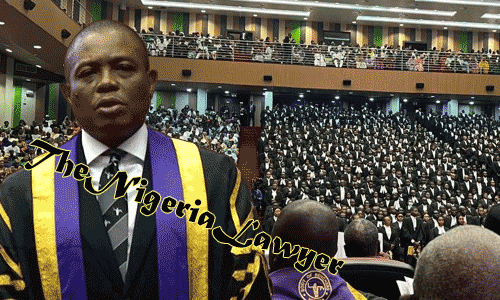
On the controversy surrounding invitation cards for Call to Bar ceremonies, the NBA president explained that the restriction to a single guest per graduate was necessary. According to him, the Body of Benchers had to consider space, safety, and crowd management, given the large number of candidates now admitted.
At the July Call to Bar exercise, 5,728 graduates were admitted in three days, while another 4,429 joined the roll of barristers between September 23 and 25. Osigwe stressed that allowing two guests per graduate, as was the case in earlier years, would overwhelm available facilities.
He acknowledged the inconvenience faced by families who would prefer to attend in larger numbers but maintained that the measure was unavoidable. “The hall has a limited capacity, and safety must remain a priority,” he said.
The Call to Bar ceremony is a statutory event conducted by the Body of Benchers to formally admit graduates of the Nigerian Law School as legal practitioners.
[A MUST HAVE] Evidence Act Demystified With Recent And Contemporary Cases And Materials

Available now for NGN 40,000 at ASC Publications, 10, Boyle Street, Onikan, Lagos. Beside High Court, TBS. Email publications@ayindesanni.com or WhatsApp +2347056667384. Purchase Link: https://paystack.com/buy/evidence-act-complete-annotation
______________________________________________________________________ “Enhance Legal Practice With Authoritative Reports” — Alexander Payne Offers Comprehensive Law Reports, Spanning Over A Century Of Nigerian Jurisprudence Interested buyers are encouraged to place their orders and enquiries via:
0704 444 4777, 0704 444 4999, 0818 199 9888
Website: www.alexandernigeria.com
Interested buyers are encouraged to place their orders and enquiries via:
0704 444 4777, 0704 444 4999, 0818 199 9888
Website: www.alexandernigeria.com