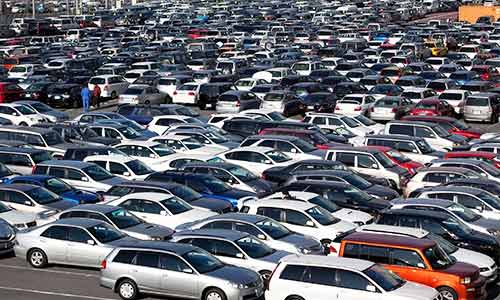
A new report by the UN Environment Programme (UNEP) has said millions of used cars, vans and minibuses exported from Europe, the United States and Japan to the developing world, including Nigeria, are of poor quality, contributing significantly to air pollution and hindering efforts to mitigate the effects of climate change.

The report shows that between 2015 and 2018, 14 million used light-duty vehicles were exported worldwide. Some 80 per cent went to low- and middle-income countries, with more than half going to Africa.
Used Vehicles and the Environment – A Global Overview of Used Light Duty Vehicles: Flow, Scale and Regulation, the first-ever report of its kind, calls for action to fill the current policy vacuum with the adoption of harmonised minimum quality standards that will ensure used vehicles contribute to cleaner, safer fleets in importing countries.
In general LDVs do not exceed a gross weight of 3.5 tons, and include saloon cars, SUVs and minibuses. Vehicles above 3.5 tons are categorized as Heavy Duty Vehicles (HDVs) and these include different types of trucks and buses.
The fast-growing global vehicle fleet is a major contributor to air pollution and climate change; globally, the transport sector is responsible for nearly a quarter of energy-related global greenhouse gas emissions. Specifically, vehicle emissions are a significant source of the fine particulate matter (PM2.5) and nitrogen oxides (NOx) that are major causes of urban air pollution.
“Cleaning up the global vehicle fleet is a priority to meet global and local air quality and climate targets,” said Inger Andersen, Executive Director of UNEP. “Over the years, developed countries have increasingly exported their used vehicles to developing countries; because this largely happens unregulated, this has become the export of polluting vehicles.”
“The lack of effective standards and regulation is resulting in the dumping of old, polluting and unsafe vehicles,” she added. “Developed countries must stop exporting vehicles that fail environment and safety inspections and are no longer considered roadworthy in their own countries, while importing countries should introduce stronger quality standards.”
The report, based on an in-depth analysis of 146 countries, found that some two-thirds of them have ‘weak’ or ‘very weak’ policies to regulate the import of used vehicles. However, it also shows that where countries have implemented measures to govern the import of used vehicles – notably age and emissions standards – these give them to access high-quality used vehicles, including hybrid and electric cars, at affordable prices. For example, Morocco only permits the import of vehicles less than five years old and those meeting the EURO4 European vehicles emission standard; as a result, it receives only relatively advanced and clean used vehicles from Europe.
The report found that African countries imported the largest number of used vehicles (40 per cent) in the period studied, followed by countries in Eastern Europe (24 per cent), Asia-Pacific (15 per cent), the Middle East (12 per cent) and Latin America (nine per cent).
Through its ports, the Netherlands is one of the exporters of used vehicles from Europe. A recent review conducted by The Netherlands of its exports found that most of these vehicles did not have a valid roadworthiness certificate at the time of export. Most vehicles were between 16 and 20 years old, and most fell below EURO4 European Union vehicles emission standards. For example, the average age of used vehicles exported to the Gambia was close to 19 years old, while a quarter of used vehicles exported to Nigeria were almost 20 years old.
“These results show that urgent action needs to be taken to improve the quality of used vehicles exported from Europe. The Netherlands cannot address this issue alone. Therefore, I will call for a coordinated European approach, and a close cooperation between European and African governments, to ensure that the EU only exports vehicles that are fit for purpose, and compliant with standards set by importing countries” Stientje Van Veldhoven, The Netherlands Minister for the Environment, said.
Poor quality used vehicles also lead to more road accidents. According to the report, many of the countries with “very weak” or “weak” used vehicles regulations, including Malawi, Nigeria, Zimbabwe, and Burundi, also have very high road traffic death rates. Countries that have introduced used vehicles regulations also see safer fleets and fewer accidents.
UNEP, with the support of the UN Road Safety Trust Fund and others, is part of a new initiative supporting the introduction of minimum used vehicles standards. The initiative’s first focus will be countries on the African continent; a number of African countries have already put in place minimum quality standards – including Morocco, Algeria, Côte d’Ivoire, Ghana and Mauritius – with many more showing interest in joining the initiative.
“The impact of old polluting vehicles is clear. Air quality data in Accra confirms that transport is the main source of air pollution in our cities. This is why Ghana is prioritising cleaner fuels and vehicle standards, as well as electric bus opportunities. Ghana was the first country in the West Africa region to shift to low sulphur fuels and this month has imposed a 10-year age limit for used vehicle imports,” said Prof. Kwabena Frimpong-Boateng, Ghana’s Minister for Environment, Science, Technology & Innovation.
Last month, the Economic Community of West African States (ECOWAS) set cleaner fuels and vehicle standards from January 2021. ECOWAS members also encouraged the introduction of age limits for used vehicles.
The report concludes that more research is needed to detail further the impacts of the trade in used vehicles, including that of heavy duty used vehicles.
[A MUST HAVE] Evidence Act Demystified With Recent And Contemporary Cases And Materials

Available now for NGN 40,000 at ASC Publications, 10, Boyle Street, Onikan, Lagos. Beside High Court, TBS. Email publications@ayindesanni.com or WhatsApp +2347056667384. Purchase Link: https://paystack.com/buy/evidence-act-complete-annotation
______________________________________________________________________ “Enhance Legal Practice With Authoritative Reports” — Alexander Payne Offers Comprehensive Law Reports, Spanning Over A Century Of Nigerian Jurisprudence Interested buyers are encouraged to place their orders and enquiries via:
0704 444 4777, 0704 444 4999, 0818 199 9888
Website: www.alexandernigeria.com
Interested buyers are encouraged to place their orders and enquiries via:
0704 444 4777, 0704 444 4999, 0818 199 9888
Website: www.alexandernigeria.com