*Says “Election Winners Should Emerge From The Ballot Box, Not The Courtroom”

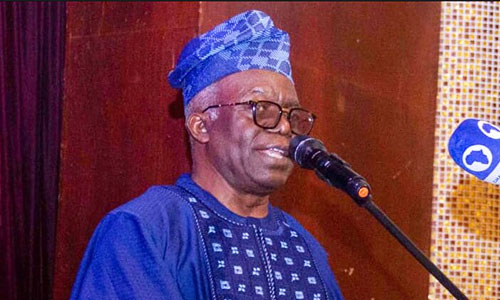
In this interview with LASISI OLAGUNJU, human rights lawyer, Mr. Femi Falana, SAN, speaks on the state of the nation, the erosion of democratic values and the future of democracy in Nigeria.
Falana said he entered the University of Ife in September 1977 to study English Language, intending to become a journalist, but was drawn into legal practice after witnessing the Olusegun Obasanjo military regime’s violent suppression of a student protest against the commercialisation of education, during which student leaders were dismissed, radical lecturers sacked, and NUNS lawyer, Chief Gani Fawehinmi, was arrested on a frivolous theft charge. He said the successful defence of Fawehinmi, mobilised by then Lagos Bar Association chairman, Comrade Alao Aka-Bashorun, impressed him, and that his study of Marxism, encountering lawyers such as Vladimir Lenin, Leonard Boudin, Fidel Castro, Nelson Mandela and Oliver Tambo, convinced him to join “the tribe of revolutionary lawyers.”
Falana said he has collaborated with progressive colleagues to defend victims of injustice across Nigeria and other African countries, helping to end indefinite detention without trial, secure the release of over 320 convicts through representations to African authorities, and save the lives of scores of people sentenced to death. He noted that the African Court on Human and Peoples’ Rights in Arusha, Tanzania, has upheld the Saharawi people’s right to self-determination based on his firm’s legal submissions, and that he remains the only Nigerian lawyer who appears before that court since its 2006 establishment. As president of the West African Bar Association, he said he campaigned successfully for the expansion of the ECOWAS Court’s mandate to cover human rights abuses in any member state.
He expressed regret, however, that Nigerian victims of violent attacks in other African countries have been denied access to the African Court because the Federal Government has failed to recognise it, limiting efforts to challenge the Cyril Ramaphosa administration over xenophobic attacks on Nigerians in South Africa. He said that while his firm has won socio-economic rights cases, the judgments have not been fully complied with, leaving him unfulfilled, adding that African resources continue to be expropriated by Western and Chinese companies at “give-away prices” alongside IMF and World Bank-imposed policies.
Addressing the ongoing dispute between the Oyo State Governor and the Federal Government over NLNG dividends, Falana said neither side’s position has resolved the underlying crisis of federalism. He said Governor Seyi Makinde’s claim that every state is entitled to N250 billion is misleading, but also disputed the Presidency’s claim that NLNG has paid roughly $21.5 billion in total cumulative dividends, with less than $3 billion received under the Tinubu administration, as incorrect. He commended Makinde, however, for drawing public attention to the matter.
According to Falana, NLNG has remitted $10.8 billion in taxes to the Federal Government since becoming tax-compliant in 2009, generated about $149.6 billion in revenue, and distributed $47.2 billion in total dividends across all four shareholders. He said the NNPCL received and diverted the $23.1 billion dividend owed to Nigeria based on its 49 percent NLNG stake, in violation of Section 162(1) of the Constitution. He said the National Assembly, the National Extractive Industry Transparency Initiative and the Revenue Mobilisation Allocation and Fiscal Commission have repeatedly, and unsuccessfully, called on NNPCL to remit the dividends since 1999. He disclosed that his firm had previously advised state governors to sue NNPCL to recover their share, but that the Nigeria Governors’ Forum had been reluctant to confront the corporation. He called for NNPCL to be directed to refund the $23.1 billion for distribution to the three tiers of government, and for NLNG to eventually remit dividends directly to the Federation Account without routing them through NNPCL.
Falana said the APC, ADC and NDC are “birds of a feather” on economic management, noting that Atiku Abubakar and Peter Obi commended President Tinubu when he announced subsidy removal, and that only Omoyele Sowore, Donald Duke and Adebayo among presidential candidates had not embraced the policy. He questioned how Nigeria arrived at the crisis, noting that the Federal Government spent between $18 and $25 billion over roughly two decades on turnaround maintenance of its four refineries, with the Buhari administration approving $2.9 billion for their rehabilitation in 2021, before NNPCL was directed to invest $2.6 billion for a 20 percent stake in the Dangote Refinery, a stake Dangote has said Nigeria holds only 7 percent of because NNPCL invested just $1 billion, a discrepancy NNPCL has not explained.
He said that following Tinubu’s May 29, 2023 announcement that subsidy was gone, alongside the merger of the dual foreign exchange rate and currency devaluation, fuel prices rose from N97 to N1,400 per litre, driving up the cost of other goods and services, while government also withdrew social service subsidies and introduced new taxes, worsening multidimensional poverty and eroding the N70,000 minimum wage.
He said it is true the government was spending about $10 billion annually funding the subsidy scheme, with the Directorate of Petroleum Resources estimating actual consumption at 38 million litres daily against NNPCL’s claimed 102 million litres, and the Nigeria Customs Service’s unanswered challenge to NNPCL to prove that 900 tankers were smuggling fuel out of Nigeria daily. He argued that, rather than simply announcing subsidy removal, Tinubu should have ordered a probe of the alleged fraud, which he said is still not too late to undertake. He proposed that with Nigeria now producing 1.8 million barrels of crude daily, as confirmed by the finance minister, the government could allocate 350,000 barrels per day for local refining, yielding over 55 million litres of petrol daily, more than domestic PMS consumption, rather than continuing to import fuel.
Referencing his definition of the Nigerian dream, given at the ITV and Radio Pre-Independence Lecture, as one of dignity, opportunity, justice and accountable government, Falana said that dream has been shattered by successive governments’ failure to meet basic responsibilities, citing widespread unemployment, insecurity and declining access to public services. He said the dream remains attainable, but not under current policies, and requires mobilising workers, students, farmers, artisans and other oppressed groups against both external economic domination and local collaborators. He said Nigeria needs not merely a change of personalities but a transformation of its political and economic order, describing this as a “revolution,” not necessarily violent, but a profound, people-driven transformation achieved through organised struggle and democratic participation.
Falana said responsibility for credible elections extends beyond INEC to political parties, security agencies, the courts and citizens, citing the Osun experience as demonstrating both the importance of transparent result management and the need for stronger enforcement against vote-buying. He called for INEC to strengthen accountability mechanisms, ensure meaningful public and party access to electoral information, guarantee independent verification of result discrepancies, and address recurring problems of inadequate preparation and technological failure, insisting that polling-unit results must remain the primary reference point for collation.
Falana expressed concern over courts of coordinate jurisdiction delivering irreconcilable decisions on INEC’s powers without legally sustainable distinctions, warning this creates uncertainty, encourages forum shopping, and exposes the electoral process to manipulation ahead of 2027. He said he retains faith in judicial reform and in judges who act with integrity, but insisted this must not translate into excusing misconduct, and called on lawyers to avoid judge-shopping or concealing binding authorities.
Falana reiterated that election winners should emerge from the ballot box rather than the courtroom, but clarified this does not mean courts should abdicate their responsibility to provide remedies where results are falsified, voters disenfranchised, or electoral laws substantially violated. He called for the investigation and prosecution of those who falsify results or corrupt electoral officials, warning that failure to impose consequences breeds impunity.
Clarifying his earlier criticism of executive-provided houses for judges, Falana said his objection is not to judicial welfare itself, which he supports, but to the method of provision and its constitutional implications, warning that discretionary executive benefits outside a transparent legal and budgetary framework could create an appearance of dependence, particularly in cases involving government. He called for judicial accommodation to be provided through properly budgeted, transparent mechanisms rather than as a personal benefit from the executive.
Falana attributed persistent kidnapping, terrorism, banditry and rural attacks to inadequate policing of rural communities, questioning how proposed state police structures would differ from existing poorly funded, ill-trained and ill-equipped state security agencies. While acknowledging state police will likely be established, he urged the National Assembly to delay their takeoff until after the 2027 general election, warning that premature deployment, given threats of violence linked to some governors and party leaders, could trigger large-scale electoral violence.
Falana described the 10th National Assembly as the most executive-minded since 1999, citing the approval of billions of dollars in external loans without debate, the approval of appointees without proper confirmation hearings beyond a ceremonial “take a bow and go,” and the failure to domesticate defence treaties, including one permitting American troops on Nigerian soil and mineral exploration, as required under Section 12 of the Constitution. He attributed this to the growing dominance of former governors in the Senate leadership and key committees, and accused lawmakers of compromising their oversight role by padding the budget with constituency projects despite lacking constitutional power to prepare the budget themselves.
Falana said forum shopping, conflicting court orders, prolonged litigation, disobedience of court orders and rising litigation costs have become entrenched features of the Nigerian legal system, serving the elite and bourgeoisie who patronise the higher courts. He said neither the Nigerian Bar Association nor the National Judicial Council is seriously addressing these problems, describing himself as mobilising progressive lawyers toward alternative dispute resolution and demanding stronger representation for poor litigants through the Legal Aid Council and Public Defender offices, alongside full interrogation of Customary, Area and Sharia Courts, which he said are the courts actually patronised by ordinary Nigerians. He dismissed the notion of the judiciary as “last hope of the common man” as a myth, given that most citizens lack the financial means to access the courts of record.
Falana said Nigeria has experienced 26 years of uninterrupted civilian rule, but not democracy, citing constitutional eligibility requirements that exclude roughly 60 million illiterate adults from contesting elections, and the dominance of “money bags” among the literate population able to afford nomination and campaign costs running into billions of naira. He cited the EFCC Chairman’s disclosure that some politicians spent between N20 billion and N30 billion to win primary elections alone, describing the resulting system as “plutocracy” rather than democracy, which excludes teachers, lecturers, lawyers, doctors, farmers, engineers and journalists from political participation. He predicted that the current pattern of thuggery, violence, killings and vote-buying cannot be sustained indefinitely, foreseeing a “violent political eruption” leading to what he described as a revolutionary overthrow of the existing order, and called for the struggle against minority rule to be waged after the 2027 general election.
[A MUST HAVE] Evidence Act Demystified With Recent And Contemporary Cases And Materials

Available now for NGN 40,000 at ASC Publications, 10, Boyle Street, Onikan, Lagos. Beside High Court, TBS. Email publications@ayindesanni.com or WhatsApp +2347056667384. Purchase Link: https://paystack.com/buy/evidence-act-complete-annotation
______________________________________________________________________ “Enhance Legal Practice With Authoritative Reports” — Alexander Payne Offers Comprehensive Law Reports, Spanning Over A Century Of Nigerian Jurisprudence Interested buyers are encouraged to place their orders and enquiries via:
0704 444 4777, 0704 444 4999, 0818 199 9888
Website: www.alexandernigeria.com