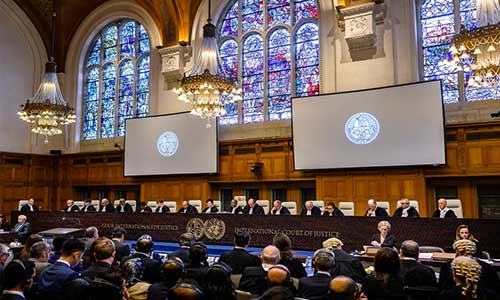
*The UN General Assembly and the Security Council will elect 5 judges (out of 15) on November 11

On 11 November 2020, during its 75th session, the UN General Assembly and the Security Council will elect 5 judges (out of 15) for a term of office of nine years, starting on 6 February 2021. There are currently 8 candidates for the election, out of which only 3 are women.
The current ICJ bench is composed of 12 men and 3 women. The women are Judges Xue Hanqin (China), Joan E. Donoghue (United States) and Julia Sebutinde (Uganda). Judges Hanqin and Sebutinde are currently running for re-election. The third candidate is Maja Seršić (Croatia). The only other woman to have served as a judge since the ICJ’s establishment in 1946 is Dame Rosalynn Higgins, who served on the Court from 1995 to 2009.
The ICJ, the highest global court and principal judicial organ of the United Nations, holds an embarrassing record when it comes to gender representation. As such, since its establishment in 1946, of the 108 ICJ judges who have served on the Court, only 4 have been women. Additionally, 4 women have served as ad hoc judges as compared to 113 men. According to article 2 of the Statute of the ICJ, members of the Court are to be elected, regardless of their nationality, from among persons of high moral character, who possess the qualifications required in their respective countries for appointment to the highest judicial offices. Article 9 requires that the General Assembly and Security Council consider the representation of the main forms of civilization and of the principal legal systems of the world.
While consideration of gender diversity is not a formal requirement, the GQUAL Campaign considers that, when electing judges, the General Assembly and the Security Council must take into account gender representation on the Court in accordance with fundamental principles of international law, such as the principle of non-discrimination, the right to equality and the right of access to decision-making. These fundamental rights are envisaged in the UN Charter, the Universal Declaration of Human Rights, the International Covenant on Civil and Political Rights and the International Covenant on Economic, Social and Cultural Rights, among other international instruments.
Article 8 of the Convention on the Elimination of all Forms of Discrimination Against Women (CEDAW), enjoins States to take measures to allow women equal opportunities to work in international organizations. Additionally, Sustainable Development Goal No. 5 urges States to include women in decision-making positions at all levels. The General Assembly recognizes in its Resolution 66/130 that women’s “active participation at all levels of decision-making is essential to the achievement of equality, sustainable development, peace and democracy”.
Considering the above, the General Assembly and the Security Council have a special duty to ensure that the ICJ’s composition reflects gender diversity, taking into account that international justice is served best, is more legitimate and effective when the bodies that impart it combine, in equal terms, the perspectives of qualified, independent, and diverse people.
[A MUST HAVE] Evidence Act Demystified With Recent And Contemporary Cases And Materials

Available now for NGN 40,000 at ASC Publications, 10, Boyle Street, Onikan, Lagos. Beside High Court, TBS. Email publications@ayindesanni.com or WhatsApp +2347056667384. Purchase Link: https://paystack.com/buy/evidence-act-complete-annotation
______________________________________________________________________ “Enhance Legal Practice With Authoritative Reports” — Alexander Payne Offers Comprehensive Law Reports, Spanning Over A Century Of Nigerian Jurisprudence Interested buyers are encouraged to place their orders and enquiries via:
0704 444 4777, 0704 444 4999, 0818 199 9888
Website: www.alexandernigeria.com
Interested buyers are encouraged to place their orders and enquiries via:
0704 444 4777, 0704 444 4999, 0818 199 9888
Website: www.alexandernigeria.com