*5% of Nigeria’s rice harvest destroyed by flood

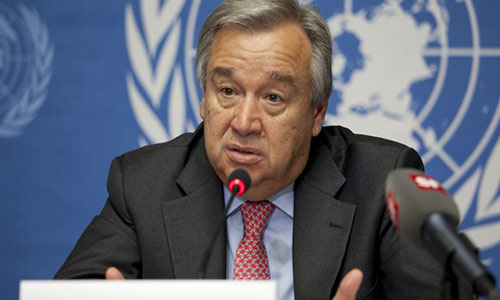
The United Nations Secretary-General Antonio Guterres has warned of a risk of famine and widespread food insecurity in Nigeria and three other African countries affected by conflict and the lives of millions of people are in danger.
The other countries are Congo, Yemen, and South Sudan.
Already about two million tons of rice has been washed away by floods, according to the Rice Farmers Association of Nigeria in Kebbi State.
That is more than 25% of the previously projected national output of 8 million tons.
In a note to Security Council members, the UN chief said the four countries rank “among the largest food crises in the world,” according to the 2020 Global Report on Food Crises and recent food security analyses. But funding to help is very low, he said.
“Action is needed now,” Guterres said.
Having endured years of armed conflict and related violence, the people of the Democratic Republic of the Congo, Yemen, northeast Nigeria and South Sudan are again facing the specter of heightened food insecurity and potentially famine.”
The U.N. chief said key indicators “are similarly deteriorating” in a number of other conflict-hit countries including Somalia, Burkina Faso and Afghanistan.
“The situation varies from country to country, but civilians are being killed, injured and displaced; livelihoods are destroyed; and availability of and access to food disrupted, amid growing fragility,” Guterres said.
“At the same time, humanitarian operations are attacked, delayed or obstructed from delivering life-saving assistance.”
He said food insecurity in conflict-affected countries “is now further exacerbated by natural disasters, economic shocks and public health crises, all compounded by the COVID-19 pandemic.”
According to the secretary-general´s note, “alarming levels of food insecurity and hunger have arisen largely as a result of the actions” of extremists affiliated with armed groups in Borno, Adamawa and Yobe States in Nigeria.
Guterres said estimates suggest more than 10 million people in the three states – about 80% of the population – need humanitarian assistance and protection, an almost 50% increase since last year and the highest recorded since humanitarian operations began. Yet, the U.N. appeal is only 33% funded, its lowest level, he said.
The note says escalating violence in volatile eastern Congo “is again driving disastrous levels of food insecurity and hunger,” and the latest analysis “indicates that over 21 million people are in crisis or worse levels of acute food insecurity.”
With only 22% of the U.N. humanitarian appeal currently funded, Guterres said, “core programs will need to be reduced or suspended.”
In Yemen, where the international community mobilized to prevent famine two years ago, he said, “the risk is slowly returning.” Escalating conflict and economic decline brought the Arab world´s poorest nation to the brink of famine two years ago, and similar conditions and worsening key indicators are emerging today, he said.
A recent survey indicated that 3.2 million people in government-controlled areas are now “highly food insecure,” and food prices are 140% higher than averages before the conflict began in 2015, Guterres said. “But with only 24% of humanitarian requirements funded in 2020, agencies are now forced to reduce or close core programs.”
In South Sudan´s Jonglei and Greater Pibor administrative area, Guterres said the situation deteriorated rapidly in the first half of 2020, “fueled by escalating violence and insecurity,” Guterres said.
Fighting has been accompanied by widespread attacks on agricultural and pastoral land and the looting of livestock and food, leaving more that 1.4 million people in the area “facing crisis or worse levels of acute food insecurity, he said. In addition, at least 350,000 children suffer from severe or moderate acute malnutrition.”
Guterres said the latest outlook from the Famine Early Warning Systems Network “is flagging worsening catastrophe conditions … in areas affected by the violence.”
Nigeria loses 25% of rice harvest to floods
About two million tons of rice is believed to have been washed away by floods in the country.
That is more than 25% of the previously projected national output of 8 million tons.
At least 450,000 hectares (1.2 million acres) were destroyed in the main rice-growing Kebbi State, according to the state chairman of the Rice Farmers Association of Nigeria, Alhaji Mohammed Sahabi.
Farmers had targeted a 2.5 million ton contribution to the national basket, but will now meet less than 20% of the target.
These were similar losses in Kano, Niger, Enugu, Jigawa and Nasarawa.
“Although we heard the forecast of flooding this year, we didn’t expect that the damage will be of this magnitude,” Sahabi said.
“Our target at state level was 2.5 million tons this year, but now we are looking at only 500,000 tons of harvest.”
President Muhammadu Buhari had expressed shock over the death of six persons and economic losses estimated to be about N1 billion to flood by rice farmers in the State.
He described the unfortunate development as a major setback in his administration’s efforts towards boosting local food production.
He said: “I am particularly sad over this incident because it’s a setback to our efforts to boost local rice production as part of measures to stop food importation.
“Kebbi State is the focal point of our policy to produce rice locally as part of this administration’s commitment to agricultural revival which suffered relative neglect in favour of food importation.
“With the loss of six lives and still counting, thousands of hectares of land flooded and estimated economic losses of more than one billion naira by rice farmers in Kebbi State, we face a major setback in our efforts to boost local food production.
“This bad news couldn’t have come at a worse time for our farmers and other Nigerians who looked forward to a bumper harvest this year in order to reduce the current astronomical rise in the costs of food items in the markets.”
Nigeria’s rice production was about 6.7 million tons in the last three years.
Rice imports declined by 200,000 tons in 2020 from 1.2 million tons last year as price-sensitive consumers switch to local staples.
[A MUST HAVE] Evidence Act Demystified With Recent And Contemporary Cases And Materials

Available now for NGN 40,000 at ASC Publications, 10, Boyle Street, Onikan, Lagos. Beside High Court, TBS. Email publications@ayindesanni.com or WhatsApp +2347056667384. Purchase Link: https://paystack.com/buy/evidence-act-complete-annotation
______________________________________________________________________ “Enhance Legal Practice With Authoritative Reports” — Alexander Payne Offers Comprehensive Law Reports, Spanning Over A Century Of Nigerian Jurisprudence Interested buyers are encouraged to place their orders and enquiries via:
0704 444 4777, 0704 444 4999, 0818 199 9888
Website: www.alexandernigeria.com
Interested buyers are encouraged to place their orders and enquiries via:
0704 444 4777, 0704 444 4999, 0818 199 9888
Website: www.alexandernigeria.com