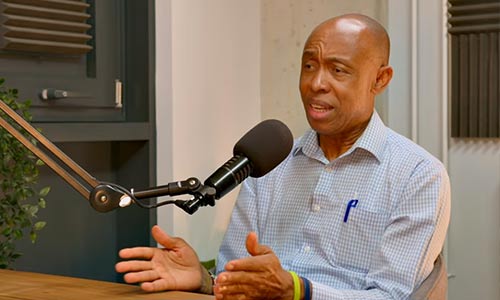
Professor of law and former Chairman of the National Human Rights Commission, Chidi Anselm Odinkalu, has said that the current proposal for state police amounts to handing existing militias over to state governors with guns, uniforms and legal cover, and that a country which has never legitimised itself in the imagination of its own citizens cannot solve its security crisis by multiplying the number of police forces.


Odinkalu spoke in an extended interview covering the state of the Nigerian project, policing doctrine, insecurity and the abduction economy, the history of atrocity in Nigeria, and the capture of the judiciary, which is the subject of his recent book on how judges have displaced voters in determining who holds office.
“A State Building Project That Was Never Legitimised”
Asked for a broad view of Nigeria’s political condition, Odinkalu said he preferred to take a structural rather than a symptomatic view.
“Nigeria is a state building project,” he said. “It is also a postcolonial project, and the thing about postcolonial projects, particularly in Africa, is that most of them were invented by foreigners. In Nigeria’s case, of course, by the Brits.”
He said the omission at independence has shaped everything since. “At independence, we did not really undertake the process or project deliberately of trying to legitimise that colonial invention. And that is really what we are struggling with here. Most of the things that we are grappling with are symptoms of that underlying historical vacuum.”
He described that vacuum as the absence of a deliberate effort to achieve a consensus legitimising the Nigerian state in the eyes of its component parts, both as to peaceful coexistence and as to the structures of political authority.
The consequence, in his account, is a country treated as spoil by those who govern it. Using a metaphor he himself flagged as uncomfortable, he described Nigeria as a victim of repeated collective violation “who does not have access to any form of remedies, or any hope at the moment of remedies,” at the hands of insiders and outsiders alike. He said the situation can be ended, but only if the country steps back and rethinks how it is run.
“United By A Sense Of Exclusion”
Odinkalu traced the failure to two omissions in the 1979 settlement, which he said followed the guillotining by the military of the constituent assembly debate on religion and sharia.
He listed the elements of that settlement as presidentialism, separation of powers among the three arms, federalism with a very powerful centre and progressively weaker states “most of whom cannot actually survive on their own,” the chapter on fundamental objectives and directive principles, and the fundamental rights chapter first introduced in 1959.
“But the underlying project of state legitimacy and coexistence was actually not addressed. The other thing that was not addressed was power sharing, and how power is supposed to be governed and transitioned among the various elements of Nigeria. Those are the two issues that are the heart of the Nigerian project,” he said.
He added: “When people do not feel that they have a stake in the country, they are liable to tear it down.”
On the present state of national feeling, he was blunt. “The only thing that unites the country at the moment is mutual disaffection. Wherever you come from, different people believe the others are having it better. So everybody is united by a sense of exclusion, apart from a core of an elite who have been at the centre for the most part through themselves and their children and their children’s children, with a few new recruits.”
He set that against the country’s diversity, putting Nigeria at about 389 ethnic groups and over 500 linguistic groups, with Adamawa State alone containing 89 ethnic groups, Kaduna 56 and Plateau 55. He contrasted it with Kenya and Ethiopia, where he said two large groups can combine to form an effective political majority, noting that in Nigeria no two ethnic groups can reach 50 per cent, which makes the mechanism for interethnic coexistence a standing challenge.
“You Cannot Have Expeditionary Policing For A Postcolonial State”
Turning to policing, Odinkalu said the subject dramatises the legitimacy problem more sharply than any other.
“Policing expresses the most fundamental obligation and power of the state with respect to guaranteeing safety and security of everyone who lives in its territory. But first of all, the state has got to accept the obligation, accept everyone that lives within its territory as equal, and commit itself to showing that it does. In Nigeria, that is not the case, at least that is not the perception.”
He located the cause in institutional inheritance. “Police started off as an expeditionary colonial force. By 1960 at independence, it had been in existence for 99 years. Pretty much a century of expeditionary colonial policing. We did not seek to transform it into an institution for a postcolonial territory.”
He set out three models: policing by consent, which he attributed to Robert Peel in the United Kingdom around 1829 and 1830; coercive policing, which he associated with the United States; and the expeditionary or colonial model. “In Nigeria we never tried to work our way through any of those. What we did was basically to continue with the colonial policing doctrine and colonial policing model, which is expeditionary. You cannot have expeditionary policing for a postcolonial state. It does not work. And that is why our policing has not worked. It is structural.”
Asked which model he would recommend, he declined to prescribe for a country of over 200 million, saying it is for the country and its people to examine the models and decide, or to invent their own. He did, however, rule two out. On fatal encounters between police and residents, he said, “the US model presents significant problems,” while “the colonial model is an atrocity model of policing, and so it doesn’t seem to me to be an option.” Adapting policing by consent to a postcolonial, multiethnic and fractured society is possible, he said, “but that requires work. It requires political imagination. It requires adaptation. Are we prepared to do that? No.”
“That Is Not Policing. That Is Legislated Banditry”
On the state police proposal itself, Odinkalu said his objection is not to decentralisation but to the manner of it.
“Decentralisation is settled. But how do you do it, in order to ensure one thing: do no harm? In the therapeutic enterprise the first rule is actually do no harm.”
He said the present proposal fails that test. “What we are talking about as state police is basically taking militias and handing them over to the state governors and encouraging the state governors to give them weapons and uniforms. That is not policing. That is legislated banditry.”
He named the formations he expects to be converted, saying that existing vigilante and militia outfits in the North, in Anambra, in Imo and in Benue would simply become state police. “Now, is that really what you want?”
He said the effect would be to multiply the problem rather than solve it. “What you are doing is basically multiplying expeditionary policing from one, which is the federal police at the moment, to 37, which is federal police plus 36.”
“108,000 New People Into The Police At A Go”
Odinkalu set out an arithmetic he said the country has not confronted.
“Let us just assume each state gets 3,000 people minimum or average. That is 3,000 times 36. That gives you 108,000 new people into the police at a go. There are no training institutions to train them.”
He continued: “Doctrine does not exist in the Nigerian police force. There are no training institutions to throughput 10,000 people, 5,000 people into a new police. And you are talking about bringing along 108,000 people in one go. In terms of training, in terms of doctrine, in terms of weapons handling, in terms of law enforcement skills, it is a recipe for disaster.”
He linked that to the fiscal question. Noting that the police is the oldest institution in Nigeria, its largest employer of labour and the most expensive to run, with security the largest line item in official appropriations, he asked how states are to bear that burden on their current revenues. “What you are doing in effect is giving them this huge power and telling them to owe people to whom they are going to give guns and uniforms. When you give uniforms and guns and laws granting them extensive powers to these people, and then you are owing them or not paying them properly, you basically create armed robbers.”
He also framed the constitutional dimension. “If you are talking about state police you are talking fundamentally about the deconcentration of federal prerogatives, the redistribution of the prerogatives in the exclusive legislative list. In the exclusive legislative list, no prerogatives are more critical than the control of police and the armed forces.”
He said the country is not even having the conversation. “We are not allowed to have a debate about what is going to happen. Not even legislators in the National Assembly who are supposed to pass the stuff are having a debate about what they are being told to pass. In that case you cannot be talking about state police. You and I cannot even have an intelligent conversation, because we don’t know what is being discussed.”
“We Have Normalised Abnormality”
Odinkalu rejected the common framing of the debate, which asks how a state police would behave under one governor as against another.
“Think about the United Kingdom. You have a mayor of London, you have Manchester, Liverpool. Somebody comes and tells you that the extent of the powers and the brutality of Greater Manchester Police depends on Andy Burnham, and the reach or civility of the London police depends on the mood of the mayor. You would say, are you okay? But in Nigeria, we have normalised that.”
He said the framing is itself the danger. “The idea that the performance of a police unit, force or service would depend on the brutality or civility of the governor should cause everybody to pause. If you are establishing police as a toy or plaything of the governor at any point in time, and not as an instrument for protecting law and order and justice, you have got a difficulty.”
He also corrected the premise that policing exists to fight insecurity. “That is not the role of the police. The police is an instrument for enforcement of law. The primary responsibility for internal security is with the state security service, or what people now call the DSS, and on the more recent doctrine, with the army. Police enforces laws equally among citizens. Where the police has to deploy lethal force, that is an exception, and the mechanisms and circumstances are very clear.”
“It Is A Value Chain”
On insecurity, Odinkalu rejected the suggestion that Nigeria’s leaders lack imagination.
“I don’t think our leaders lack imagination. When they want to trigger it they trigger it and it works magically. It seems to me there is evident complicity,” he said, referring to accounts by other researchers describing complicity in the abduction economy.
He described kidnapping for ransom as an established industry. “It is a value chain. It is a trillion naira industry in all likelihood.”
He said the enterprise is one of the clearest examples of collaboration across the divides the country is told are unbridgeable. “Despite all the manufactured divisions between different parts of Nigeria, the collaborations across those divides are often missed, and one of the places in which those collaborations have been quite evident is in atrocity crimes.”
He traced the origin of the joint enterprise between elements in the state sector, ransom negotiators and kidnappers to the Niger Delta at the turn of the millennium, and corrected the record on school abductions, saying the first in Nigeria was not Chibok but the abduction of 15 school children from an international school in Aba, Abia State, in about September 2010 by a figure he named as a pioneer bandit, who was tracked down and reportedly killed in the borderlands between Abia and Rivers, after which those operations ceased.
“Bosso Does Not Have More Than 115 Police Officers”
Odinkalu argued that the geography of policing has been ignored in the allocation of security assets.
He compared Abia State, at just under 6,000 square kilometres, with Niger at 76,800, Borno at about 70,300, Taraba at over 57,000 and Kaduna at 41,000, noting that southern Kaduna alone is the size of the entire South East, that Ogun at over 28,000 square kilometres is the fourteenth largest state, and that thirteen states are individually larger than the whole South East. Northern Nigeria, he said, is 71 per cent of the country’s land mass.
He then gave what he called a dramatisation of the problem. The largest local government area in Nigeria, he said, is about 11,600 square kilometres, roughly the size of Imo and Abia combined, and it has no more than about 115 police officers deployed to all of it. “Of course it is overrun with so-called bandits, because you cannot police that territory with that minuscule number of police officers.”
He said that theatre requires a different approach entirely. “If you are going to be policing there, you need technology integrated into operations, a nimble operational capability, transport logistics, air operations capabilities, and all of that needs to be governed by technology. If you do not have those, you are not making any progress.”
“Equal Citizenship” And The Cases Nobody Talks About
Odinkalu said the disparity in state response to abductions is what corrodes citizenship.
He noted that children abducted in Borno have been held far longer than pupils whose case attracted national attention in the South West and were released, while little is said about them. He also disclosed that a serving judge of the High Court of Kebbi State had been abducted and that, from what he understood, the abductors had made contact demanding N200 million in ransom, adding: “Are you hearing much about it? No.” He recalled that a judge of the Borno State High Court had been abducted with his wife about two and a half years earlier and released after roughly two months.
“There is a disparity, at least in the imagination of most people, in the way abductions in the south appear to be dealt with relative to abductions in parts of the north. And that goes back to the idea of equal citizenship. The idea that every Nigerian must count equally, not just as a matter of ideal, but as a matter of the way we deploy the assets of the state.”
He extended the point to Nigerians abroad, saying that on what he had read, 90 Nigerians have been killed in South Africa over the past four years, most of them from the South East, without the full range of the state’s diplomatic assets being deployed. “Nobody, not even criminals who are your nationals, should be killed like that and nothing happens and not one arrest is made.”
He illustrated the contrast with an experience of his own. When the torso of a black child was found in the Thames in London around the turn of the millennium, he said, British police mounted an intense investigation using forensic anthropologists, reconstructed the child’s likely appearance and origin, and worked through birth and national insurance records excluding black male children born in the relevant window. Because his own first child was male and born in that period, officers from Scotland Yard visited him at home in London and asked him to account for his son, who was at school in Nigeria, and required proof of it.
“Now that is a bond. And that is equal protection. If a state demonstrates that degree of attention to its nationals, nationals are bound to take it seriously. This is what I mean by policing models. Because if you have an expeditionary policing model, a black body anywhere is not your problem. It is an irrelevance. And at the moment, that is what happens.”
“Most Of Our Clients Were Dead”
Odinkalu described the early years of his own practice, after he was called to the Bar in 1988, as deputy national secretary of the Civil Liberties Organisation, where he founded and led the legal directorate.
“What we did was represent dead people. Most of our clients were dead,” he said. “How did they die? Extrajudicial execution by the police. Much of my work in the early part of my legal career was going around picking up dead bodies and learning the different ways in which Nigerians are liquidated. If you died with a bullet, you were lucky.”
He said that experience marked him early. “I knew my way through most of the public mortuaries in Lagos. From a fairly early age I transcended my mortality, because when you see that, the first thing that strikes you is, it could be me there but for the grace of God.”
He recalled a man who returned to Nigeria for Christmas in 1990, was accosted by police on his way from the airport, ended up in a police station and came out dead the following morning with the dollars he carried gone. “I first met him in the mortuary,” he said, adding that the trauma of that period stays for life. “By the time I was 25 I was resigned to dying before I was 40. I am telling you the truth.”
“Colonialism Was An Exercise In Systematic Atrocity”
Asked why Nigerians are so readily disposed of, Odinkalu said the doctrine of expendability was established in the colonial legal order.
“Colonialism was an exercise in systematic atrocity and systematic demonstration of the expendability of you and I,” he said, listing killings by staff of the Royal Niger Company at Lokoja in 1888, the killing of over 2,000 in less than 48 hours in 1893, Akassa in 1895, Benin in 1897, the Anglo-Aro war of 1901 to 1902, and the Satiru massacre of 1906, in which he said an entire settlement south of Sokoto was wiped off the map and no longer exists. He also cited the Iva Valley shooting of striking coal miners in 1949.
He recounted that after Lugard sacked the Sultanate in Sokoto in 1903, the fleeing Sultan was pursued and killed with members of his family, and that the remainder of the group, led by his son, ended up in Sudan, which he gave as the origin of the large Nigerian-descended population there.
“That massacre habit essentially established that we are not worth anything. By the time we became independent, we were not worth anything. Everybody in uniform could liquidate anybody. That continues till date. To re-engineer that takes a different kind of leadership and, fundamentally, a different kind of country. If you do not have that different kind of country, what you are doing calling state police is doing harm.”
“There Is No Part Of The Country That Is Spared”
Odinkalu said Nigeria’s postcolonial tragedies are complex and that no group has a monopoly of victimhood or of guilt.
“There is enough blame to go around. There is enough tragedy to go around,” he said, tracing the sequence from the Tiv crises of the early 1960s, in which he noted that some of the leading officers who carried out atrocities were from the South East, through the emergency and the operation that followed in the old Western Region, the 1964 elections, the January 1966 coup, the pogroms and the civil war.
He noted a fact he said most Nigerians do not know: that the officer later held responsible for assassinating a head of state had been, in 1966, the leader of death squads in the northern pogroms.
“No part of the country will be left untouched if we actually looked at Nigeria properly in the entrails of atrocity. But what it could do is to unite us in the understanding that we are all victims and we are all perpetrators, and nobody should come to this with anything like the kinds of suppositions we bring to the table. And at the moment I don’t think that honesty is there.”
He cited the Zaria massacre of December 2015, in which he said over a thousand Shiites were killed in a single episode, noting that according to the inquiry set up by the Kaduna State government, seven trucks and over 40 soldiers working more than six hours were needed to bury the dead. He traced successive massacres of the Shia community back to Bakolori in 1981 and said he was the only public officer in Nigeria who took the trouble to visit Sheikh Ibraheem Zakzaky while he chaired the National Human Rights Commission, noting that six of the cleric’s children were killed by the military, three of them in the 2015 events.
He also described visiting Ugep in Cross River State on 24 December 2015 to mark 40 years since the massacre there, in which soldiers rampaged through the community after a soldier’s body was found in a gutter, and said his own father died that same day, with friends from Ugep accompanying him to the mortuary. “Why did I go to Ugep? Because I could relate with atrocity.”
He recalled visiting Zaki Biam repeatedly for anniversaries of the 2001 killings, where he said soldiers did not merely kill, and where he met survivors who had been mutilated. “When we talk about atrocities in Nigeria, there is no community that is spared. This idea of the expendability of the Nigerian is really what gets at me, and it is across the board. Nobody is spared by the Nigerian state or agents of the Nigerian state, now being replicated by non-state actors across the board. Can we alter it? We can, but it needs a methodical, systematic approach to it, and at the moment it is lacking.”
“It Was My Own Ignorance That Inspired The Book”
Turning to the judiciary, Odinkalu said his book grew out of realising he had been misled as a law student.
“I had been told, oh, colonialism was such a fantastic thing and it gave us these fantastic institutions. I then get into my own processes of learning or unlearning all of that and I discover all of that was a lie. Somebody had created a fantastical myth, and you had a whole generation of professors, and a successor generation of professors, spouting that lie. Spouting it not because they invented the lie, but because they had been oriented into it, conditioned into it, to a point of not being able to question it.”
He said the only way to unlearn it was to excavate history. “The book is about the judiciary, but actually it is about a journey through history, the political history and institutional evolution of Nigeria, because that is the only way to understand this. Admittedly quite irreverent. But without doing that, I don’t think we can build the kinds of institutions we deserve as a people.”
“Under Colonial Rule You Could Not Have An Independent Judiciary”
Odinkalu said judicial independence in Nigeria is described as a colonial inheritance, which presupposes that it existed under colonial rule.
“Two things defined colonial rule. Number one was white whim, and the second was white superiority. Underpinning all of those was the sovereign whim of the colonist. That sovereign whim meant that you could not have the same arrangements in the metropolitan country as you had in the colony. The institutions had to be such that they could be instrumentalised at the caprice or whim of the colonial sovereign.”
He said the point was made openly in Lugard’s amalgamation report of 1919. “He made it very plain and justified the fact that they could not have an independent judiciary, because they needed judges who could work with and understand colonial executive whim.”
His conclusion is not that independence is unattainable but that it was never inherited. “By the time we came to independence, what was established was not an independent judiciary. It was a judiciary lacking in independence as a matter of fact. I am not saying we cannot build one. I am saying we should have recognised that we did not have one, and therefore undertaken a very deliberate task of trying to forge one.”
“Judges Are Part Of Government”
Asked to explain his statement that courts and judges are at once institutions and employees of the state and yet agents of government, Odinkalu pointed to a recent example.
He recalled that in about November 2024 the Chief Judge of the Federal Capital Territory High Court led judges of that court on a courtesy visit to the FCT Minister, and in explaining the purpose of the visit said that judges are part of government, that they exist to make the job of government easier, and that they can always help government in what it seeks to do. “This is what colonial authority has actually established.”
He said it was not the first such episode, citing the account in Nasir El-Rufai’s memoir of paying a courtesy visit as FCT Minister to a Chief Judge who had been his senior at school, after which, on El-Rufai’s own telling, the court cooperated with him in achieving his objectives for the remainder of his tenure.
He gave a further illustration from 1974, when allegations of corruption were levelled by affidavit against figures close to the then head of state, who complained to his Chief Justice, following which a meeting of the advisory judicial council was convened and the use of affidavits for that purpose was outlawed, in what he described as clear breach of the scope of that body’s powers.
“The judiciary in many cases, not in all cases obviously, but in many cases much more than we care to itemise, has been an instrument of the will of the state, and continues to play all those roles that enable terrible things to happen in government.”
How Judges Became The Selectorate
Odinkalu traced the displacement of voters by judges through a sequence of cases.
He began with the 2003 Anambra governorship election, where the mandate was manifestly stolen and where, three years later, the courts deprived the beneficiary of the mandate and handed it to the man they found had won, by recomputing the figures the electoral commission had produced. “At the time we were all very happy about it,” he said, because the alternative of a rerun in 2006 was believed likely to be captured. “The road to hell is paved with good intentions, and this is really where it started.”
He then described the Rivers State pre-election case decided by the Supreme Court in 2007, in which the court held that parties, not candidates, own the platform, and declared as governor a man who had not been on the ballot at all. “So you start with the courts inventing, computing and recomputing electoral outcomes, and you now have the courts inventing winners from candidates who were not even on the ballot. And the nature of elections had changed.”
He said the consequences became visible a decade later and have affected every major party, citing the nullification of votes cast for the APC candidate who had won over 70 per cent in Zamfara in 2019, with the seat given to a candidate who polled about 20 per cent; the Imo case, in which the seat was taken from the man who manifestly won and given to another; and a Bayelsa case in which the seat was transferred to the PDP candidate. “And we had created a monster. Judges knew at that point that they were the people who mattered in elections.”
He put figures to the trend, saying elections ending up in court rose from 43 per cent in 2015 to 82 per cent in 2023. “As a matter of arithmetic it is the judges deciding the elections. As a matter of jurisprudence it is the courts deciding elections. So what do you do if you are a candidate? You don’t have to waste money campaigning. You conserve your money, settle with INEC and settle with the judges, and you are likely to win.”
He recounted at length the case in which two of three Justices of Appeal, having agreed at conference on one outcome, delivered the opposite judgment the following morning, and in which the National Judicial Council subsequently found that N27 million in 2004 money and a house each had been shared. The two were recommended for dismissal and were compulsorily retired, while the judge who became the minority went on to the Supreme Court.
He also described a politician who, he said, reached the National Assembly three times without winning a single election, once to the House of Representatives and twice to the Senate, on each occasion obtaining an order declaring him the winner, including in one instance of an election in which he was not a candidate. “I mean, how do you do that? All of this is in the record. You do not need to invent any of this story.”
“That Is Not Where You Decide An Election”
Odinkalu said the effect is that Nigerians and lawyers now hold two parallel conversations about elections.
“Citizens talk about the fact that their votes don’t count, from vote selling to votes not being counted, and they are angry about that. Lawyers will be discussing statements of claim and statement of defence. What did you plead and what did you not plead? And we don’t see anything wrong with that.”
He rejected that as a way of resolving elections. “We are talking about an election. If you go for an election, you are not expecting it to end up as statement of claim and statement of defence by lawyers. If you are having to settle an election based on the skills of lawyers in drafting filings in court, that is no longer an election. And at that point you have got to pause and ask yourself, where have we gone wrong?”
“Politicians Jump The Queue Of Judicial Dysfunction”
Odinkalu said the speed with which senior politicians obtain judgments, compared with ordinary litigants, is itself the reason reform has never come.
He noted that a party registration matter decided at the High Court in June had produced a Court of Appeal judgment before the end of July, with a Supreme Court decision likely by September. “That would not happen to an ordinary citizen. The average case in most high court systems would last over five years.”
He contrasted it with a governorship dispute from the 1983 elections which was decided by the Supreme Court around 2012 or 2013, some three decades later, in favour of a candidate who was by then dead. “If governorship elections and all cases had to be decided in that timeline, and senior politicians had to line up like that, the politicians would have made an effort to reform the judiciary. They would have forced issues.”
He also observed that those who benefit from the system are discarded by it when they fall from favour, saying that although he is in a small minority when he speaks up about the treatment of a prominent figure currently in difficulty, “if the system falls out of favour with you, or you fall out of favour with it, you go into the bin, and you go into the bin with ruthlessness.”
“Call Them By Their Names”
Reading from his own book, the interviewer put to him the proposition that reform begins with the withdrawal of social capital from those who compromise institutions. Odinkalu agreed and offered a method.
“We should stop calling them Alhaji and Chief and Doctor and all of those things. We should just call them by their names. As I like to say, that thing that you cannot call by its name, you cannot hold to account.”
He drew an analogy from family abuse. “One of the biggest crimes in our society is incest, mostly seniors in families abusing young people who cannot speak for themselves. Why do they get away with abuse? Because the seniors we treat as institutions. Uncle is not a person. Uncle is an institution. Auntie is an institution.”
He continued: “If the man’s name is Nicodemus, and every day you call him Uncle, and the day he tries to touch you as a twelve year old you say, Nicodemus, leave me, he will be shocked, because you have breached the carapace of institution and got to him as a person. It is the same thing with our societies. As long as we keep calling criminals Alhaji, we are not reaching them as people, and we cannot hold them to account.”
He pointed to practice elsewhere. “No matter how powerful these people think they are, once they are addressed as who they are, people, citizens will always reach them. At the moment we gratify nonsense as people in Nigeria, and that is why they get away with nonsense and criminality.”
“A Blot On The Record Of Governor Soludo”
Asked about the killing of the Chairman of the Onitsha branch of the Nigerian Bar Association and his wife in 2002, Odinkalu gave an account of the case and of what followed.
He said the lawyer had just returned from the NBA annual conference when he and his wife, who was pregnant, were attacked and killed, and that the attack was carried out by elements of the militia then operating in Anambra under the authority of a figure who was working in the cabinet of the then governor. He said that on the records he reviewed personally, that figure led the operation, and that the victim’s wife was running towards him, the family’s law firm having reportedly acted for him, when she was hit.
Prosecutions ensued around 2006 and the man was arrested and held in pre-trial detention on a charge of murder, he said, but the court was sacked and there was a prison break in which he was freed, after which the records were never reconstituted and the trial did not properly conclude. The couple’s three young children survived and have all now graduated.
Odinkalu said he revisited the matter as chairman of the Truth, Justice and Peace Commission in Anambra State, and that the Commission’s report, delivered to the governor in about March 2024, recommended that the government reopen the matter and bring the man and those he commanded to account.
“Regrettably, in October 2024 the governor appointed him his security adviser. That is one of the issues I find difficult to let go. It is not as if the governor does not know, because I personally briefed him.”
Pressed for a direct answer, he gave one. “The governor has his reasons. I am not privy to them. But in response to your direct question, on the basis of the report of the Truth, Justice and Peace Commission, there are questions that remain unanswered, and that in my view is a blot on the record of Governor Soludo.”
“Educate Yourself About History”
Asked what Nigerians should read, Odinkalu declined to prescribe titles but made one recommendation of subject matter.
“Try and educate yourself about history. History is fundamental to how we understand and how we translate the promise of our country into something worthwhile for everyone.”
He linked the national amnesia to policy. “For the most part we stopped teaching history in our schools. We stopped teaching our young people about our history, so that orientation in memory is lacking. And because we stopped teaching history in our schools, we stopped producing historians from our universities, and the quality of our history departments has also gone down.”
He contrasted the generation of Nigerian historians of international standing with the position today, and observed that the most substantial recent histories are now being produced outside the universities by writers he described as amateurs in the formal sense but exceptional in their output. “You no longer find historians in our universities. That is the problem.”
He said he stopped reading fiction long ago. “That is largely because I come from Nigeria, and in Nigeria life is actually more exciting than fiction.”
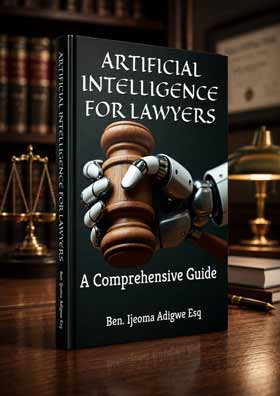 The book also examines Nigeria's legal ecosystem, focusing on the LPELR and NBA AI Guidelines. As a bonus, every purchase comes with a FREE eBook titled: How to Use the AI Features in LegalPedia and LawPavilion.
Ohio Books Ltd praises the publication, stating:
"....this is the only Nigerian book I know of on the topic."
How to Order:
📞 Call, Text, or WhatsApp: 08034917063 | 07055285878
📧 Email: benadigwe1@gmail.com
🌎 Website: www.benadigwe.com
Ebook Version: Access it directly online at https://selar.com/prv626
Authored by Ben Ijeoma Adigwe Esq., ACIarb (UK), LL.M, Dip. in Artificial Intelligence, Director at the Delta State Ministry of Justice, Asaba, Nigeria.
_______________________________________________________________________
The book also examines Nigeria's legal ecosystem, focusing on the LPELR and NBA AI Guidelines. As a bonus, every purchase comes with a FREE eBook titled: How to Use the AI Features in LegalPedia and LawPavilion.
Ohio Books Ltd praises the publication, stating:
"....this is the only Nigerian book I know of on the topic."
How to Order:
📞 Call, Text, or WhatsApp: 08034917063 | 07055285878
📧 Email: benadigwe1@gmail.com
🌎 Website: www.benadigwe.com
Ebook Version: Access it directly online at https://selar.com/prv626
Authored by Ben Ijeoma Adigwe Esq., ACIarb (UK), LL.M, Dip. in Artificial Intelligence, Director at the Delta State Ministry of Justice, Asaba, Nigeria.
_______________________________________________________________________
“Order Justice Omolaye-Ajileye’s Electronic Evidence Books Now” — Essential Guides On Evidence Act, Case Law And Digital Proof
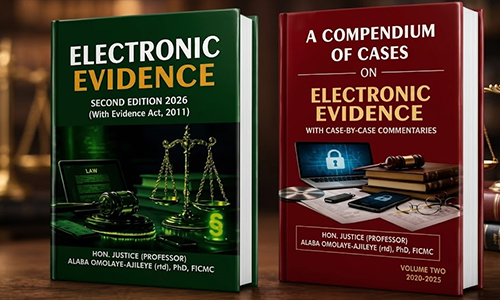
 Interested buyers are encouraged to place their orders and enquiries via:
0704 444 4777, 0704 444 4999, 0818 199 9888
Website: www.alexandernigeria.com
Interested buyers are encouraged to place their orders and enquiries via:
0704 444 4777, 0704 444 4999, 0818 199 9888
Website: www.alexandernigeria.com