
In our contemporary world of today, people move from one place to another in search of greener pasture. As a result, the need to leave their original homes to a completely strange abode becomes inevitable. This transitional movement, however, has brought with it, the need to let accommodation to people either for residence, Business or other purpose. This, invariably gave birth to a landlord and tenant relationship and accompanied with it is the need to regulate this relationship within the scope of the law.


Under the administration of justice in Nigeria, the right of both the landlord and tenant are guaranteed and well recognised under the relevant applicable laws on Tenancy matter. Regrettably, however, on many occasions, people do abuse this rights at the detriment of others. In our conventional court in Nigeria, there are record numbers of decided cases on tenancy matter bordering mostly on wrongful use of statutory rights by both parties. Many a times, people view and make use of their right outside the purview of what is generally accepted by the law and thereby trampled on the right of others.
Some landlord, who as a matter of law, is entitle to recovery of possession of premises from a defaulting tenant often lose this right due to their inadvertence towards the requisite requirements under the enabling laws on tenancy matters. Conversely, the right of the tenant to be served with a quit notice is now a subject of abuse by some tenant who place an heavy reliance on this right. Ignorantly, they erroneously believe, that their entitlement to quit notice before eviction operate without limitations. All the right and privilege of both parties in tenancy matters operate with limitation and failure to take cognizance of this limitation often rendered either or both parties to be at the receiving end. This article however aim to analyse and examine the position of the law in relation to landlord right of recovery of premises, the duration and effect of quit notice, and the possible aftermath for non-compliance with the rules.
*THE RIGHTS OF BOTH PARTIES AND THEIR LIMITATIONS*
Before we go further, it’s imperative to state at this juncture, that the applicable laws on tenancy matters in Nigeria are *two (2)* and their applicability depend so much on the circumstances and the states involved. These two laws are:
1. *THE TENANCY LAW 2011*
2. *RECOVERY OF PREMISES ACT*
As pointed out earlier, the applicability of these laws depend on the circumstances and the state involved. Some states adopt these two laws, and the one to be applicable in a given situation depend on whether the premises involved is a residential or non-residential premises. While for other state, they only adopt only one, and it regulate the two situations. Similarly, It’s imperative to note that, these laws were enacted principally to provide for procedures a landlord must adopt to recover possession of premises. A landlord who wish to secure back his premises from a tenant must adhere strictly with the procedure. Any form of deviation from same is fatal to the case. They are condition precedent that need to be complied with. These requirements will be discussed below.
As a matter of law, one of the duly recognised and important right of a landlord in tenancy matter is right of recovery of premises from a tenant. However, In doing this, the right of the tenant to quit notice must be take into consideration. It therefore follows that, a landlord who seek to recover possession of his premises is under a duty to issue a notice to quit to the tenant. It’s imperative to note that, a notice to quit is *ONLY* necessary for the determination of a tenancy, where the tenancy has not been determined.
The duration of a notice to quit will usually depend on the agreement between the parties. However, in the absence of any agreement to that effect, the period of notice will be determined by the law regulating tenancy matter. Under the Tenancy Law, 2011, the duration of a quit notice depend largely on the duration of the tenancy agreement between the parties. Section 13 of Tenancy provide thus:
” __where there is no stipulation as to the notice to be given by either party to determine the tenancy, the following shall apply-_
(a) _a week’s notice_ _for a tenant at will;_
( _b) one (1) month’s_ _notice for a monthly tenant;_
(c) _three (3) months_ _notice for a quarterly tenant;_
( _d) three (3) months notice for a half-_ __yearly tenant; and_
_(e) six months notice for a yearly tenant_ ”
The above are the duration for a quit notice in the absence of any agreement by the parties. It should however be noted here that, at the expiration of a quit notice, a landlord will be entitle to recover back his premises. See the case of *COBRA LTD & ORS. V. OMOLE ESTATES AND INVESTMENT LTD. (2000) LPELR-CA/L/270/96* where the court held that:
” _It is settled that once a valid notice to quit has been served the tenancy is automatically determined at the expiration of the notice.”_
However, in a situation where a tenant neglect or refuse to vacate or give up possession of the premises after the expiration of a valid quit notice, all the landlord need to do is to serve the tenant a notice of intention to proceed to recover possession on a date not less than 7 days from the date of service of such notice. In calculating the 7 days, the day of service must be excluded but the day of expiry must be included.
Similarly, it should be noted that, Service of a notice to quit is not always a condition precedent for recovery of premises. A notice to quit is ONLY necessary for the determination of a tenancy, where the tenancy has not been determined. There are some instances or circumstances where quit notice will not be needed before a landlord can recover his premises. This will be discussed below.
*WHERE NOTICE TO QUIT CAN BE DISPENSE WITH*
As pointed out earlier that, a landlord who seek to recover his premises from a tenant must issue a quit notice. This rule however operate with exception. There are instances where a tenant can be denied his/her right to quit notice. They are in two ways and both will be discussed below.
The first instance is a situation where the tenancy is determined by effluxion of time, the landlord need not to serve quit notice to the tenant. A tenancy is determined by the effluxion of time where the period for which rent was paid has elapsed. For instance, where Mr A. rents a duplex from Mr. B for one year; from 1st January, 2018 to 31st December, 2018. At the expiration of the said one year, the tenancy is determined. Hence, from 1st January, 2019, the tenancy is deemed expired/determined and the landlord need not to serve any quit notice. All that is needed to do is for the landlord to serve the tenant a 7 days notice to recover possession of premises.
This position was affirmed by the court in the case, of *Odutola V. Papersack Nig. Ltd. (2006) 18 NWLR (Pt 1012) 470 SC* where the court held that:
” _From the moment a year’s rent became due and payable by the Respondent but remained unpaid, the yearly tenancy, if any, created by the conduct of the parties thereto came to an end by effluxion of time and the Respondent thereby became a tenant at will of the 1st Appellant by continuing in possession of the property.”_
The second instance is where a tenant terminate the tenancy agreement by issuing a notice of termination of tenancy. This often arise where the tenant is not satisfied with the premises or an urgent need to change location arise.
*CONCLUSION*
Landlord and tenant relationship is an area of law in Nigeria that had sparkled up a lot of controversy in our conventional court. On many occasions, parties in tenancy matters often jump the wagon while exercising their individual right in tenancy relationship. Some landlord while exercising their right of recovery of possession often neglect the requisite requirements of the law. Rather than following the due process, they will throw caution to the wind and engage with their tenant in a show of shame in a bid to remove the tenant from the premises. Similarly, there are too much of heavy reliance on quit notice by some tenants who believe that, they can’t be chase out of their premises without a quit notice even where their tenancy agreement had been determine by effluxion of time. Commendably, our laws as of today In Nigeria, had to a large extent regulates landlord and tenant relationship with the enactment of laws that define the rights and limitations of both parties in tenancy relationship.
*Gobir Habeeb Bolaji is a 400level law student from Usman Danfodiyo university, Sokoto. He can be reach via* G-Mail: Habeebgobir2@gmail.com Num: 08108527278
“Order Justice Omolaye-Ajileye’s Electronic Evidence Books Now” — Essential Guides On Evidence Act, Case Law And Digital Proof
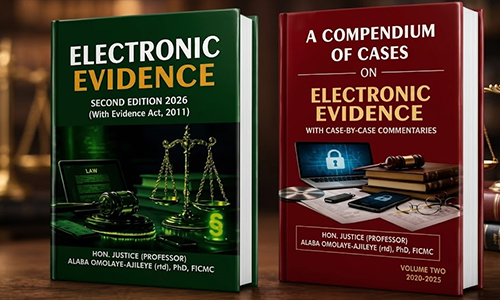
 The book also examines Nigeria's legal ecosystem, focusing on the LPELR and NBA AI Guidelines. As a bonus, every purchase comes with a FREE eBook titled: How to Use the AI Features in LegalPedia and LawPavilion.
Ohio Books Ltd praises the publication, stating:
"....this is the only Nigerian book I know of on the topic."
How to Order:
📞 Call, Text, or WhatsApp: 08034917063 | 07055285878
📧 Email: benadigwe1@gmail.com
🌎 Website: www.benadigwe.com
Ebook Version: Access it directly online at https://selar.com/prv626
Authored by Ben Ijeoma Adigwe Esq., ACIarb (UK), LL.M, Dip. in Artificial Intelligence, Director at the Delta State Ministry of Justice, Asaba, Nigeria.
______________________________________________________________________
[A MUST HAVE] Evidence Act Demystified With Recent And Contemporary Cases And Materials
The book also examines Nigeria's legal ecosystem, focusing on the LPELR and NBA AI Guidelines. As a bonus, every purchase comes with a FREE eBook titled: How to Use the AI Features in LegalPedia and LawPavilion.
Ohio Books Ltd praises the publication, stating:
"....this is the only Nigerian book I know of on the topic."
How to Order:
📞 Call, Text, or WhatsApp: 08034917063 | 07055285878
📧 Email: benadigwe1@gmail.com
🌎 Website: www.benadigwe.com
Ebook Version: Access it directly online at https://selar.com/prv626
Authored by Ben Ijeoma Adigwe Esq., ACIarb (UK), LL.M, Dip. in Artificial Intelligence, Director at the Delta State Ministry of Justice, Asaba, Nigeria.
______________________________________________________________________
[A MUST HAVE] Evidence Act Demystified With Recent And Contemporary Cases And Materials

 Interested buyers are encouraged to place their orders and enquiries via:
0704 444 4777, 0704 444 4999, 0818 199 9888
Website: www.alexandernigeria.com
Interested buyers are encouraged to place their orders and enquiries via:
0704 444 4777, 0704 444 4999, 0818 199 9888
Website: www.alexandernigeria.com