“Danjuma Donates N3 Billion, Dangote N500 Million, BUA’s Rabiu N25 Million” — As Tinubu, Jonathan, Shettima, Kukah, Sultan Of Sokoto, Sanusi And Others Pay Glowing Tributes To Gowon At Autobiography Launch

Former Nigerian Head of State, General Yakubu Gowon, on Tuesday declared that Nigeria must never be allowed to collapse, insisting that his commitment to the unity and long-term survival of the country remains unwavering, as he warned politicians against desperation and “do-or-die” politics ahead of the 2027 general elections.
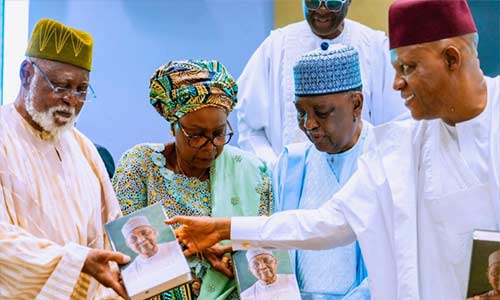
Gowon spoke at the public presentation of his autobiography, My Life of Duty and Allegiance, in Abuja, where President Bola Tinubu, former President Goodluck Jonathan, Vice President Kashim Shettima, the Sultan of Sokoto Muhammadu Sa’ad Abubakar III, the Emir of Kano Sanusi Lamido Sanusi, and a host of other national leaders paid glowing tributes to him.
The event, held at the Bola Ahmed Tinubu International Conference Centre, attracted an array of dignitaries, including former Head of State Abdulsalami Abubakar; former military president Ibrahim Babangida, who was represented by his daughter, Aisha; diplomats, traditional rulers, military officers, scholars and business leaders.
“Nigeria Will Not Fall”
Reflecting on his years in office, Gowon maintained that Nigeria survived enormous trials during his administration and expressed confidence that the country would overcome its present challenges.
“On my watch as Head of State, the country did not fall, and I am confident that despite all its challenges, Nigeria still will not fall,” he declared.
He criticised the inability of political actors to conduct transparent elections, even within their own political parties, saying such practices continue to weaken democratic development.
“We must not give room to the naysayers who see no good in our nation and would rather label it a failed state,” he warned.
He also expressed concern that Nigerians often complicate simple national issues with divisive and ambiguous solutions that generate unnecessary tensions across the country, adding that public service should never be seen as a pursuit of personal glory, but as a sacred responsibility demanding conscience, conviction and commitment to national interest.
“We all must rise to contain the desperation frequently exhibited by the political class who engage in what they love to call ‘do or die’ politicking,” he said.
A Symbolic Year
Speaking at the launch, Gowon reflected on Nigeria’s turbulent political history and the difficult years leading to the Civil War, stressing that despite enormous challenges, the country survived and must continue to endure.
According to him, 2026 represents a symbolic year in Nigeria’s history as it marks 60 years since the military intervened in governance and since he assumed leadership under difficult national circumstances.
“Nigeria stood at the brink of disintegration in 1966, but we remained determined to preserve the unity of the country,” Gowon said.
The elder statesman explained that the publication of his autobiography was not intended to glorify his person, but to preserve historical truth and correct what he described as misinformation and disinformation surrounding his role in national affairs.
“I only needed to tell my truth, not join issues with anyone or sit in judgment over what may be considered right or wrong,” he stated.
Gowon said he had initially chosen silence after leaving office, but later realised the need to document his experiences in order to preserve institutional memory and prevent distorted narratives capable of reopening old national wounds.
Declaring his enduring faith in Nigeria, he said: “I cannot say it loudly enough that my belief in the long-term survival of Nigeria is total, because my love for the country and its people is beyond question.”
“Go On With One Nigeria”
Recalling a memorable newspaper interpretation of his name as “Go On With One Nigeria,” Gowon said the phrase strengthened his determination to preserve national unity.
The former Head of State paid tribute to members of the armed forces, traditional rulers, civil servants and ordinary Nigerians who supported efforts to keep the country united during the Civil War years. He particularly acknowledged the role played by the late Sultan of Sokoto and other traditional leaders who worked behind the scenes to promote peace and stability during one of Nigeria’s most difficult periods.
“If The Devil’s Ready To Help” — How US And Britain’s Refusal Drove Nigeria To Soviet Union And A Lebanese Black-Marketeer
One of the most striking revelations from the autobiography came from Chapter Fifteen, titled “If The Devil’s Ready To Help,” in which Gowon chronicles his desperate search for weapons as Nigeria’s ammunition stockpile collapsed to half a million rounds for the entire Army by late 1968.
He said the stockpile was insufficient to sustain operations, while traditional Western allies remained aloof.
He wrote: “As the weeks of fighting wore on, our stock of ammunition was steadily depleted by these wastes, and we could not replenish them because international sales restrictions prevented suppliers from selling military hardware to Nigeria.
“Left with no choice, I ordered the Federal troops to hold their position after the capture of Enugu up to Okigwe and Umuahia because I could not, in clear conscience, commit them to further advance knowing that the ammunition to sustain the effort was in short supply.”
Gowon said he was particularly stung by the contrast between the inaction of the Western allies in Nigeria and their aggressive military posture in Vietnam and Cambodia, where American air power was being deployed at scale. He sought out the British and American ambassadors in a meeting he described as one of the most consequential of the war.
About the meeting, he said: “If I say I’m not disappointed, it will be an understatement.
“I, however, left them in no doubt that I had a duty and responsibility to keep Nigeria united and safe for all Nigerians and other nationals resident in Nigeria.
“As they were about to enter their cars, preparatory to leaving the State House, I said, if I say I’m not disappointed, it will be an understatement, so I will go to any devil to get what I need to deal with the problem, to do my duty to my country, and when that happens, I hope I will not be accused of doing something wrong.”
Both ambassadors left without any commitment, Gowon said.
The Moscow Pivot
However, the former Head of State said he had already decided on his next move. He directed his Principal Secretary, Hamza Ahmadu, to contact the Soviet Ambassador, Mr. Aleksandr Romanov, at Dodan Barracks. He said Moscow’s willingness to supply arms could serve as the lever that forced Britain and America back to the negotiating table.
A Nigerian delegation led by Commissioner of Information Anthony Enahoro, Permanent Secretary Edwin Ogbu, Chief of Air Staff Emmanuel George Kurubo and Ambassador John Ukegbu was promptly dispatched to Moscow.
“The Soviet Union supplied us some MiG-15 trainers and MiG-17 bombers for the meeting, which was a huge success,” he wrote, adding that Soviet-Nigerian relations grew into something “special” in the aftermath of the war, a warmth that had been purchased by Western indifference.
Ali Jamal — The Lebanese Black-Marketeer Who Believed In Nigeria
According to him, Moscow alone could not solve the immediate ammunition crisis. For that, Gowon said he turned to Ali Jamal, a Lebanese businessman with access to the black market for military hardware, “who strongly believed in Nigeria” and who offered to personally finance the procurement of ammunition and equipment, asking only to be reimbursed interest-free once the government could pay.
“Jamal was not deterred even after I told him that I had no money with which to make immediate payments for the purchases.
“He told me not to worry and that he would use his own money to provide the ammunition we needed but would want to be reimbursed interest-free at the shortest possible time.
“With his support, we were able to get some of the hardware and the ammunition we needed to change the face of the war,” Gowon wrote.
Awolowo And The FEC Showdown
But the arrangement nearly collapsed at the Federal Executive Council when Finance Commissioner Chief Obafemi Awolowo refused to authorise payment, objecting that the process had not been properly followed and that it constituted extra-budgetary expenditure.
“I was aghast because it suddenly appeared to me that the Finance Commissioner and others at the FEC did not understand the depth of the problem I was in to ensure the survival of the men in the field and that war was successfully prosecuted,” Gowon recalled.
He told Awolowo: “I’m afraid I’ll want to use my powers and authority, which I think I can do as Head of State and Head of Government, to give any department the order to do what is required to be done.”
On the altercation at the council meeting, he said: “Although I used anger and the power of my office to win the argument and retain the integrity of the nation with my friend, I felt proud of my team that always insisted on following due process to justify every action and every expenditure. Jamal subsequently was paid in full.”
Tinubu’s Tribute Through Shettima
Representing President Tinubu at the event, Vice President Kashim Shettima described Gowon as a symbol of reconciliation, unity and statesmanship whose legacy continues to inspire generations of Nigerians.
He praised Gowon for steering Nigeria through one of its darkest periods and for laying the foundation for post-war healing through the famous declaration of “no victor, no vanquished.”
“A nation that misplaces its memory soon begins to quarrel with its own reflection,” Shettima said while emphasising the importance of preserving history and learning from past national experiences.
He also commended Gowon for establishing the National Youth Service Corps and for co-founding the Economic Community of West African States, saying both initiatives strengthened national cohesion and regional integration.
“She understood that unity cannot be sustained by speeches alone. Unity must be given institutions, roads, schools and shared experiences,” Shettima said while referring to the contributions of Gowon and his wife, Victoria Gowon.
The Vice President also appealed for peace and unity in Plateau State, warning that division and mistrust remain threats to national progress.
“There can never be development without peace, and there can never be peace without development,” he added.
Shettima further disclosed that Tinubu resisted attempts by some individuals to sow division during the 2023 election campaign, insisting that the President remained committed to inclusiveness and national unity.
“They Told Tinubu I Was Planning To Kill Him” — Shettima’s Bombshell
In one of the most attention-grabbing disclosures of the event, Vice-President Kashim Shettima opened up on how some persons tried to pitch him against President Bola Ahmed Tinubu barely three months after coming into power.
Shettima said the individuals, whom he refused to name but said are from Borno State, told Tinubu that he was plotting to kill him and take over power.
“Three months into our swearing in, some people told Tinubu I was planning to kill him to take over power. The President had called me and said, ‘Sit down! Your people came to me and said stop wearing those Shettima’s clothes,'” Shettima said.
“But the president said their story did not add up. He said when you gave me those clothes, I was an aspirant. I would not have been the candidate, neither were you going to be Vice presidential candidate.
“Some people told him after election that I was planning to use the clothes to kill him and take over. However, Tinubu wore the clothes after that because he is not fetish.”
Shettima advised Nigerians to be better united as their brother’s keeper, not as merchants of divisions.
Jonathan: “A Living Testimony”
Former President Goodluck Jonathan, who chaired the occasion, also praised Gowon for laying the foundation for national healing after the Civil War through the “no victor, no vanquished” declaration.
Jonathan described the autobiography as a living testimony of leadership during one of Nigeria’s most turbulent eras and said younger Nigerians now have an opportunity to better understand the difficult decisions made during the war years.
“Today’s event is not merely the unveiling of a book. It is the presentation of a living testimony. It reflects a leader who stood at the centre of some of the defining moments in our national journey,” Jonathan said.
The former president said the autobiography offered deep insights into military leadership, peace building and the challenges of governing a diverse nation.
“The Nigerian autobiography offers not only a personal account of military strategy and leadership, but also one of the big insights into the challenges of nationhood, reconciliation, peace building, and statesmanship,” he said.
Reflecting on the 1967–1970 civil war, Jonathan described the period as one of the most painful chapters in Nigeria’s history but commended Gowon’s approach to reconciliation after the conflict.
“The years of the civil war from 1967 to 1970 remain among the most painful chapters of our national experience. Yet, this historical record is committed to the realisation of national unity and perhaps more importantly, the unanimity at the end of this conflict embodied in the enduring declaration of ‘no victor, no vanquished.’ The declaration laid the foundation for healing, reconstruction and reintegration at a time when victims and witnesses would have been in pain,” he said.
Jonathan’s Tribute To NYSC
Jonathan also praised Gowon for introducing policies that transformed Nigeria, particularly the establishment of the NYSC.
“In Nigeria, the establishment of the NYSC was one key policy that today remains in place,” he said.
He noted that the scheme helped foster unity among young Nigerians and addressed shortages of teachers in rural schools at the time.
Recalling his personal experience, Jonathan said: “I remember in 1973, I was in class three in secondary school when the third batch of the NYSC came. In those days, it was so difficult to get graduate teachers to teach in secondary schools, especially schools that were not in the cities.”
He said two corps members posted to his school taught him subjects including Mathematics, Chemistry and Biology and contributed significantly to his education.
“So the vision of the NYSC is great and will continue to be great,” he added.
Jonathan further commended Gowon for continuing to promote peace and national unity decades after leaving office, and urged Nigerian leaders to document their experiences for the sake of preserving history for future generations.
Other Tributes
In their goodwill messages, former military President General Ibrahim Babangida, former Head of State Abdulsalami Abubakar, Plateau State Governor Caleb Mutfwang, and Emir of Kano Sanusi Lamido Sanusi all paid glowing tribute to Gowon for his values and his standing as a symbol of national unity.
Kukah’s Review — Betrayal, Humiliation, And A Plot Of Land Revoked By El-Rufai
The highlight of the event was the extensive review of Gowon’s autobiography by Matthew Hassan Kukah, Bishop of the Catholic Diocese of Sokoto, who described the former Head of State as a man who endured betrayal, humiliation, political intrigue and suffering without bitterness.
Kukah said the 859-page memoir, divided into 36 chapters, provided rare insight into the coups of 1966 and 1975, the Civil War, the Aburi Accord, and Gowon’s years in exile after he was overthrown while attending an African summit in Kampala, Uganda.
According to Kukah, Gowon returned from office with virtually nothing despite presiding over Africa’s largest country during the oil boom era. The cleric narrated how Gowon struggled financially in exile, survived on support from friends and diplomats, and relied heavily on the sacrifices of his wife, Victoria, while studying at Warwick University in the United Kingdom.
Kukah said the book also revealed how Gowon lost properties, had his military benefits withdrawn, and faced political persecution after the 1975 coup.
The Abuja Plot Of Land
Kukah used the occasion to recount how the former Minister of the Federal Capital Territory, Nasir El-Rufai, revoked a plot of land belonging to Gowon in Abuja.
“He didn’t have a plot of land. And when he came back, it was just out of pity, let me put it that way, that General Babangida agreed. Finally, they named one crescent after him, and after the crescent, they now gave him a plot of land, his first plot of land in Abuja,” Kukah said.
The bishop said Gowon had mobilised resources and commenced construction on the land before the allocation was revoked during El-Rufai’s tenure as FCT minister.
“He mobilised resources to try and start building. He begins to build. Then El-Rufai, who was minister of the FCT, revoked the land,” Kukah stated.
According to him, the intervention of retired General Theophilus Danjuma and others eventually helped Gowon recover the property.
A Memoir Built On Memory After Two Fires
Kukah disclosed that much of Gowon’s personal archives and records were lost in two separate fire incidents in Bakori and Kaduna, making the memoir largely dependent on the former military leader’s recollections.
“It’s important to underscore the fact that whatever you read in the book is the result of what the author was able to recall. You will find in the book evidence of excellent memory and details of things,” he said.
Obasanjo As “Informal Guardian Angel”
Kukah highlighted revelations surrounding Gowon’s relationship with former President Olusegun Obasanjo, citing portions of the memoir suggesting deep trust between both men despite political tensions after Gowon’s overthrow.
Quoting from the book, Kukah said Gowon described Obasanjo as his “informal guardian angel” whom he trusted “more than any other soldier.” Kukah also referenced accounts by former Chief of Staff, Supreme Headquarters, Allison Ayida, regarding debates within the military over whether Gowon should be allowed to return to Nigeria from exile.
According to him, Ayida recalled that some officials feared political backlash if Gowon’s planned return became public knowledge.
Victoria Gowon — “The Shield, The Diplomat, Who Wore The Trousers”
Beyond politics, Kukah devoted a significant portion of his review to Gowon’s wife, Victoria Gowon, whom he described as “the shield, the diplomat, who wore the trousers in the house.”
According to the bishop, the memoir detailed the extent of hardship the Gowon family endured in exile in the United Kingdom after the 1975 coup. He said Gowon struggled to secure employment or even open a bank account, while his wife sustained the family by sewing bed sheets and making pillows for sale.
“He himself said in the book that he became what he called a kept man because she was the one looking after everything in the house,” Kukah noted.
The bishop further narrated how a domestic worker allegedly sent to assist the family by Nigerian officials was later discovered to be monitoring them for incriminating evidence.
“At the end of the day, the poor man could not find anything to report back home,” Kukah said.
Despite the hardships, Kukah noted that Gowon remained committed to peace, reconciliation and national unity, concluding: “To keep Nigeria one is a task that must be done.”
Former Minister of Defence, Retired General Theophilus Danjuma, on Tuesday donated N3 billion at the public presentation of the autobiography.
Danjuma, who served as the Chief Presenter at the event, was represented by a former Chief of Defence Staff, Retired General Martin Luther Agwai. Apart from the financial pledge, Danjuma directed that 12 copies of the book be purchased and distributed to the libraries of each of the 20 universities that had awarded honorary doctorate degrees to Gowon over the years.
In his tribute, Danjuma described Gowon as Nigeria’s foremost living statesman, an international icon, and a wartime commander whose leadership prevented Nigeria from disintegration.
“Gen. Gowon is not only a household name in Nigeria but also a globally acknowledged leader with an impeccable record in leadership, nation-building and military strategy.
“His well-recorded slogan of ‘no victor, no vanquished’ after the civil war set the tone for an effective post-war policy of reconciliation, reconstruction, and rehabilitation,” Danjuma said.
The retired General noted that his friendship with Gowon spanned over 70 years, dating back to their childhood days in the Wusasa area of Zaria, adding that the memoir is a “treasure trove of history” and a gift to the world.
Mr. Mansur Ahmed, the representative of Alhaji Aliko Dangote, announced the purchase of 25 copies of the book for N500 million to honour the former Head of State.
Ahmed, a Senior Adviser to the richest man in Africa, stated that his boss, Dangote, was only a 10-year-old primary school pupil when Gowon was leading the nation through its most turbulent times.
He said Gowon’s successful efforts to keep Nigeria unified created the stable environment that allowed Dangote to grow up and build a pan-African business empire.
Other corporate leaders and dignitaries also made substantial purchases of the book at the event, including Alhaji Abdul-Samad Rabiu, the President of BUA Group, who procured copies of the book for N25 million.
Also speaking at the launch, the publisher of the autobiography and Chief Executive Officer of Havilah Group, Akogun Lanre Adesuyi, noted that the autobiography documents Gowon’s personal journey, his years in military service, the events leading to the civil war, post-war reconciliation efforts and his reflections on nation-building.
Adesuyi described the autobiography as more than a personal memoir, saying it represented an important contribution to Nigeria’s historical documentation.
“Today, pages will be turned, memories will speak, and history will find its authentic voice,” Adesuyi said. “This is no ordinary book presentation. Rather, we are here to share the author’s story of an era and the enduring power of character. I repeat: character, character, character. This country needs character.”
Adesuyi said Gowon deliberately chose to recount his experiences without bitterness or judgment.
“General Yakubu Gowon has chosen to address history without judgment. As he repeatedly told us while working on this book, it is all about telling his truth. And as we all know, truth is always a defence,” he said.
He stressed the importance of preserving historical records, warning that failure to document events allows distorted narratives to thrive.
Gowon remains one of the most significant figures in Nigeria’s political history. He ruled the country from 1966 to 1975 and led Nigeria during the Civil War fought between 1967 and 1970 after the attempted secession of the former Eastern Region as Biafra.
Following the war, Gowon became widely known for promoting reconciliation through his “No Victor, No Vanquished” policy, which aimed to rebuild national unity and reintegrate affected communities. Over the decades, he has consistently advocated peace, national integration and interfaith harmony through platforms such as the Nigeria Prays movement.
His renewed call for unity comes at a time Nigeria faces heightened economic hardship, insecurity, regional tensions and increasing political activities ahead of the 2027 elections.
For a nation at the cusp of another bruising electoral cycle, the 859-page memoir My Life of Duty and Allegiance and the tributes that accompanied its public presentation in Abuja on Tuesday converge on a single, urgent message: that Nigeria has been through worse, that its unity is not negotiable, that the political class must rise above do-or-die politics, and that the survival of the country is, in the words of its 91-year-old wartime leader, a matter on which his belief is “total because my love for the country is beyond question.”
From the revelations about how Western indifference drove Nigeria into the arms of the Soviet Union and a Lebanese black-marketeer during the Civil War, to the personal accounts of betrayal, exile, financial hardship and the revocation of an Abuja plot of land by Nasir El-Rufai; from the N3 billion donation by Danjuma and the N500 million tribute by Dangote, to Shettima’s bombshell about a plot to pitch him against President Tinubu within three months of their inauguration Tuesday’s event in Abuja was at once a book launch, a state occasion, a historical reckoning, and a national conversation about where Nigeria has been and where it must go.
As Bishop Kukah concluded in his review, channelling one of the enduring themes of the memoir: “To keep Nigeria one is a task that must be done.”
[A MUST HAVE] Evidence Act Demystified With Recent And Contemporary Cases And Materials

Available now for NGN 40,000 at ASC Publications, 10, Boyle Street, Onikan, Lagos. Beside High Court, TBS. Email publications@ayindesanni.com or WhatsApp +2347056667384. Purchase Link: https://paystack.com/buy/evidence-act-complete-annotation
______________________________________________________________________ “Enhance Legal Practice With Authoritative Reports” — Alexander Payne Offers Comprehensive Law Reports, Spanning Over A Century Of Nigerian Jurisprudence Interested buyers are encouraged to place their orders and enquiries via:
0704 444 4777, 0704 444 4999, 0818 199 9888
Website: www.alexandernigeria.com
Interested buyers are encouraged to place their orders and enquiries via:
0704 444 4777, 0704 444 4999, 0818 199 9888
Website: www.alexandernigeria.com