*Chief Justice of Kenya Emphasizes Africa’s Unique Role in Shaping Future of Dispute Resolution
*Dr. Wale Babalakin: Robust Overhaul Needed in Nigeria’s Dispute Resolution System to Attract Investment
*Prof. Fabian Ajogwu: Embracing Diversity Key to Fostering Impactful Partnerships in African Arbitration

Speakers’ at the 45th annual general conference of the The Nigerian Institute of Chartered Arbitrators (NICArb) have called for collaboration, innovation, and inclusivity as they underscored the critical need for Africa to lead in the global arbitration landscape.
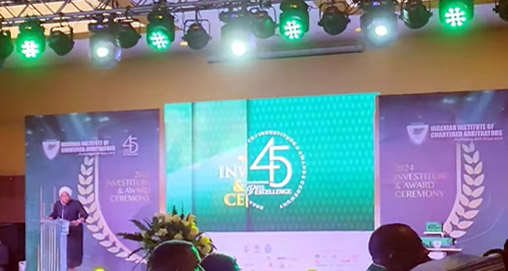
The Nigerian Institute of Chartered Arbitrators (NICArb) celebrated 45 years of excellence, with a two-day conference which took place from November 28 to 29 at the Eko Hotel and Suites in Lagos.
The conference, themed “Transformation and Interventions: The Evolving Trends in Arbitration and ADR Practice in Africa,” brought together experts, judges, and practitioners to discuss the changing landscape of arbitration and alternative dispute resolution (ADR) in Africa.
In her virtual goodwill address, the Chief Justice of Kenya, Hon. Justice Martha Koome, EGH, emphasized Africa’s unique heritage in dispute resolution and the need to innovate while preserving traditional practices.
While she underscored the importance of ADR in enhancing access to justice in Africa, Justice Koome emphasized the unique position Africa holds in shaping the future of dispute resolution, noting that the continent’s rich tradition of community-based conflict resolution mechanisms predates modern judicial systems.
“Alternative Dispute Resolution (ADR) plays a critical role in improving access to justice, especially in jurisdictions where the formal court system is overwhelmed. It provides citizens with quicker, more affordable, and less adversarial means to resolve disputes, empowering individuals and communities alike.”
“Way before the formal judicial system existed, African societies relied on mediation, dialogue, negotiations, and consensus-building to address disputes within our communities. These indigenous practices entrenched social harmony and peace, which are core values in ADR today.
She called on African nations to integrate ADR into formal legal frameworks and policies, citing Kenya’s approach as an example. “In Kenya, ADR is embedded in our constitution, legislation, and judicial blueprint for social transformation through access to justice. This integration ensures ADR is not only recognized but also actively practiced in addressing contemporary disputes.”
The Chief Justice highlighted the rising adoption of ADR across Africa, attributing it to factors such as its cost-effectiveness, alignment with cultural values, and the continent’s increasing attractiveness as an investment frontier.
She also urged stakeholders to embrace technology and artificial intelligence to make ADR more inclusive and accessible.
“Modern ADR practices are not just a continuation of our heritage but an enhancement to meet present-day needs. We must capitalize on opportunities such as the African Continental Free Trade Area (AfCFTA) and rising foreign invest.Uk b.m n jg to entrench ADR practice further.
“We are living in an age where technology will be the biggest disruptor in every field of law, including ADR. The rise of artificial intelligence and digital platforms in dispute resolution will not only enhance efficiency but also ensure that more people can access ADR services without geographical or financial barriers.
“The future of ADR in Africa is very promising. As a pillar of access to justice, economic growth, and social harmony, we must nurture a collaborative spirit, leveraging our resources and expertise to build robust ADR frameworks.
“Arbitration is a global phenomenon that transcends borders. As Africa continues to grow economically and politically, our legal frameworks must evolve to handle disputes on a global scale. We must embrace international standards while integrating local knowledge to create solutions that are tailored to the needs of African countries and their people”, she said.
Dr. Wale Babalakin, OFR, SAN, Principal Partner of Babalakin & Co, called for a robust overhaul of Nigeria’s dispute resolution system, citing weaknesses that deter investment.
“The quickest index to investment in any country is its dispute resolution process. We are struggling because of our weak track record in enforcing agreements and the inefficiency of our judicial system.
“The evolving trends in arbitration and ADR are not just academic topics; they are essential to solving the pressing issues faced by Africa in the context of today’s interconnected global economy.
“This is a time for Africa to take charge of its destiny by advancing dispute resolution methods that will serve its unique needs and challenges.”
He further pointed out the necessity for African nations to rely on their own systems, saying: “It is no longer sustainable for Africa to continually depend on foreign arbitration institutions to resolve disputes that arise within our own borders. We have the expertise, we have the resources, and now is the time for us to build our own institutions that are in tune with the realities of our continent.”
He urged the arbitration community to focus on specialization and capacity-building among arbitrators, especially in critical sectors like oil and gas.
“It’s not good enough to just want to be an arbitrator. Arbitrators must be trained experts in their chosen fields to ensure that arbitral awards are well-researched and credible.”
Dr. Babalakin emphasized the need for collaboration between all stakeholders, including governments, legal practitioners, arbitrators, and academics, to establish a robust arbitration framework in Africa.
He noted: “It is imperative for the entire African legal community to come together in advancing arbitration as a tool for sustainable development. The time has come for us to create an arbitration framework that is not only efficient and effective but also deeply reflective of our diverse cultural, legal, and socio-political contexts.
“Only then can we ensure that Africa is able to resolve its disputes in ways that are fair, efficient, and transparent.”
Managing Partner at Aboyade & Co., Mrs. Funke Aboyade, SAN, FCIArb, stressed the need for Nigeria’s judiciary to support arbitration processes.
“There are lots of hard conversations to be had, especially regarding how the judiciary can partner with the arbitration and ADR world so that arbitration awards and the process itself are respected. Nigeria has made progress with the repeal of the old Arbitration Act and the enactment of the Arbitration and Mediation Act in 2023.
“However, we still face challenges such as court interventions, which undermine the finality of arbitration awards”, she said.
Mrs. Aboyade highlighted Mauritius as an example of a country that has successfully established a sacrosanct arbitration process. “We have a lot to learn from Mauritius. Despite being a smaller country, they’ve gotten their act together, and their arbitral process is sacrosanct. If we address these issues holistically, Nigeria can become a preferred arbitration seat in Africa.”
She also pointed out the contentious Supreme Court decision in U.B.A. v. Trident as a reflection of the challenges faced by arbitration in Nigeria, describing the need for broader dialogue to determine the way forward.
Mr. Lawan Pedro, Senior Advocate of Nigeria and Attorney General of Lagos State, who was representing the Governor of Lagos State, Mr. Babajide Sanwo-Olu spoke on the transformative role of arbitration and alternative dispute resolution (ADR) in Africa.
He emphasized that arbitration is not just a conflict resolution mechanism but a critical tool for building trust, fostering partnerships, and driving economic development.
Mr. Pedro highlighted Lagos as a growing hub for arbitration in Africa, stating: “Institutions like the Court of Arbitration, the LCA, exemplify our commitment to establishing world-class arbitration facilities. Lagos is becoming the epicenter of dispute resolution in Africa.”
He also pointed out that transformation in arbitration and ADR is not just a theme for this conference but a “call to action” that presents unprecedented opportunities for specialization, localization, and digitalization.
Mr. Pedro urged the continent to take charge of its own dispute resolution systems, advocating for the growth of African arbitrators and institutions capable of competing on the global stage.
“Arbitration is not just a mechanism, it’s a promise—a promise of fairness, efficiency, and justice,” he said.
He stressed the importance of creating legal frameworks that are not only efficient but also inclusive, reflecting Africa’s diverse context.
Concluding his speech, he called on participants to contribute to positioning Africa as a global leader in arbitration, ensuring that arbitration becomes a transformative force for justice and progress.
Reflecting on the conference’s theme, President and Chairman of NICArb’s Governing Council, Professor Fabian Ajogwu, OFR, SAN, underscored the importance of embracing Africa’s rich legal and cultural diversity to foster impactful partnerships, reshape dispute resolution frameworks, and unify the arbitration ecosystem across the continent.
“This year’s theme is timely and significant,” he said, adding that transformations, whether local or international, disrupt existing processes and necessitate proactive interventions by governments, institutions, and stakeholders. He highlighted the Arbitration & Mediation Act (AMA) 2023 as an example of such interventions, noting its innovations in arbitration and ADR practices in Nigeria.
Reflecting on Africa’s legal and cultural diversity, Professor Ajogwu stressed the need to harmonize these elements to redefine ADR in Africa. “By fostering impactful partnerships and reshaping dispute resolution frameworks, we can build a more unified, inclusive, and innovative arbitration ecosystem,” he said.
Professor Ajogwu also recognized the significance of the Arbitration & Mediation Act (AMA) 2023 in Nigeria, which introduced innovations that enhance arbitration and ADR practices.
“This initiative has the potential to reshape the African dispute resolution framework, fostering greater cooperation across diverse legal traditions,” he remarked.
Chairman of the 2024 Annual Conference Planning Committee, Professor Yusuf Olaolu Ali, SAN, FCArb, highlighted the importance of interrogating transformations in ADR amidst a volatile, uncertain, complex, and ambiguous (VUCA) world.
“Topmost on the list of transformation is technology and the latest in artificial intelligence (AI), which portends huge changes to the practice of arbitration and ADR,” he stated. He also pointed to the African Continental Free Trade Agreement (ACFTA) as a significant area of change, describing it as a potential breeding ground for commercial conflicts, with arbitration poised as the preferred resolution mechanism.
Professor Ali emphasized that transformations bring both challenges and opportunities, necessitating interventions from stakeholders through regulatory reforms, strategic partnerships, and innovative practices.
[A MUST HAVE] Evidence Act Demystified With Recent And Contemporary Cases And Materials

Available now for NGN 40,000 at ASC Publications, 10, Boyle Street, Onikan, Lagos. Beside High Court, TBS. Email publications@ayindesanni.com or WhatsApp +2347056667384. Purchase Link: https://paystack.com/buy/evidence-act-complete-annotation
______________________________________________________________________ “Enhance Legal Practice With Authoritative Reports” — Alexander Payne Offers Comprehensive Law Reports, Spanning Over A Century Of Nigerian Jurisprudence Interested buyers are encouraged to place their orders and enquiries via:
0704 444 4777, 0704 444 4999, 0818 199 9888
Website: www.alexandernigeria.com
Interested buyers are encouraged to place their orders and enquiries via:
0704 444 4777, 0704 444 4999, 0818 199 9888
Website: www.alexandernigeria.com