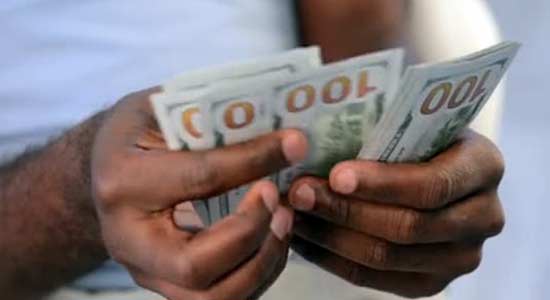
The naira appreciated to N1,355.25 per dollar at the official foreign exchange market on Friday, marking its strongest level in recent sessions and capping a week of consistent gains that saw the currency strengthen from N1,389/$ on Tuesday to Friday’s close a N33.75 improvement in just four trading days.

However, data from the Central Bank of Nigeria also revealed that Nigeria’s external reserves have continued to decline in April, falling to $48.85 billion as of April 9 from $49.18 billion at the start of the month raising concerns about whether the naira’s recovery can be sustained if reserve depletion continues.
The naira’s performance across the shortened trading week following the Easter holiday showed a steady appreciation trend at the official market.
Trading resumed on Tuesday after the Easter break. The currency opened the week at N1,389/$, showing initial weakness. It then strengthened to N1,369/$ on Wednesday, further appreciated to N1,365/$ on Thursday, and closed the week at N1,355.25/$ on Friday.
This represents a significant improvement from the pre-Easter close of N1,382.75/$ recorded on Thursday, April 2, 2026 meaning the naira gained N27.50 between the pre-Easter and post-Easter trading sessions.
On a year-on-year basis, the naira has strengthened significantly. After Easter in April 2025, the currency was trading at N1,606/$ at the official market. At N1,355.25/$ this Easter, the naira has gained over N250 or approximately 15.6 per cent in the past twelve months.
The data highlights a reversal from last year’s post-Easter depreciation trend, indicating improved short-term currency stability that contrasts sharply with the volatility that characterised the exchange rate in 2024 and early 2025.
The naira’s gains during the week were supported by a broad-based decline in the US dollar globally following the unwinding of safe-haven positions that had built up during the Middle East crisis.
The US dollar had strengthened significantly in March as geopolitical tensions between the United States, Israel, and Iran triggered a flight to safety among global investors. The conflict drove oil prices higher, pressured global equities, and increased inflation concerns, with investors shifting to the dollar as a safe-haven asset.
However, since the ceasefire agreement earlier in the week, these positions have begun to unwind, leading to a broad-based dollar decline. The greenback was heading for its largest weekly drop since January, providing tailwinds for emerging market currencies including the naira.
Despite the naira’s appreciation, the declining trajectory of Nigeria’s external reserves has emerged as a source of concern.
Reserves fell to $48.85 billion as of April 9, 2026, from $49.18 billion at the start of the month a decline of $330 million in just nine days.
This decline follows a period of strong accumulation earlier in the year. In February 2026, reserves had risen to $50.45 billion the highest level in over a decade with the CBN attributing the increase to improved foreign exchange inflows and policy reforms aimed at boosting market liquidity.
The reversal from $50.45 billion in February to $48.85 billion in April represents a drawdown of approximately $1.6 billion in roughly two months, raising questions about whether the CBN is defending the naira’s value through reserve depletion rather than organic market forces.
If reserves continue to decline at this rate while the naira appreciates, it could signal that the currency’s strength is being maintained through CBN intervention rather than fundamental improvement in foreign exchange supply a situation that may prove unsustainable over the medium term.
The Central Bank of Nigeria has projected a positive outlook for reserves despite the recent decline. The apex bank expects reserves to rise to $51.04 billion by the end of 2026, up from $45.01 billion at the end of 2025.
Achieving this target would require a reversal of the current declining trend and net accumulation of over $2 billion from current levels a target that depends on sustained oil revenue inflows, foreign portfolio investment, diaspora remittances, and other sources of foreign exchange.
The CBN’s ongoing monetary and foreign exchange reforms, including measures to boost market liquidity and improve investor confidence, have supported exchange rate stability in recent months. However, the gap between reserve projections and current trajectory will need to narrow if the positive outlook is to materialise.
In a related development during the week, Nigeria’s Treasury Bills auction attracted N2.95 trillion in subscriptions, significantly overshooting the N700 billion on offer. The strong demand for government securities reflects continued investor appetite for naira-denominated assets, supported by attractive yields and relative currency stability.
The oversubscription also suggests that domestic liquidity remains robust, with financial institutions and investors willing to lock funds into government instruments rather than chase foreign exchange a dynamic that supports the naira by reducing speculative demand for dollars.
The sustainability of the naira’s appreciation will depend on several factors in the coming weeks. These include whether external reserves stabilise or continue to decline, whether the global dollar weakness persists following the Middle East ceasefire, the trajectory of oil prices which directly affect Nigeria’s foreign exchange earnings, the CBN’s monetary policy decisions and foreign exchange market interventions, and the pace of foreign portfolio investment inflows, which respond to both domestic yields and perceived currency risk.
The naira’s performance in the coming weeks will also be influenced by political developments, including the ADC leadership crisis, the 2027 election cycle preparations, and broader investor sentiment about Nigeria’s economic and political outlook.
For now, the naira’s appreciation to N1,355.25/$ represents a positive development for an economy still adjusting to the reforms initiated in 2023 — but the declining reserves trend suggests the gains may be fragile if underlying foreign exchange supply does not improve.
[A MUST HAVE] Evidence Act Demystified With Recent And Contemporary Cases And Materials

Available now for NGN 40,000 at ASC Publications, 10, Boyle Street, Onikan, Lagos. Beside High Court, TBS. Email publications@ayindesanni.com or WhatsApp +2347056667384. Purchase Link: https://paystack.com/buy/evidence-act-complete-annotation
______________________________________________________________________ “Enhance Legal Practice With Authoritative Reports” — Alexander Payne Offers Comprehensive Law Reports, Spanning Over A Century Of Nigerian Jurisprudence Interested buyers are encouraged to place their orders and enquiries via:
0704 444 4777, 0704 444 4999, 0818 199 9888
Website: www.alexandernigeria.com
Interested buyers are encouraged to place their orders and enquiries via:
0704 444 4777, 0704 444 4999, 0818 199 9888
Website: www.alexandernigeria.com