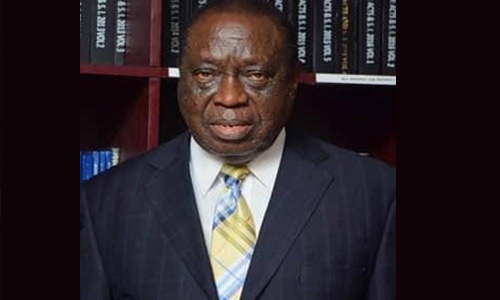
A former President of the Nigerian Bar Association (NBA), Chief T. J. O. Okpoko, SAN, has called on the Honourable Attorney-General of the Federation and Minister of Justice, Prince Lateef O. Fagbemi, SAN, to reject in its entirety the report of the three-man committee headed by Chief Wole Olanipekun, SAN, warning that any reliance on the report could undermine the constitutional governance of the Nigerian Bar Association and set a dangerous precedent for the legal profession.

In a detailed letter titled “Chief T. J. Onomigbo Okpoko, SAN’s Brief Reaction to ‘Directions and Outcomes of the Honourable Attorney General of the Federation, Prince Lateef O. Fagbemi, SAN on the Report of the 3-Man Committee’”, Chief Okpoko questioned the very premise upon which the committee was constituted, stating that he could find no evidence of any conflict between the NBA and any person or group that would warrant such intervention.
The former NBA President argued that the appointment of Chief Wole Olanipekun, SAN, as Chairman of the Committee was fundamentally flawed because of his acknowledged leadership role within Egbe Amofin O’odua, the body that instituted the litigation challenging the NBA’s electoral process.
According to him, this created an obvious conflict of interest, contrary to the established principle that no person should sit in judgment over a matter in which he has an interest. He therefore maintained that the Committee’s report could not validly form the basis of any directive or decision affecting the affairs of the NBA.
Chief Okpoko also challenged the legal standing of Egbe Amofin O’odua, stating that his search through NBA records revealed no basis for treating the association as an accredited or affiliated organ of the Nigerian Bar Association. He argued that Egbe Amofin lacks the constitutional authority to interfere in the NBA’s internal electoral process or determine who may contest for national office.
Rejecting the Committee’s findings on zoning, Chief Okpoko stated that the report contained historical inaccuracies regarding the origin and development of the NBA’s zoning arrangement. He emphasized that the zoning policy was never intended to empower any regional association to nominate or impose candidates on the NBA, nor to prevent other eligible lawyers from contesting elections.
He further argued that the practice of Egbe Amofin selecting a preferred candidate is purely an internal arrangement of that association and has no constitutional force within the NBA. Consequently, he maintained that no regional group has the authority to exclude qualified candidates from participating in national elections or restrict the right of NBA members across the country to freely choose their leaders.
The former NBA President warned that recognising Egbe Amofin as a nominating authority for NBA elections would amount to endorsing a process unknown to the NBA Constitution and would establish a dangerous precedent capable of undermining the democratic character of the Association.
He urged the Attorney-General to advise members of Egbe Amofin to support their preferred candidate through legitimate campaigning while allowing every qualified contestant to participate freely in the election.
Drawing from his experience as the 18th President of the Nigerian Bar Association, Chief Okpoko recalled the crisis that engulfed the NBA between 1992 and 1998 and the extensive efforts required to restore stability to the Association.
He cautioned against repeating mistakes that could plunge the NBA into another period of institutional instability, urging the Attorney-General to reconsider his position and reject any recommendation that would permit external groups to dictate the Association’s democratic processes.
Chief Okpoko concluded by appealing to the Attorney-General to exercise wisdom and safeguard the independence and constitutional integrity of the Nigerian Bar Association, warning that any attempt to legitimise Egbe Amofin as a nominating arm of the NBA would have far-reaching and potentially damaging consequences for the future of the legal profession in Nigeria
 Interested buyers are encouraged to place their orders and enquiries via:
0704 444 4777, 0704 444 4999, 0818 199 9888
Website: www.alexandernigeria.com
Interested buyers are encouraged to place their orders and enquiries via:
0704 444 4777, 0704 444 4999, 0818 199 9888
Website: www.alexandernigeria.com

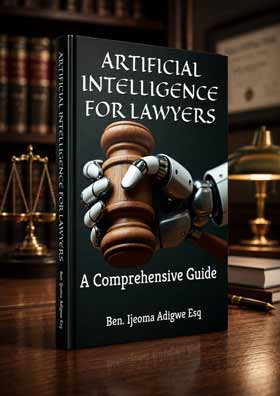 As an added bonus, every purchase comes with a FREE ebook titled: “How to use the AI in Legalpedia and Law Pavilion.”
Ohio Books Ltd praises the publication, stating:
"....this is the only Nigerian book I know of on the topic."
How to Order:
📞 Call, Text, or WhatsApp: 08034917063 | 07055285878
📧 Email: benadigwe1@gmail.com
🌎 Website: www.benadigwe.com
Ebook Version: Access it directly online at https://selar.com/prv626
Authored by Ben Ijeoma Adigwe Esq., ACiarb (UK), LL.M, Dip. in Artificial Intelligence, Director at the Delta State Ministry of Justice, Asaba, Nigeria.
_______________________________________________________________________
As an added bonus, every purchase comes with a FREE ebook titled: “How to use the AI in Legalpedia and Law Pavilion.”
Ohio Books Ltd praises the publication, stating:
"....this is the only Nigerian book I know of on the topic."
How to Order:
📞 Call, Text, or WhatsApp: 08034917063 | 07055285878
📧 Email: benadigwe1@gmail.com
🌎 Website: www.benadigwe.com
Ebook Version: Access it directly online at https://selar.com/prv626
Authored by Ben Ijeoma Adigwe Esq., ACiarb (UK), LL.M, Dip. in Artificial Intelligence, Director at the Delta State Ministry of Justice, Asaba, Nigeria.
_______________________________________________________________________
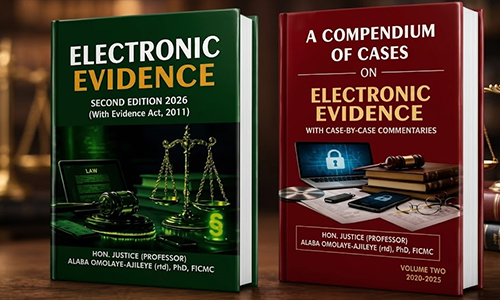
“Order Justice Omolaye-Ajileye’s Electronic Evidence Books Now” — Essential Guides On Evidence Act, Case Law And Digital Proof