*Asks How EU, US and UK Observers Will Monitor an Online Election, Questions Whether They Will Be Given Access to Backend Systems and Lawyers’ Data

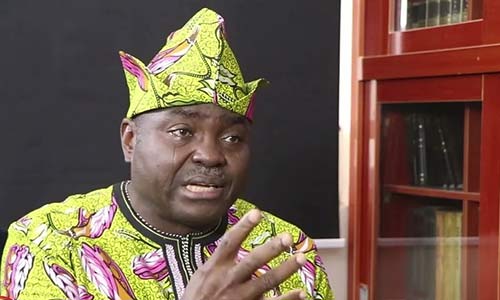
Chief J.S. Okutepa, SAN, has challenged the authority of NBA President Mazi Afam Osigwe, SAN, to invite the European Union, the United States, the United Kingdom, Yiaga Africa, the Transition Monitoring Group (TMG), and other organisations to observe the 2026 NBA national elections, questioning where the President derived the power to issue such invitations, asking how foreign observers would monitor an election conducted entirely online, questioning whether they would be given access to backend systems and lawyers’ data, and stating that international observers cannot address the fundamental concerns that “many believe the outcome of the forthcoming NBA elections have already been pre-determined.”
Okutepa’s response, addressed directly to President Osigwe, came after the NBA President informed him that the association had invited international and local observers to monitor the elections. The Senior Advocate, who has been a consistent critic of the NBA’s electoral processes spanning multiple election cycles, stated that while he was initially constrained not to comment because his views had been “misconcieved and taken very personal” by some, including the President, his love for “a united, strong, and independent NBA” compelled him to respond.
Okutepa SAN’s most pointed challenge was directed at the constitutional basis for the President’s action.
“My President sir, where did NBA possess the power to invite non-lawyers to observe elections of lawyers from? Sir where did you get the power to invite these organisations and countries from? Are you now Chairman of ECNBA? Is NBA the same as ECNBA?” Okutepa asked.
“I thought ECNBA is said to be an independent body far from your office and is not subject to the control of the President of the NBA. Why have you chosen to invite these countries and organisations? To score what point?” the Senior Advocate challenged.
The question strikes at the institutional architecture of the NBA’s electoral process. The ECNBA is constituted as an independent body responsible for conducting the elections, precisely so that the incumbent President, who may have preferences about the outcome, does not exercise control over the electoral process. If the invitation of election observers is a function of the ECNBA’s independence, the President’s unilateral decision to invite international monitors could be seen as an encroachment on the committee’s authority, the very kind of presidential interference that critics have alleged throughout the current election cycle.
Okutepa raised a practical question that goes to the heart of whether international election observation is meaningful in the context of an electronic vote.
“Sir I thought that the elections of the NBA 2026 are going to be conducted online. If the elections are going to be online as I was made to understand, how are those you have invited to monitor the elections going to monitor it?” Okutepa asked.
“Are they going to be allowed to see what goes on at the backend of the systems being used for the elections, or they will be giving access codes and access to the data of lawyers?” the Senior Advocate pressed.
The question is technically significant. Traditional election observation involves monitors watching physical processes: ballot paper distribution, voting, counting, and collation. In an online election, the critical processes, voter authentication, vote recording, vote counting, and result transmission, occur within electronic systems whose integrity can only be verified by examining the backend architecture, the source code, the database, the authentication logs, and the server infrastructure.
If international observers are merely shown the frontend, the voting interface that ordinary members see, their observation tells the electorate nothing about whether the backend processes are secure, transparent, and free from manipulation. If they are given access to the backend, that raises separate questions about the security and privacy of lawyers’ data.
Okutepa stated that the concerns driving the current NBA election crisis are about the integrity of the electoral process itself, not about the presence or absence of observers.
“Nigerian lawyers including my humble self are worried about the processes prior to this NBA elections. That informed the interventions of the past presidents of the NBA and the office and person of the Honourable Attorney General of the Federation. I was in the meeting,” Okutepa stated.
“I have been consistent in my view that the processes of NBA elections matter much more than inviting external bodies to observe what most lawyers feel is a stage-managed process to produce an already pre-determined outcome,” the Senior Advocate declared.
He described the invitation of observers as “populist propaganda that does not address the real issues and worries being expressed by well-meaning members of the bar.”
Okutepa directly challenged the President to explain how international observers would address the specific concerns that have been raised.
“Mr President, kindly guide me on how the invitations you extended to these external organisations and countries will restore the dwindling confidence of most reasonable Nigerian lawyers in the electoral processes of NBA, which many believe that the outcome of the forthcoming NBA elections have already been pre-determined,” Okutepa stated.
“I want to know sir what mechanism you have put in place that the much talked about universal suffrage is indeed universal suffrage and not an already one man or few men sitting somewhere to determine those to lead us at the behest of the emerging godfather of NBA elections,” the Senior Advocate added.
Okutepa drew on his long record of critiquing NBA electoral processes, reproducing comments he made after the 2018 NBA election to demonstrate the consistency of his position.
“I have been saying so much about the processes in NBA elections. In 2018 after the NBA elections I said: ‘I honestly believe that the processes that throw those who are to lead the Bar in the most populous black Nation should be the concerns of both the winners and losers of the election,'” Okutepa recalled.
He then recited the extended passage from his 2018 statement, which concluded with a series of declarations that have become his most quoted words on the subject:
“I weep for NBA. I weep for the legal profession. I weep for Nigeria. I weep for both young and old lawyers. I weep for those of us who saw this and stood by. I weep for those who allowed themselves to be used to produce the outcome we see now. I weep for those who preached transparency but engaged in conduct that is less than honest. I weep for young lawyers who are copying bad examples from the senior ones. I weep for those of us seniors who are not leading by examples. I weep for us who preferred to stomach perversion of due process on the grounds that we must not scatter NBA. I weep for myself that I found myself in the midst of this mess. I weep for the legal profession where light has been overtaken by darkness.”
The reproduction of this 2018 statement was deliberate, serving to demonstrate that the concerns being raised about the 2026 election are not new, that they have recurred across multiple election cycles, and that the structural problems in the NBA’s electoral process have not been addressed despite years of criticism.
Okutepa prefaced his critique with a personal declaration of loyalty to the association.
“Mr President, aside NBA I have no any other association. I love it and I would not want it to be weakened and destroyed,” Okutepa stated.
“Sir I am sorry if the views I expressed herein hurt you and anyone around you, but forgive me I must offer it in the interest of posterity and my conviction that a stronger and independent NBA cannot be achieved by populist propaganda that does not address the real issues and worries being expressed by well-meaning members of the bar,” the Senior Advocate added.
He also acknowledged that his views had made him a target: “Given how my views and stand on NBA politics and affairs and NBA elections are being misconceived and taken very personal by some, and in particular your good self, and how I am being targeted for unwarranted attacks, I was constrained initially not to make comments and to keep quiet so that I will not be misconceived and subjected to further attacks.”
“But the more I decided to resist not to write and to keep quiet, the more my love for a united, strong, and independent NBA, that must be run transparently by members of NBA and which is properly positioned to lead by example in democratic processes, made me to reply you, Mr President,” Okutepa stated.
Okutepa’s challenge to the invitation of international observers adds another layer to the multi-front dispute over the 2026 NBA election. The invitation was announced by President Osigwe during his Channels Television interview as a response to concerns about the electoral process, intended to demonstrate transparency and openness to external scrutiny.
However, Okutepa’s response reframes the invitation as itself part of the problem: a move by the NBA President, whose neutrality has been questioned by the Olanipekun Committee and whose conduct was found by the AGF’s accepted report to have been partisan, to create the appearance of transparency without addressing the substantive concerns about the ECNBA’s constitution, the service providers’ corporate standing, the authentication framework, and the overall integrity of the electoral architecture.
The Senior Advocate’s question about whether observers would access the backend of the electronic voting system remains unanswered. In the absence of such access, international observation of an online election risks becoming, as Okutepa implicitly suggested, a legitimising exercise that validates the outcome without verifying the process.
The NBA election remains scheduled for Saturday, July 18, 2026. Neither the ECNBA nor the NBA President has publicly responded to Okutepa SAN’s specific questions about the legal basis for inviting observers or the practical mechanism by which they would monitor an online election.
The letter was written by Chief J.S. Okutepa, SAN, addressed to the President of the Nigerian Bar Association, Mazi Afam Osigwe, SAN.
[A MUST HAVE] Evidence Act Demystified With Recent And Contemporary Cases And Materials

Available now for NGN 40,000 at ASC Publications, 10, Boyle Street, Onikan, Lagos. Beside High Court, TBS. Email publications@ayindesanni.com or WhatsApp +2347056667384. Purchase Link: https://paystack.com/buy/evidence-act-complete-annotation
______________________________________________________________________ “Enhance Legal Practice With Authoritative Reports” — Alexander Payne Offers Comprehensive Law Reports, Spanning Over A Century Of Nigerian Jurisprudence Interested buyers are encouraged to place their orders and enquiries via:
0704 444 4777, 0704 444 4999, 0818 199 9888
Website: www.alexandernigeria.com
Interested buyers are encouraged to place their orders and enquiries via:
0704 444 4777, 0704 444 4999, 0818 199 9888
Website: www.alexandernigeria.com