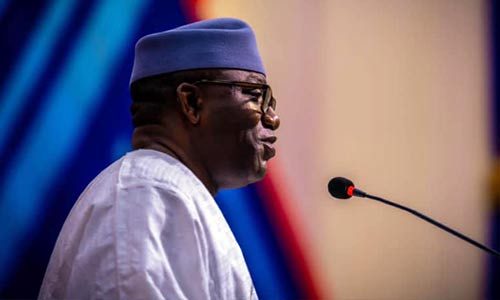
Former Ekiti State Governor, Dr Kayode Fayemi, has recounted how the Federal Government allegedly warned Ekiti and Ondo states against independently reconstructing the dilapidated Akure–Ado Ekiti road, saying both states were told they would not be reimbursed if they proceeded without federal approval.

Fayemi made the disclosure in August 2022 while reacting to efforts by the then Minister of State for Transportation, Prince Ademola Adegoroye, to get the Federal Government to accelerate work on the strategic interstate highway.
Adegoroye had met the then Minister of Works and Housing, Babatunde Fashola, SAN, and urged him to urgently address the condition of the road, saying residents and travellers in Ondo and Ekiti were experiencing considerable hardship because of its poor state. Fashola acknowledged at the time that funding difficulties had affected mobilisation of the contractor.
Reacting to the renewed intervention, Fayemi said he had spent about three years pushing for the reconstruction and dualisation of the road and had explored several financing options when progress under the Federal Government remained slow.
According to him, the project was eventually awarded at about ₦30 billion, but only about ₦2 billion had been released to the contractor at the time of his intervention.
“I have spent the last three years on the subject of this road,” Fayemi said, explaining that limited releases had prevented the contractor from executing the project at the expected pace.
Fayemi said Ekiti and Ondo subsequently turned to the African Development Bank for financing and secured in-principle support through the intervention of AfDB President, Dr Akinwumi Adesina.
According to the former governor, the states wanted to reconstruct and dualise the road themselves but encountered opposition because the route was classified as a federal road.
He alleged that the Federal Government refused to cede the road to the two states and warned that they would not be refunded if they went ahead with the project independently.
Fayemi later explained that, because the Federal Government was the sovereign authority required for the AfDB financing arrangement, Ekiti and Ondo ultimately agreed to transfer the proposed financing arrangement to the Federal Government so that the project could proceed.
He said the states even assisted federal officials in following up with the AfDB, but another difficulty emerged over compliance with the development bank’s procurement procedures.
According to Fayemi, the AfDB required its standard procurement process to be followed before the financing could be accessed, while the Federal Government had already awarded the project to a contractor.
The former governor maintained that the inability to reconcile the existing contract with AfDB procurement requirements further delayed access to the proposed funding.
He said efforts were subsequently made to secure Sukuk financing for the project, but that also failed to immediately translate into sufficient funding for the contractor.
Fayemi added that the states later began pursuing another option involving the Nigerian National Petroleum Company’s tax credit road programme as they searched for a workable financing route.
The former governor said the prolonged delay had even created friction between him and Fashola because of the frequency with which he raised the condition of the road.
He maintained that Ekiti and Ondo had earlier offered to take responsibility for the road, reconstruct it and introduce tolling as a means of recovering the investment, but the proposal was not initially accepted by the Federal Government.
The controversy highlighted the complications surrounding the rehabilitation of federal roads by state governments, particularly where states seek external financing but require federal consent because ownership and statutory responsibility for the roads remain with the Federal Government.
Adegoroye, who was then pressing for urgent federal intervention, said communities in both states were bearing the consequences of the delays and promised to continue engaging the Works Ministry until construction commenced.
Fashola, for his part, maintained that the road had not been abandoned and attributed the slow progress principally to funding constraints.
The difficulties continued beyond Fayemi’s intervention. By December 2022, the Federal Government had terminated the initial contract and re-awarded sections of the road to other contractors, while the original contractor, Dantata and Sawoe, commenced legal action challenging the termination. Reports at the time again put the amount released under the earlier arrangement at about ₦2 billion.

 Interested buyers are encouraged to place their orders and enquiries via:
0704 444 4777, 0704 444 4999, 0818 199 9888
Website: www.alexandernigeria.com
Interested buyers are encouraged to place their orders and enquiries via:
0704 444 4777, 0704 444 4999, 0818 199 9888
Website: www.alexandernigeria.com