The Nigeria Customs Service has announced the commencement of the Federal Government’s 2026 Fiscal Policy Measures and Tariff Amendments, introducing revised rules governing imports, exports, excise duties and other trade-related transactions.


The reforms, approved by President Bola Tinubu, amend Nigeria’s Customs and Excise Tariff framework as part of efforts to promote economic competitiveness, support domestic industries, strengthen revenue generation and align the country’s tariff system with its regional and international obligations.
The National Public Relations Officer of the Nigeria Customs Service, Deputy Comptroller Abdullahi Maiwada, announced the implementation in a statement issued on Wednesday.
According to the Service, the new measures include a revised Import Adjustment Tax List for the implementation of the Economic Community of West African States Common External Tariff for 2022 to 2027.
They also include a revised National List under the ECOWAS Common External Tariff, an updated Import Prohibition List, a revised list of goods liable to excise duty and a revised Export Prohibition List.
Another major component of the framework is the Green Tax surcharge imposed on motor vehicles with engine capacities of 2,000 cubic centimetres and above.
Under the policy, vehicles with engine capacities between 2,000cc and 3,999cc attract a two per cent surcharge, while vehicles with engines of 4,000cc and above attract four per cent.
Vehicles below 2,000cc, electric vehicles, mass-transit buses and qualifying locally manufactured vehicles are exempt from the surcharge.
Customs said the fiscal and tariff amendments were designed to facilitate legitimate trade while strengthening the administration and enforcement of government fiscal policies across the country.
It directed importers, exporters, manufacturers, licensed customs agents and other participants in Nigeria’s trade ecosystem to familiarise themselves with the amended tariff schedules.
“Importers, exporters, manufacturers, licensed customs agents, and other stakeholders are required to familiarise themselves with the provisions of the amended tariff schedules and ensure full compliance with the applicable fiscal and regulatory requirements governing their respective transactions,” the Service said.
The NCS said the complete 2026 Fiscal Policy Measures and Tariff Amendments had been published on its official website to ensure public access and support a smooth transition to the revised framework.
Stakeholders were encouraged to carefully study the document and obtain proper guidance before commencing transactions affected by the new tariff classifications, duties, taxes or prohibitions.
The broader fiscal measures also reduced tariffs on several food products, vehicles, industrial inputs and construction materials.
Under the framework, import duties on fully built passenger vehicles were reduced from 70 per cent to 40 per cent, while tariffs on bulk rice were reduced from 70 per cent to 47.5 per cent.
Duties on broken rice were reduced to 30 per cent, while agricultural and manufacturing machinery were granted zero-duty status.
Tariffs on raw sugar, palm oil, steel products, electrical components, medical equipment and other industrial materials were also revised.
The Federal Government said the changes were intended to lower business input costs, stimulate industrial activity, support local production and ease the cost of essential goods.
The Customs Service maintained that it would continue to discharge its responsibilities relating to trade facilitation, revenue collection and border security under the new framework.
It added that the successful implementation of the reforms would require cooperation from importers, exporters, manufacturers, customs agents and other stakeholders.
According to the Service, adherence to the revised measures will contribute to building a more competitive, transparent and sustainable Nigerian economy.
 Interested buyers are encouraged to place their orders and enquiries via:
0704 444 4777, 0704 444 4999, 0818 199 9888
Website: www.alexandernigeria.com
Interested buyers are encouraged to place their orders and enquiries via:
0704 444 4777, 0704 444 4999, 0818 199 9888
Website: www.alexandernigeria.com

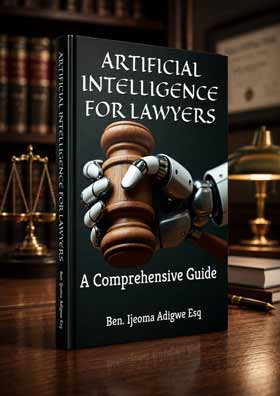 The book also examines Nigeria's legal ecosystem, focusing on the LPELR and NBA AI Guidelines. As a bonus, every purchase comes with a FREE eBook titled: How to Use the AI Features in LegalPedia and LawPavilion.
Ohio Books Ltd praises the publication, stating:
"....this is the only Nigerian book I know of on the topic."
How to Order:
📞 Call, Text, or WhatsApp: 08034917063 | 07055285878
📧 Email: benadigwe1@gmail.com
🌎 Website: www.benadigwe.com
Ebook Version: Access it directly online at https://selar.com/prv626
Authored by Ben Ijeoma Adigwe Esq., ACIarb (UK), LL.M, Dip. in Artificial Intelligence, Director at the Delta State Ministry of Justice, Asaba, Nigeria.
_______________________________________________________________________
The book also examines Nigeria's legal ecosystem, focusing on the LPELR and NBA AI Guidelines. As a bonus, every purchase comes with a FREE eBook titled: How to Use the AI Features in LegalPedia and LawPavilion.
Ohio Books Ltd praises the publication, stating:
"....this is the only Nigerian book I know of on the topic."
How to Order:
📞 Call, Text, or WhatsApp: 08034917063 | 07055285878
📧 Email: benadigwe1@gmail.com
🌎 Website: www.benadigwe.com
Ebook Version: Access it directly online at https://selar.com/prv626
Authored by Ben Ijeoma Adigwe Esq., ACIarb (UK), LL.M, Dip. in Artificial Intelligence, Director at the Delta State Ministry of Justice, Asaba, Nigeria.
_______________________________________________________________________
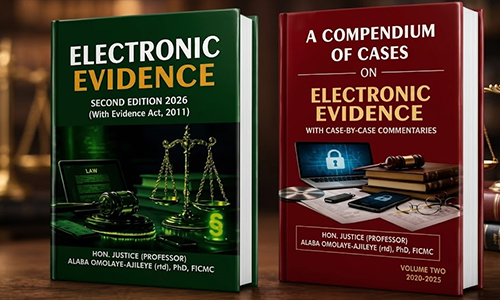
“Order Justice Omolaye-Ajileye’s Electronic Evidence Books Now” — Essential Guides On Evidence Act, Case Law And Digital Proof