By C. K. Anyanwu, Esq.& Amarachi Lilian Obi (Mrs)

Introduction
The evolution of telecommunications has fundamentally altered the landscape of tortious liability. In the digital age, a single click can disseminate information globally, raising complex questions about where a legal “wrong” actually occurs. The Court of Appeal recently addressed these complexities in the landmark case of Daily Times (Nigeria) Ltd v. Arum (2023) 17 NWLR (Pt. 1914) 559 CA, setting a definitive precedent for online defamation in Nigeria.
a.) Defining the “Online” Space
Legal clarity begins with definitions. The Court defines “online” as being connected to, served by, or available through a system, specifically computer or telecommunications systems like the internet. This definition moves the court away from physical print and into the realm of virtual accessibility.
b.) The Global Implication of Digital Publication
One of the most profound takeaways from the Arum case is the court’s recognition of the “universal accessibility” of the internet. Unlike a physical newspaper with limited circulation, an online publication implies an inherent desire by the publisher to make the material available globally.
c.) The Jurisdictional Test: Where Does the Libel Occur?
The most critical aspect of this judgment concerns jurisdiction. In traditional libel, the cause of action is complete upon publication. However, for online content, the Court of Appeal has established a “Download and Access” rule:
i) A publication available online is deemed to take place at the location where it is downloaded or accessed.
ii) The cause of action is not complete by the mere act of uploading. It must be accessed or downloaded by a third party in a specific jurisdiction.
iii) Mere “virtual existence” or passive internet activity is insufficient to confer jurisdiction. The law requires a nexus between the forum and the injury.
d.) Establishing Venue in State High Courts
To determine which State High Court has the requisite jurisdiction to hear a suit against a defendant who may reside elsewhere, the claimant must prove:
- The publication was accessed or downloaded in that State by the plaintiff.
- The plaintiff ordinarily resides or carries on business in that State.
- The publication was accessed or downloaded in that State by the plaintiff’s witnesses.
In Daily Times v. Arum (supra), the Court found that because the respondent (who lived in Enugu) and his witnesses accessed the defamatory material in Enugu, and because the content targeted events and personalities within Enugu, the High Court of Enugu State possessed the jurisdiction to hear the matter under its Civil Procedure Rules.
Conclusion: (No Hiding Place for Bloggers)
The Court of Appeal has sent a clear message to digital publishers and bloggers: the “borderless” nature of the internet is not a shield against litigation. If a publisher “offloads” defamatory material onto the internet, they must be prepared to justify their claims wherever that material is read, particularly where the victim is targeted.
This decision strengthens the rights of aggrieved parties to seek redress in their own jurisdictions, provided they can prove the material was consumed there.
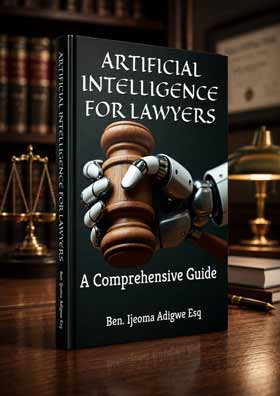 The book also examines Nigeria's legal ecosystem, focusing on the LPELR and NBA AI Guidelines. As a bonus, every purchase comes with a FREE eBook titled: How to Use the AI Features in LegalPedia and LawPavilion.
Ohio Books Ltd praises the publication, stating:
"....this is the only Nigerian book I know of on the topic."
How to Order:
📞 Call, Text, or WhatsApp: 08034917063 | 07055285878
📧 Email: benadigwe1@gmail.com
🌎 Website: www.benadigwe.com
Ebook Version: Access it directly online at https://selar.com/prv626
Authored by Ben Ijeoma Adigwe Esq., ACIarb (UK), LL.M, Dip. in Artificial Intelligence, Director at the Delta State Ministry of Justice, Asaba, Nigeria.
______________________________________________________________________
[A MUST HAVE] Evidence Act Demystified With Recent And Contemporary Cases And Materials
The book also examines Nigeria's legal ecosystem, focusing on the LPELR and NBA AI Guidelines. As a bonus, every purchase comes with a FREE eBook titled: How to Use the AI Features in LegalPedia and LawPavilion.
Ohio Books Ltd praises the publication, stating:
"....this is the only Nigerian book I know of on the topic."
How to Order:
📞 Call, Text, or WhatsApp: 08034917063 | 07055285878
📧 Email: benadigwe1@gmail.com
🌎 Website: www.benadigwe.com
Ebook Version: Access it directly online at https://selar.com/prv626
Authored by Ben Ijeoma Adigwe Esq., ACIarb (UK), LL.M, Dip. in Artificial Intelligence, Director at the Delta State Ministry of Justice, Asaba, Nigeria.
______________________________________________________________________
[A MUST HAVE] Evidence Act Demystified With Recent And Contemporary Cases And Materials

 Interested buyers are encouraged to place their orders and enquiries via:
0704 444 4777, 0704 444 4999, 0818 199 9888
Website: www.alexandernigeria.com
Interested buyers are encouraged to place their orders and enquiries via:
0704 444 4777, 0704 444 4999, 0818 199 9888
Website: www.alexandernigeria.com