INTRODUCTION

The importance of Law of Evidence in any Judicial system can not be over emphasized. The exact definition of what evidence entails has always offered special difficulties to legal writers.
It must be appreciated that many Scholars have made their contributions as to what the meaning of Evidence is about . However, this writer is only concern whether High court , Appeal Court and Supreme court in their appellate jurisdictions would apply the provisions Evidence Act over appeals from courts that are not bound to apply Evidence Act .
Meaning Of Evidence
Oxford Advance Learner’s Dictionary New 8th Edition at page 503 , defines Evidence to mean the facts , signs or objects that make you believe that something is true. It also defines Evidence to mean the Information that is used in court to try to prove something.
Professor Cross ( in his Cross on Evidence ) defines Evidence as the Testimony , hearsay , document , things and facts which a court will accept as evidence of the facts in issue in a given case.
Also Nigerian authors are not left out in lending their credence as to what the meaning of evidence is all about . Akinola Aguda in his book The Law of Evidence defines judicial evidence to mean the means by which facts are proved in order to prove or disprove some facts in issue.
Therefore , from the above definition , it can be said without mincing word that the functional word distillable from examination of evidence is fact.
Fact is defined in Section 258 of the Evidence Act ,2011 to mean (a) anything , state of things capable of being perceived by the senses ; and
(b) any mental condition of which any person is conscious…
The Supreme court in the case of EMMANUEL .M.O. CHUKWUOGOR V RICHARD OBIGIABOR OBIORA( 1987) 3 NWLR pt 61 held that in its broad sense , Evidence encompasses and includes the means employed for the purpose of proving a disputed facts .
Therefore , Evidence is the means of proving the truth of an alleged fact while the Law of Evidence is the rules guiding the admissibility of evidence in the court.
Having proferred the meaning of Evidence , the question now , Whether High Court , Court of Appeal and Supreme court in their appellate jurisdictions would apply the provisions of Evidence Act over appeals from courts that are not bound to apply the Evidence Act ?
The Evidence Act 2011 has specified the types of Proceedings and the courts in which its provisions are applicable .
Thus ,the Act provides in Sections 256 as follows:
This Act shall apply to all the judicial proceedings in or before any court established in the Federal Republic of Nigeria…
In the light of the above provisions , the general rule is that the Evidence Act applies to all the proceedings before the courts established in Nigeria .
Section 6 of the 1999 Constitution establishes the Superior courts of records in the country. Besides , there are other courts which include Magistrate/District court , Sharia/ Area Court and other Special courts such as court martial , Election Petition Tribunal . Court for this purpose, could also include all judges and magistrates and except arbitrators , all persons legally authorised to take evidence.
Ipso facto , the Evidence Act went further to exempt or limit the application of the Act in proceedings before some of these courts.
The exemptions and limitations are provided as follows :
… but it shall not apply to
- Proceeding before an arbitrator
- a field general court Martial ;or
- Judicial proceeding in any civil cause or matter in or before any Sharia court of appeal or customary court of Appeal , Area court or customary court , unless any authority empowered to do so under the constitution , by order published in the Gazette, confers upon any or all Sharia court of Appeal, Customary court of Appeal ,Area court or customary courts in the Federal Capital Territory Abuja or a State , as the case may be , power to enforce any or all the provisions of this Act.
(2) In Judicial proceeding in any criminal cause or matter , in or before an Area Court , the court shall be guided by the provisions of this Act …
Notwithstanding anything in this section , an Area court shall , in Judicial proceeding in any Criminal cause or matter , be bound by the provisions of Sections 134 to 140.
The Court held in the case of DKE V NWIZI (2013)LPELR CA /E/163/ 2011, that section 256(1)paragraph C of the Evidence Act , 2011 expressly excludes or ousts the application of the Evidence Act to civil causes or matters in proceedings before customary court .Also see the case of Latunde V Lajinfin ( 1989)5 SCNJ59.
The settled law is that the laws applicable in an appellate court are normally the same as those that apply in the court from which the case on appeal comes .See ONIBUDO AND ORS V AKIBU &ORS ( 1982) SC 60.
Ipso facto , from the above settled law , one can draw a conclusion that Evidence Act would not be applied by the Appellate Courts over appeals from the courts which have been exempted from applying the Evidence Act.
In the light of the above , the Supreme court held in the case of OGUNYEMI V OJAYEMI (1987)1 NWLR pt 760 that …since Evidence Act does not apply in Customary Court , a high court in its appellate jurisdiction to hear appeals from the Customary court would be in error to apply the provisions of the Act in deciding an appeal to it from the Customary court
Thus , recently in Garkuwa Pina vs Jagaba Mai Angwa ( 2018) LPELR SC .122/ 2006 the Court of Appeal applied the provisions of Evidence Act in determining the admissibility of an admission made in exhibit 1. On further appeal to the Supreme court , it was held if the Area Court is not bound to apply the provisions of the Evidence Act , the High Court and the Court of Appeal had no jurisdictions to apply the provisions of the Evidence act to the decisions that emanated from the Upper Area Court.
CONCLUSION.
In view of the above provisions of Evidence Act and Judicial interpretation of the said provisions , High Court , Court of Appeal and Supreme court in their appellate jurisdictions have no jurisdictions to apply the provisions of the Evidence Act over appeals emanating from the courts which are not bound to apply the provisions of the Evidence Act.
However, they are mandatory to observe the rules of Natural Justice and Fairness . See Garkuwa Pina v Jagaba Mai Angwa supra.
O.T.Olamide, is a 400level Law student of Ahmadu Bello University ,Zaria, Kaduna State.
Phone No: 08144856315, Email : olaniyitimothyolamide@gmail.com

Get your copy today and take the first step toward financial growth:👉 https://selar.co/4f16676016
_______________________________________________________________________ ARTIFICIAL INTELLIGENCE FOR LAWYERS: A COMPREHENSIVE GUIDE
Reimagine your practice with the power of AI “...this is the only Nigerian book I know of on the topic.” — Ohio Books Ltd
Authored by Ben Ijeoma Adigwe, Esq., ACIArb (UK), LL.M, Dip. in Artificial Intelligence, Director, Delta State Ministry of Justice, Asaba, Nigeria.
Bonus:
Get a FREE eBook titled “How to Use the AI in Legalpedia and Law Pavilion” with every purchase.
ARTIFICIAL INTELLIGENCE FOR LAWYERS: A COMPREHENSIVE GUIDE
Reimagine your practice with the power of AI “...this is the only Nigerian book I know of on the topic.” — Ohio Books Ltd
Authored by Ben Ijeoma Adigwe, Esq., ACIArb (UK), LL.M, Dip. in Artificial Intelligence, Director, Delta State Ministry of Justice, Asaba, Nigeria.
Bonus:
Get a FREE eBook titled “How to Use the AI in Legalpedia and Law Pavilion” with every purchase.
How to Order: 📞 Call, Text, or WhatsApp: 08034917063 | 07055285878 📧 Email: benadigwe1@gmail.com 🌐 Website: www.benadigwe.com
Ebook Version: Access directly online at: https://selar.com/prv626
________________________________________________________________________ The Law And Practice Of Redundancy In Nigeria: A Practitioner’s Guide, Authored By A Labour & Employment Law Expert Bimbo Atilola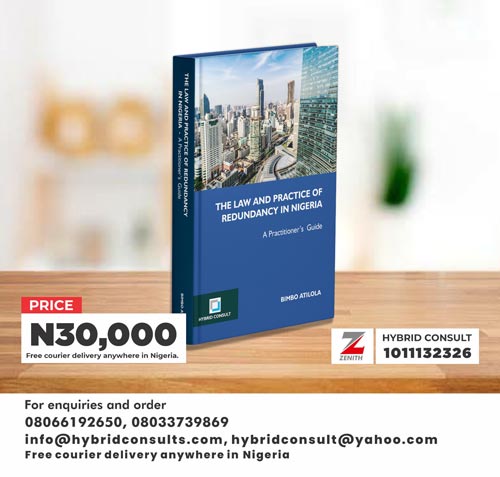 _______________________________________________________________________
[A MUST HAVE] Evidence Act Demystified With Recent And Contemporary Cases And Materials
_______________________________________________________________________
[A MUST HAVE] Evidence Act Demystified With Recent And Contemporary Cases And Materials