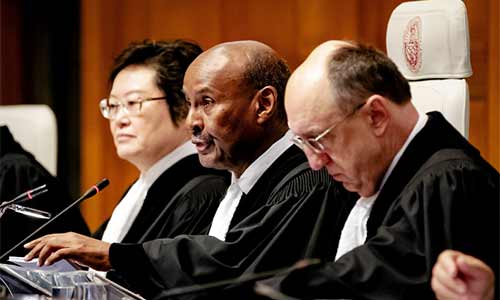
The UN’s top court on Wednesday ordered Uganda to pay the Democratic Republic of Congo $325 million over a brutal war two decades ago, just a fraction of what Kinshasa demanded.

The ruling by the International Court of Justice (ICJ) comes as a blow to DR Congo after it sought a massive $11 billion in reparations over the devastating conflict that lasted from 1998 to 2003.
Judges said Kinshasa had failed to prove its African neighbour was directly responsible for any more than 15,000 of the hundreds of thousands of people believed to have died in the war.
“The court sets out the total amount of compensation awarded to the DRC, which is 325 million US dollars,” said Joan Donoghue, the chief judge of the Hague-based court.
Breaking down the figure, the court said Uganda must pay $225 million for damage to persons, including deaths, injuries and sexual violence, and $40 million for damage to property.
It must also pay $60 million for damage to natural resources, including the looting of coltan, a metallic ore used in phones and computers, and other raw materials as well aor deforestation and the destruction of wildlife.
The judgment caps a long legal battle.
In 2005 the ICJ ruled that Uganda had to pay reparations, but the two countries never settled on an amount and no money changed hands.
Kinshasa then claimed more than $11 billion for the occupation of its volatile northeastern Ituri region.
‘Wrongful Acts’
Awarding DR Congo less than one-thirtieth of what it had demanded, the court acknowledged that Uganda was to blame for a “significant part” of the casualties in the war due to its “wrongful international acts”.
But judges said there was “insufficient evidence to support the DRC’s claim of 180,000 civilian deaths for which Uganda owes reparation” by being directly responsible.
“The court considers that the evidence presented to it suggests that the number of deaths for which Uganda owes reparations falls in the range of 10,000 to 15,000 persons,” said Donoghue.
It relied on UN figures and expert reports for its figures, adding that “detailed proof of specific events that have occurred in a devastating war in remote areas almost two decades ago is not available”.
At its height, the conflict drew in nine African countries, with Uganda and Rwanda backing rebel forces against the Kinshasa government as they jostled for control of the mineral-rich Ituri region.
Mixed Feelings
In Ituri on Wednesday, motorbike taxi driver Lodha Losa welcomed the ruling.
The Ugandans “looted our belongings, raped our women,” he said in the main town of Bunia. “They must give back, it’s our right.”
Edouard Uvoya, a preacher, agreed.
Ugandan soldiers carried out “mass killings”, he said. “They stole gold, diamonds, ivory, wood — even copper electrical wiring.”
But Christian Uteki, a lawyer, said he had mixed feelings.
“Uganda was sentenced and that is a reason to be proud,” he said.
But “the amount of $325 million is very small,” in view of “all the damage done”.
Uganda’s representatives rejected what they called “staggering” demands for the claim, telling the court last year that the $11 billion claimed by DR Congo was “disproportionate and economically ruinous”.
“It essentially seeks to make Uganda responsible for everything that happened in the conflict,” Uganda’s Attorney General William Byaruhanga told the court.
Founded after World War II, the ICJ in The Hague rules in disputes between countries, mainly based on treaties. Its decisions are final and cannot be appealed.
Currently, Congolese and Ugandan troops are back in the region, but this time in an unprecedented offensive against the Allied Democratic Forces, the region’s deadliest militia, which the Islamic State group calls its affiliate.
In the latest suspected ADF rebel attack, three people were killed on Saturday in the Beni territory in the neighbouring North Kivu province.
[A MUST HAVE] Evidence Act Demystified With Recent And Contemporary Cases And Materials

Available now for NGN 40,000 at ASC Publications, 10, Boyle Street, Onikan, Lagos. Beside High Court, TBS. Email publications@ayindesanni.com or WhatsApp +2347056667384. Purchase Link: https://paystack.com/buy/evidence-act-complete-annotation
______________________________________________________________________ “Enhance Legal Practice With Authoritative Reports” — Alexander Payne Offers Comprehensive Law Reports, Spanning Over A Century Of Nigerian Jurisprudence Interested buyers are encouraged to place their orders and enquiries via:
0704 444 4777, 0704 444 4999, 0818 199 9888
Website: www.alexandernigeria.com
Interested buyers are encouraged to place their orders and enquiries via:
0704 444 4777, 0704 444 4999, 0818 199 9888
Website: www.alexandernigeria.com