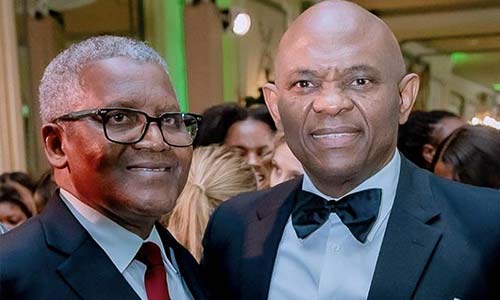
The United Bank for Africa Group has confirmed the arrest of three individuals in connection with the circulation of false and defamatory claims targeting its Group Chairman, Tony O. Elumelu, describing viral reports alleging that the billionaire banker had divorced his wife as “entirely fabricated, malicious, and intended to mislead the public while damaging his reputation.”

In a related development, the Dangote Group has dismissed as “false, malicious, and baseless” a separate publication alleging that its President, Aliko Dangote, distanced himself from Elumelu, stating categorically that “at no time did the President or the Group make such statements or express such sentiments” and that Dangote “maintains a longstanding and cordial relationship” with Elumelu.
The dual responses from two of Africa’s most prominent corporate organisations against what they describe as coordinated disinformation mark a significant escalation in how Nigerian business leaders are responding to the growing threat of fabricated online content, with UBA pursuing criminal prosecution and both groups issuing cease-and-desist directives backed by threats of legal action.
UBA stated that the matter has been escalated to law enforcement authorities, who have commenced a full investigation. Three individuals have been arrested in connection with the publication of the false divorce claims.
Those arrested include Mr. Kingsley Akunemeihe, who operates the social media handle @Directorkem; Mr. Chigozie Success Ihebom; and Mr. John Surpruchi Nwanorue, who operates the handle @problemchimky.
UBA stated that investigations are ongoing and may lead to further arrests and prosecutions of individuals involved in “originating or amplifying the false claims,” a formulation that puts on notice not only those who created the content but also those who shared, republished, or otherwise spread the defamatory material.
The bank issued a cease-and-desist directive to “all individuals and platforms disseminating the content,” demanding immediate removal and “preservation of all related records for potential legal proceedings.”
The preservation directive is legally significant. By requiring platforms and individuals to preserve records rather than simply delete the content, UBA is ensuring that the digital trail of the defamatory material, including who posted it, when, and how it spread, remains available as evidence for the criminal prosecution and any civil proceedings that may follow.
UBA described the viral reports as a deliberate campaign to damage the reputation of its Group Chairman.
The bank “reaffirmed its commitment to protecting the integrity, privacy, and reputation of its leadership and brand,” stating that it would “pursue all available legal remedies against those found culpable.”
The statement did not disclose the specific content of the fabricated divorce claims or the platforms on which they were circulated, but the reference to “viral reports” and the arrest of individuals who operate social media accounts suggests the content was primarily disseminated through social media platforms and may have been amplified by blogs and online publications.
The decision to pursue criminal prosecution rather than merely seeking civil damages or content removal signals UBA’s determination to establish a deterrent against future defamatory campaigns targeting its leadership. The arrests of the three named individuals, with the prospect of additional arrests, send a message that fabricating claims about public figures for online engagement carries real-world criminal consequences.
The Dangote Group’s response, issued by Group Chief Branding and Communications Officer Anthony Chiejina, addressed a separate but apparently related publication that alleged Aliko Dangote had publicly explained why he “distanced himself” from Elumelu.
“The Dangote Group has become aware of a publication titled ‘Aliko Dangote Speaks Out on Why He Distanced Himself from Tony Elumelu,’ which is false, malicious, and baseless,” the statement read.
The Group addressed several specific claims in the publication.
On the alleged financing of the Dangote Refinery through personal borrowing, the Group was categorical: “The Group categorically rejects claims that the development of the Dangote Petroleum Refinery and Petrochemicals was financed through personal borrowing from friends. These assertions are wholly inaccurate and constitute a deliberate misrepresentation of facts.”
“As a matter of principle, Aliko Dangote neither finances his projects through personal borrowing from friends nor engages in lending arrangements of that nature. Any individual making such claims should provide verifiable evidence to substantiate them,” the Group stated.
On the alleged estrangement, the Group was equally direct: “Equally false are suggestions of any estrangement between Aliko Dangote and Mr Tony Elumelu, with whom he maintains a longstanding and cordial relationship.”
The statement that Dangote “maintains a longstanding and cordial relationship” with Elumelu directly contradicts the entire premise of the fabricated publication, which had presented the two business leaders as being at odds.
The Dangote Group raised an additional concern that extends beyond the specific publication to a broader pattern of disinformation.
“The Group notes with concern a rising pattern of fabricated statements and the unauthorised use of Aliko Dangote’s name, likeness, and image in AI-generated advertisements and other misleading content. These actions amount to reputational harm and potential fraud,” the Group stated.
The reference to AI-generated content highlights an emerging threat that is affecting public figures globally but has become particularly acute in Nigeria’s social media environment. Advances in artificial intelligence have made it increasingly easy to create realistic but entirely fabricated content, including fake interviews, doctored images, and manufactured quotes, that can be disseminated as genuine statements by prominent individuals.
For a figure of Dangote’s stature, whose name is associated with Africa’s largest private sector conglomerate and whose endorsement or criticism of any product, service, or individual carries enormous commercial weight, the unauthorised use of his name and likeness in AI-generated content poses not only reputational risks but potential financial harm to consumers who may make decisions based on fabricated endorsements.
Both UBA and the Dangote Group issued explicit warnings about legal consequences for those involved in creating or spreading the false content.
UBA stated it would “pursue all available legal remedies against those found culpable,” with three individuals already arrested and investigations ongoing.
The Dangote Group stated: “All individuals, organisations, and platforms involved in the creation, publication, or dissemination of such false content are hereby put on notice to desist immediately. The Group will take appropriate steps, including legal action where necessary, to protect its reputation and that of its leadership.”
The parallel warnings from two of Nigeria’s largest corporate entities create a significant precedent. While individual defamation claims are common, the coordinated response from UBA and Dangote against what appears to be a linked disinformation campaign suggests a more aggressive corporate approach to protecting executive reputation.
The fabricated content about Elumelu and Dangote fits within a wider pattern of online disinformation targeting Nigeria’s business leaders, politicians, and public figures.
Social media platforms and online blogs have become vehicles for fabricated stories about divorces, financial disputes, corporate feuds, and personal scandals involving prominent Nigerians. The content is often designed to generate clicks and advertising revenue for the publishers, with sensational headlines and fabricated quotes attracting engagement from users who may not verify the claims before sharing them.
The economic incentive for creating such content is significant. A viral story about a billionaire’s divorce or a feud between two of Africa’s richest men can generate millions of views and substantial advertising income for the publisher, even if the content is entirely fabricated.
The legal and reputational consequences for the subjects of such fabrications, however, can be severe. False claims about a bank chairman’s personal life could affect investor confidence, share prices, and institutional relationships. False claims about a rift between two major business leaders could affect business partnerships, market perceptions, and commercial dealings.
The Dangote Group concluded its statement by reaffirming its corporate identity and mission.
“Dangote Group remains committed to upholding the highest standards of integrity, while continuing to drive industrialisation, economic self-sufficiency, and sustainable development across Africa,” the Group stated.
The statement positions the Group’s response not merely as a defence of its president’s personal reputation but as a defence of the corporate values and mission that the Dangote name represents.
The combined actions of UBA and the Dangote Group send a clear message to the ecosystem of blogs, social media accounts, and online publications that profit from fabricating content about prominent Nigerians.
Three arrests have already been made. Investigations are ongoing. Further arrests may follow. Cease-and-desist directives have been issued. Records are being preserved for legal proceedings. And two of Africa’s most powerful corporate entities have committed their legal resources to pursuing those responsible.
For publishers and social media users who create or amplify fabricated content for engagement and profit, the arrests in the Elumelu case demonstrate that the digital anonymity that social media appears to offer does not protect against criminal prosecution. The three arrested individuals operated identifiable social media accounts, and their real-world identities were established and acted upon by law enforcement.
The episode may serve as a turning point in how Nigerian corporations and public figures respond to online defamation, moving from reactive statements denying false claims to proactive criminal prosecution of those who fabricate and disseminate them.
As UBA stated, it will “pursue all available legal remedies.” As the Dangote Group warned, “appropriate steps, including legal action” will be taken.
The message is unambiguous: fabricating stories about corporate leaders for online engagement is no longer a consequence-free activity in Nigeria.
[A MUST HAVE] Evidence Act Demystified With Recent And Contemporary Cases And Materials

Available now for NGN 40,000 at ASC Publications, 10, Boyle Street, Onikan, Lagos. Beside High Court, TBS. Email publications@ayindesanni.com or WhatsApp +2347056667384. Purchase Link: https://paystack.com/buy/evidence-act-complete-annotation
______________________________________________________________________ “Enhance Legal Practice With Authoritative Reports” — Alexander Payne Offers Comprehensive Law Reports, Spanning Over A Century Of Nigerian Jurisprudence Interested buyers are encouraged to place their orders and enquiries via:
0704 444 4777, 0704 444 4999, 0818 199 9888
Website: www.alexandernigeria.com
Interested buyers are encouraged to place their orders and enquiries via:
0704 444 4777, 0704 444 4999, 0818 199 9888
Website: www.alexandernigeria.com