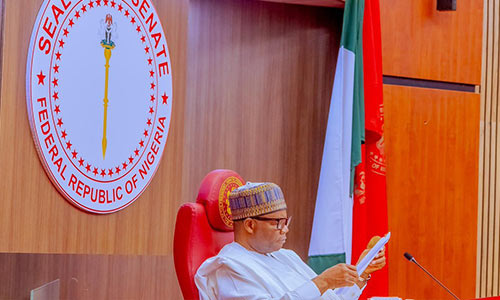
Senate President Godswill Akpabio has clarified that the Senate did not reject electronic transmission of election results, stating that what the upper legislative chamber did was to retain the provision in the 2022 Electoral Act which allows the Independent National Electoral Commission (INEC) to determine the manner in which results are transmitted.

Akpabio made the clarification on Wednesday after the Senate passed the Electoral Act, 2022 (Repeal & Re-enactment) Bill, 2026, following over five hours of clause-by-clause consideration and debate.
“Distinguished colleagues, the social media is already awash with reports that the Senate has literally rejected electronic transmission of results. That is not true,” Akpabio said after the bill was passed.
“What we did was to retain the electronic transmission which has been in the Act and was used in 2022. So please, do not allow people to confuse you. If you are in doubt, we will make our final votes and proceedings available to you if you apply.
“This Senate under my watch has not rejected the electronic transmission of results. It is in my interest as a participant in the next election for such to be done. So please don’t go with the crowd.
“We have retained what was in the previous provision by way of amendment. That was all we did. The previous provision had made allowance for electronic transmission. So, it is still there as part of our law. We cannot afford to be going backwards.”
Akpabio urged Nigerians to distinguish between rejecting electronic transmission and rejecting mandatory electronic transmission.
The Senate President also dismissed claims that the Senate deliberately delayed the passage of the bill.
@thenigerialawyer“Don’t Go With The Crowd, Don’t Allow People Confuse You” — Senate President Says Upper Chamber Retains INEC’s Discretion On Results Transmission♬ original sound – TheNigeriaLawyer
“There was no deliberate attempt on the part of the Nigerian Senate to delay the amendment of the Electoral Act. Our intention had always been to ensure that we do our best, and we do it painstakingly, taking our time to ensure that what comes out reflects the yearnings and aspirations of all Nigerians, and also to be sure that the next election, all questions connected with the next election will be answered by the amendments to the Electoral Act 2022,” Akpabio stated.
The bill was the only item listed on the Order Paper after a valedictory session for the late Senator Okey Ezea. The clauses were examined at the Committee of the Whole, after which Akpabio announced their passage following a majority voice vote.
The amendment bill was approved after lawmakers engaged in over five hours of debate and clause-by-clause consideration of all 155 clauses. Amendments were made to a number of clauses, with the majority retained as proposed.
A major point of debate was the electronic transmission of results under Clause 60. Lawmakers rejected a proposal that would have made electronic transmission mandatory, which sought to compel presiding officers to upload polling unit results to the INEC Result Viewing Portal (IReV) in real time after results were signed and stamped on Form EC8A.
Instead, the Senate retained the current provision that allows INEC to determine “the manner in which results and accreditation data are transferred.”
Under the Electoral Act 2022, electronic transmission is not expressly compulsory. Section 60 provides that results shall be transferred “in a manner as prescribed by the Commission,” giving INEC the power to determine whether, when, and how technology such as BVAS and the IReV portal is used.
This was the legal basis upon which INEC uploaded polling unit results electronically during the 2023 general elections, even though the law itself did not impose a strict obligation for real-time transmission.
The rejected Senate amendment sought to change that framework by compelling presiding officers to upload results immediately and electronically, a move civil society groups and opposition parties argue would strengthen transparency and reduce manipulation.
But lawmakers maintained that embedding a rigid technical process in the law could limit INEC’s flexibility, especially in areas with connectivity challenges.
Election Timelines Reduced: The lawmakers reviewed the electoral timetable by reducing the period within which INEC must publish the notice of election from 360 days to 180 days. This followed the adoption of a motion by Senator Tahir Monguno, who explained that the reduction was necessary to enable INEC meet up with the requirements on publication of notice, saying that it was already late if the 360 days was taken into consideration regarding the next general election.
Similarly, the deadline for political parties to submit their candidate lists was shortened from 180 days to 90 days before the election.
Vote Buying Penalties: To curb the growing menace of vote buying, the committee amended Section 22 of the Act to impose stiffer penalties, increasing the fine for offenders from ₦500,000 to ₦5 million.
However, the Senate rejected a proposed 10-year jail term for buying or selling voter cards. Instead, it retained the existing two-year imprisonment option and increased the fine from ₦2 million to ₦5 million.
Voter Identification: On voter identification and accreditation under Clause 47, the Senate formally replaced the use of “smart card readers” with the Bimodal Voter Accreditation System (BVAS). However, lawmakers rejected the introduction of electronically generated voter identification, insisting that the Permanent Voter Card (PVC) remains the only valid means of identification at polling units.
Election Petitions: Lawmakers also struck out Clause 142, which would have allowed proof of non-compliance in election petitions using only original or certified documents without oral evidence. The clause was removed to avoid what senators described as unnecessary delays in court proceedings.
Ballot Paper Inspection: On ballot paper inspection under Clause 44, the Senate retained the current procedure, which requires INEC to invite political parties to inspect sample electoral materials at least 20 days before an election. Political parties are also given two days to submit written approval or disapproval of their details on the samples.
Akpabio announced that a joint committee of the Senate and House of Representatives will meet to harmonise the Act and send it to President Bola Tinubu for assent.
Senator Niyi Adegbonmire, Chairman of the Senate Committee on Judiciary, Human Rights and Legal Matters, will lead the harmonisation committee from the upper legislative chamber.
Other members are Senators Tahir Monguno, Adamu Aliero, Orji Kalu, Abba Moro, Asuquo Ekpeyong, Aminu Abass, Tokunbo Abiru, and Simon Lalong.
The Senate had come under pressure to pass the Electoral Act Bill to guide INEC ahead of the elections. On Tuesday, the Senate adjourned plenary session to Wednesday after a closed-door session which lasted over four hours without making public the outcome of their deliberations.
Upon returning to plenary after its long closed-door session, Akpabio, who didn’t give any details on the outcome of their session, simply said the lawmakers at the session deliberated on matters that concern the “Senate in particular and the National Assembly in general.”
With its passage, the amended Electoral Act now moves to the harmonisation stage with the House of Representatives, setting the framework for the conduct of future elections under revised timelines and procedures.

 ARTIFICIAL INTELLIGENCE FOR LAWYERS: A COMPREHENSIVE GUIDE
Reimagine your practice with the power of AI “...this is the only Nigerian book I know of on the topic.” — Ohio Books Ltd
Authored by Ben Ijeoma Adigwe, Esq., ACIArb (UK), LL.M, Dip. in Artificial Intelligence, Director, Delta State Ministry of Justice, Asaba, Nigeria.
Bonus:
Get a FREE eBook titled “How to Use the AI in Legalpedia and Law Pavilion” with every purchase.
ARTIFICIAL INTELLIGENCE FOR LAWYERS: A COMPREHENSIVE GUIDE
Reimagine your practice with the power of AI “...this is the only Nigerian book I know of on the topic.” — Ohio Books Ltd
Authored by Ben Ijeoma Adigwe, Esq., ACIArb (UK), LL.M, Dip. in Artificial Intelligence, Director, Delta State Ministry of Justice, Asaba, Nigeria.
Bonus:
Get a FREE eBook titled “How to Use the AI in Legalpedia and Law Pavilion” with every purchase.
How to Order: 📞 Call, Text, or WhatsApp: 08034917063 | 07055285878 📧 Email: benadigwe1@gmail.com 🌐 Website: www.benadigwe.com
Ebook Version: Access directly online at: https://selar.com/prv626
________________________________________________________________________ The Law And Practice Of Redundancy In Nigeria: A Practitioner’s Guide, Authored By A Labour & Employment Law Expert Bimbo Atilola _______________________________________________________________________
"You Don't Need To Be Rich, You Just Need To Start" — Victoria Ezeigwe, Esq Launches Investment Handbook For Nigerians Starting With ₦5,000
_______________________________________________________________________
"You Don't Need To Be Rich, You Just Need To Start" — Victoria Ezeigwe, Esq Launches Investment Handbook For Nigerians Starting With ₦5,000

Get your copy today and take the first step toward financial growth:👉 https://selar.co/4f16676016
_______________________________________________________________________