*Says Soldiers Admitted Killing Was A Mistake, Cleaned Up Blood Before Police Arrived, And Entered Compound By Scaling The Fence

The family of Abdulsamad Jamiu, a 24-year-old National Youth Service Corps member who was shot and killed by soldiers inside his room at his family residence in Dei-Dei, Shagari Quarters, Abuja, in the early hours of Saturday, April 25, has rejected the Nigerian Army’s claim that he died in crossfire during a security operation, presenting detailed evidence that he was shot through a locked door while asking “who is there?” and alleging that soldiers subsequently admitted the killing was a mistake, cleaned up bloodstains using materials from the family kitchen, and entered the compound by scaling the fence rather than through the gate.
The killing has triggered outrage, community protests, and demands for an independent investigation, as the family insists the Army’s account of a robbery-related crossfire is “false, misleading, and an affront to the memory of an innocent young man” who was one month away from his NYSC Passing-Out Parade and had been retained by his place of primary assignment.
An Army delegation led by Brigadier S.O. Buhari visited the family residence on Sunday, April 27, and according to the family, acknowledged “gaps” in the military’s earlier account, including that they were unaware the house was fenced and that the room where the shooting occurred was located downstairs, contradicting the original claim of a “stray bullet” in a crossfire.
The Headquarters Guards Brigade initially described the killing as an unfortunate incident during a legitimate security operation.
Acting Assistant Director Army Public Relations, Lieutenant Olawuyi Odunola, stated that troops of the Guards Brigade Quick Response Group, on routine night patrol, responded to a distress call over an armed robbery incident in the area.
“Upon arrival, the troops came under gunfire from the fleeing armed robbers, resulting in a brief but intense exchange. In the course of the engagement, Mr Jamiu was caught in the crossfire,” Odunola stated, adding that despite efforts to secure the area and preserve lives, Jamiu “sadly succumbed to his injuries.”
The family’s version, supported by physical evidence at the scene and witness testimony, contradicts the Army’s narrative on virtually every material point.
How Soldiers Entered: The family stated that soldiers entered the compound by scaling the fence at the rear, destroying the barbed wire in the process, rather than through the main gate which remained untouched. Residents confirmed that damaged barbed wire remained visible at the rear fence, while the gate showed no signs of forced entry.
How The Shooting Occurred: The family stated that soldiers proceeded through the backyard exit door and went straight to Abdulsamad’s room on the ground floor. A small girl living in the home told the family she heard Abdulsamad asking “who is there? who is there?” before the soldiers responded with gunshots through his locked door.
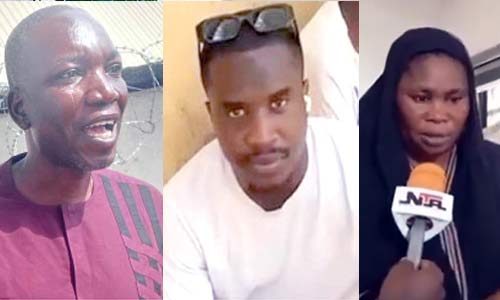
“They shot him through the door. They shot the door two times,” the mother, Habiba Abubakar, stated. A bullet hole was visible on the wooden door, consistent with a shot fired from outside through a closed door.
No Crossfire: The family stated that no weapons were recovered from the scene, no armed adversary was identified or produced, and witnesses heard only a single gunshot throughout the night, the one fired inside the Jamiu residence. “There was no robbery incident in this area as has been claimed. There was no gunfire exchange that led to the death of my son, who was inside his room at the time,” the father, Engineer Sani Jimoh, stated.
The Bullet Trajectory: The family stated that the bullet trajectory showed the shot was fired from outside the room through a closed door, “not consistent with a firefight.” The victim was found with “a blown head” in a pool of blood on the floor of his locked room.
The Blood Cleanup: In one of the most disturbing allegations, the family stated that after the killing, soldiers instructed local vigilante members to clean up the bloodstains before police arrived at the scene. The mother alleged that soldiers directed vigilantes to fetch a bucket and detergent from her kitchen.
“They entered my kitchen, took Klin, from there, took bucket and gave the vigilante to mop the blood. What happened? Why would they do that?” the mother stated.
The alleged cleanup of the crime scene before police arrival raises serious questions about evidence tampering and obstruction of justice.
The Admission: The family alleged that soldiers admitted at the scene, in the presence of the Divisional Police Officer, that they had made a mistake and killed an innocent person. “The soldiers acknowledged that the killing of Abdulsamad Jamiu was a mistake. They admitted that they had killed an innocent person,” the family’s formal statement read. They said this admission was captured in a written statement.
Habiba Abubakar’s account of learning about her son’s death is a portrait of a mother’s worst nightmare.
She had travelled with her husband for a burial ceremony, expecting to return on Saturday to meet her son at home. At approximately 2:30 a.m., a neighbour called to say she was hearing gunshots.
“I said hello. She said, ‘Hope there is no problem?’ She said she’s hearing gunshots. Fear gripped me,” Abubakar recounted.
She tried calling her first son but his phone was switched off. Her daughter’s line was busy. When she finally reached her husband, he was evasive.
“Initially, he didn’t want to tell me the actual truth. He said, ‘Soldier carried Abdulsamad.’ I said, soldier, Abdulsamad? How, for what? He said, no, they want to go and interrogate him,” the mother recounted.
Her phone was then taken from her while she was crying. When she demanded it back, the family claimed they could not find it.
“That was when I knew that my son is not alive again,” she stated.
She kept pressing her daughter Farida for the truth, but Farida kept urging her to calm down, citing her blood pressure.
“I’m getting to Abuja, only for me to discover that my son was dead,” the mother stated, weeping throughout the interview.
“Who did he offend? I want to know. Who did you offend?” she repeated through her grief.
Engineer Sani Jimoh, who was in Okene, Kogi State, when the incident occurred, received the news from his daughter Farida, who was in the house at the time.
Farida told him she heard a gunshot from the ground floor and immediately rushed toward her brother’s room, only to be met by soldiers who flashed a torchlight at her. She pleaded with them not to harm her.
“She told me that, based on her observation, the soldiers were three in number and they immediately demanded her to follow them toward the house’s fence,” Jimoh stated.
The soldiers told Farida they were pursuing a suspect who they believed had jumped into the compound.
“She had to run toward his room immediately where she found his lifeless body on the floor, in a pool of his blood, and a blown head. She confronted them telling them that ‘so you have killed my brother,'” Jimoh recounted.
He said he spoke to one of the soldiers via phone after Farida handed over her phone. The soldier repeated the explanation about pursuing a thief who may have jumped into the compound.
“I tried to ask them how they accessed my home, but their response was that I should not bother about that,” Jimoh stated.
He challenged the soldiers’ explanation: “Even if you are pursuing an armed robber, you should not open fire toward his locked room, when you can hear him asking, ‘who is there, who is there.'”
The father left Okene at 3 a.m. and arrived in Abuja later that morning. The DPO briefed him, offered condolences, and asked him to sign an undertaking before the body could be released.
Jimoh chose to collect the body and bury his son the same day, Saturday, in accordance with Islamic practice.
The father suspects the soldiers may have been sent to target his son specifically. “I suspect them for something else, like someone sent them to do it,” he stated.
On Sunday, April 27, a delegation from the Nigerian Army headquarters led by Brigadier S.O. Buhari visited the family residence to offer condolences and inspect the scene.
According to the family, the delegation acknowledged gaps in the Army’s earlier account during the visit. “They stated that they were unaware that the house was fenced and that the room where the shooting occurred was located downstairs. This contradicts their earlier claim suggesting the death resulted from a ‘stray bullet,'” the family stated.
The delegation assured the family that the officers involved would be investigated and held accountable. However, the family insisted that beyond condolences, there must be accountability and a correction of the public narrative.
Abdulsamad Jamiu, 24, was a graduate of Civil Engineering from the Federal University of Technology, Minna. He was serving his mandatory National Youth Service Corps year in Karu Local Government Area of Nasarawa State and was just one month away from his Passing-Out Parade.
His cousin, Yusuf Enesi Adeiza, described him as disciplined, focused, and widely admired. “He got retained where he served. His Passing-Out Parade was supposed to be next month. He was doing everything right,” Adeiza stated.
Beyond his engineering career, Jamiu was also a Qur’anic teacher. Suleiman Usman, a Kubwa resident, recalled him as his former teacher: “His soothing voice filled the mosque. It was a beautiful recitation.”
His childhood friend Muhsim Nazifi described him as “absolutely brilliant” and a graduate of Madarasatul Hayatul Islam Gbazago who was “one of the best students the school has ever produced.”
Nazifi recalled that Jamiu was reserved and principled: “He was the type who would distance himself from a friend if he discovered that the person had bad habits. He parted ways with one of his friends because he found out the person smoked.”
In a detail that has added poignancy to the tragedy, Adeiza recalled Jamiu’s last moments with his friends: “He went round greeting everyone and saying goodbye. We even joked about it because that’s not how we normally part ways. Now it feels like he somehow knew, like he was saying goodbye for the last time.”
His father revealed that Jamiu had dreamed of joining the Nigerian Army. “My son dreamed of joining the Nigerian Army, so I asked them to fulfil his wish by enlisting one of his younger brothers into the service,” Jimoh stated.
Youths in the Dei-Dei community staged a protest demanding an end to what they described as harassment by soldiers in the area.
Residents alleged that soldiers had imposed an unofficial curfew requiring all residents to be indoors by 10 p.m., beating anyone found outside regardless of their reason for being out.
“They don’t exempt anyone, whether you operate a shop, or come from a place of work, or have an emergency demand. Once it is 10 p.m. they will beat you,” a resident identified as Joseph stated.
A shop owner, Salihu Yusuf, alleged he was beaten by soldiers for not closing his shop by 10:30 p.m., and that a female customer buying eggs was also beaten.
A community leader, speaking confidentially, said the soldiers had been enforcing a curfew for about a month following a request by a local landlord who contacted a senior army officer friend in Bauchi to facilitate surveillance in the area due to past kidnapping incidents. The army officer reportedly relayed the request to the 102 Guards Battalion at Zuma Barracks.
The community leader disputed the Army’s robbery claim: “There was no such incident here, to tell the truth.”
The family has made several specific demands. An immediate independent investigation outside military control with civilian oversight. The identification, suspension, and prosecution of all personnel involved in the shooting. A withdrawal of the Army’s initial statement describing the death as crossfire. A formal public apology from the Nigerian Army. And compensation for the family’s loss.
“The Nigerian Military operates under a constitutional mandate to protect Nigerian citizens. On the night of 25th April 2026, that mandate was catastrophically and fatally violated,” the family’s statement concluded.
The Nigerian Army stated that investigation into the incident is ongoing. “Once the investigation is concluded, you will be updated,” Lieutenant Odunola stated.
The NYSC Director of Information, Caroline Embu, said the Corps was saddened by the death of a serving member and that investigation was ongoing.
The FCT Police Command’s spokesperson, Josephine Adeh, said through an officer that the matter was not currently before the command and may have been reported to the Dei-Dei Divisional Headquarters.
The killing of Abdulsamad Jamiu raises the fundamental question that has haunted Nigeria’s internal security operations for years: who protects citizens from their protectors?
A young man who studied engineering, taught the Quran, dreamed of joining the Army, was retained at his place of service, and was one month from completing his national service, was shot dead inside his own room, through a locked door, while asking “who is there?” by soldiers who then cleaned up his blood and initially claimed he died in crossfire.
If the family’s account is accurate, and the Army delegation’s acknowledgment of “gaps” in its original account suggests it may be, then what happened in Dei-Dei on the night of April 25 was not an operational tragedy but an extrajudicial killing followed by evidence tampering and a false public statement.
The family has asked for justice. The community has asked for an end to harassment. And Abdulsamad Jamiu’s mother has asked the question that no investigation, no matter how thorough, can fully answer: “Who did he offend? I want to know.”
[A MUST HAVE] Evidence Act Demystified With Recent And Contemporary Cases And Materials

Available now for NGN 40,000 at ASC Publications, 10, Boyle Street, Onikan, Lagos. Beside High Court, TBS. Email publications@ayindesanni.com or WhatsApp +2347056667384. Purchase Link: https://paystack.com/buy/evidence-act-complete-annotation
______________________________________________________________________ “Enhance Legal Practice With Authoritative Reports” — Alexander Payne Offers Comprehensive Law Reports, Spanning Over A Century Of Nigerian Jurisprudence Interested buyers are encouraged to place their orders and enquiries via:
0704 444 4777, 0704 444 4999, 0818 199 9888
Website: www.alexandernigeria.com
Interested buyers are encouraged to place their orders and enquiries via:
0704 444 4777, 0704 444 4999, 0818 199 9888
Website: www.alexandernigeria.com