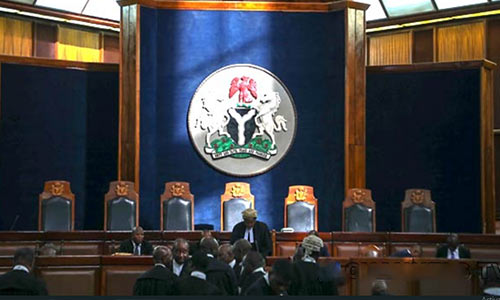
The Supreme Court of Nigeria has settled one of the most litigated procedural questions in Nigerian trial practice, holding that a defective or irregularly sworn witness statement on oath will no longer be fatal to the admissibility or validity of the evidence once the witness adopts the statement in open court, takes a fresh oath before the trial court, and submits to cross-examination by the opposing party.

The decision, delivered by Justice Adumein, JSC, in Katagum v. Umar (2026) 8 NWLR [Pt. 2046] 457, at pages 490-491, paragraphs B-F, marks a significant departure from the earlier strict position adopted by the same court in Nammagi v. Akote (2021) 3 NWLR (Pt. 1762) 170, and carries immediate practical consequences for litigation across all courts in Nigeria where witness statements on oath constitute the primary mode of presenting testimony.
What the Supreme Court Held
Justice Adumein, delivering the judgment, held:
“The failure to take an oath or make an affirmation can in no case be construed to affect the liability of a witness to state the truth. By Section 4 of the Oaths Act, the failure to administer an oath on a witness before giving evidence is a mere irregularity which does not affect the decision arrived at on that evidence, unless it is shown to have occasioned a miscarriage of justice.”
The court then addressed the specific scenario that has generated the most litigation: a written witness statement that was either not sworn at all or sworn irregularly, for example before an unauthorised person or in circumstances that do not comply with the strict requirements of the Oaths Act.
“If the written statement was not made on oath or sworn at all, it would still be valid as the witness’ written statement intended to be given as evidence. Nothing precludes the witness from adopting it as his testimony when testifying on oath in examination-in-chief in open court,” Justice Adumein stated.
Applying the principle to the facts, the court held: “In the instant case, PW1 took an oath in open court, sworn on the Holy Bible, before he proceeded to adopt his written statement. He was duly cross-examined by counsel for the 1st and 2nd respondents. Therefore, any purported defect in his written statement was cured by the oath taken before the trial court.”
The Legal Foundation: Section 4 of the Oaths Act
The Supreme Court’s reasoning is anchored in Section 4 of the Oaths Act, which provides that the failure to administer an oath on a witness before giving evidence is “a mere irregularity” that does not affect the decision arrived at on that evidence, unless the irregularity is shown to have occasioned a miscarriage of justice.
The provision creates a two-part test. First, the failure to properly administer an oath is classified as an irregularity rather than a nullity. This classification is critical because irregularities can be cured, while nullities cannot. Second, the irregularity does not affect the validity of the evidence or the decision based on it unless the party challenging the evidence demonstrates that the irregularity actually caused a miscarriage of justice, a much higher threshold than merely pointing to the procedural defect.
The Supreme Court’s application of this provision means that the burden has shifted. Previously, under the strict approach, the party tendering the evidence bore the risk that any defect in the oath would render the statement incompetent. Now, the party challenging the evidence must demonstrate not merely that the oath was defective but that the defect actually caused a miscarriage of justice, a burden that will be difficult to discharge in most cases where the witness subsequently took a proper oath in open court and was cross-examined.
The Curing Mechanism: In-Court Oath and Cross-Examination
The judgment establishes a clear mechanism by which an irregularly sworn witness statement is cured. The witness must take a proper oath or make an affirmation in open court before the trial judge, adopt the previously prepared written statement as their testimony in examination-in-chief, and submit to cross-examination by the opposing party.
When these three steps are completed, any defect in the manner in which the written statement was originally sworn is cured. The rationale is straightforward: the purpose of the oath is to bind the witness’s conscience and create criminal liability for perjury. When the witness takes a fresh oath in open court before the trial judge and then adopts the statement, the statement is thereafter given under a valid oath. The subsequent cross-examination ensures that the opposing party has the full opportunity to test the truth and accuracy of the evidence.
Departure from Nammagi v. Akote
The decision represents a significant departure from the Supreme Court’s earlier position in Nammagi v. Akote (2021) 3 NWLR (Pt. 1762) 170.
In Nammagi v. Akote, the Supreme Court held a witness statement incompetent after the witness admitted during cross-examination: “I signed the witness statement on oath before my lawyer.” The court considered the oath defective because it was not administered by a person authorised by law to administer oaths. Under the strict approach applied in that case, the defect was treated as fatal to the admissibility of the evidence, regardless of whether the witness subsequently took a proper oath in court.
The contrast between the two decisions is stark. Under Nammagi v. Akote, a witness statement sworn before a lawyer (who is not a Commissioner for Oaths in respect of statements to be used in proceedings in which the lawyer is counsel) was incompetent and could not be rescued by subsequent in-court adoption. Under Katagum v. Umar, even a statement that was “not made on oath or sworn at all” remains valid as a written statement intended to be given as evidence and can be adopted by the witness on oath in court.
The shift from the strict approach to the curative approach effectively overrules the practical effect of Nammagi v. Akote on the specific question of whether in-court adoption can cure a defective oath, though the Supreme Court did not expressly state that it was departing from the earlier decision.
The Practical Impact
The decision carries immediate and far-reaching practical consequences for litigation across Nigerian courts.
For trial lawyers, the judgment means that technical objections to witness statements based solely on the circumstances in which the oath was administered, whether before an unauthorised person, in a lawyer’s office, or in any other irregular manner, will no longer succeed if the witness has taken a proper oath in court and been cross-examined. The focus shifts from the formality of the oath-taking process to the substance of the evidence and whether any irregularity actually prejudiced the opposing party.
For judges, the judgment provides clear authority for admitting and relying on evidence given through witness statements that may have been irregularly sworn, provided the witness adopted the statement on oath in open court and was available for cross-examination. Courts are no longer required to exclude otherwise relevant and probative evidence on the technical ground that the pre-trial oath was defective.
For litigants, the judgment reduces the risk that meritorious cases will be lost on technicalities. Under the strict approach, a party could lose an entire case because its key witness’s statement was sworn before the wrong person, even though the evidence itself was true, relevant, and tested through cross-examination. The curative approach ensures that substance prevails over form.
The Boundaries of the Principle
While the judgment significantly liberalises the treatment of defective oaths, it does not eliminate all safeguards. The principle operates subject to an important qualification derived from Section 4 of the Oaths Act: the irregularity will not affect the decision “unless it is shown to have occasioned a miscarriage of justice.”
This means that if a party can demonstrate that the defective oath actually caused prejudice, for example if the absence of a proper oath at the pre-trial stage meant that the witness felt free to include false statements that the witness would not have included under a properly administered oath, and if this can be shown to have affected the outcome, the court retains the power to treat the irregularity as vitiating the evidence.
However, in practice, this qualification is unlikely to be invoked successfully in most cases. Where the witness has taken a fresh oath in open court and has been subjected to cross-examination designed to test the truthfulness and accuracy of the evidence, the argument that a defective pre-trial oath caused a miscarriage of justice will be extremely difficult to sustain.
The Broader Significance
The decision reflects a broader judicial trend toward prioritising substantive justice over procedural technicality. For decades, Nigerian litigation has been characterised by what many practitioners and judges have described as an excessive focus on technical objections that do not go to the merits of cases but exploit procedural irregularities to defeat otherwise valid claims or defences.
The Supreme Court’s statement that “the failure to take an oath or make an affirmation can in no case be construed to affect the liability of a witness to state the truth” is a powerful expression of the principle that the ultimate purpose of court proceedings is to discover the truth and do justice, not to provide a platform for technical gamesmanship.
By holding that the witness’s adoption of the statement on oath in open court and submission to cross-examination cures any prior irregularity, the court has placed the emphasis where it belongs: on the substance of the evidence, the credibility of the witness as tested through cross-examination, and whether justice has been served.
What Legal Practitioners Must Now Do
The decision requires an immediate adjustment in litigation strategy. Lawyers can no longer rely on technical objections that a witness statement was “sworn in a lawyer’s office,” “not properly sworn,” or sworn before a person not authorised to administer oaths as a basis for excluding evidence or overturning judgments on appeal.
The focus must now shift to the substance of the evidence: is it credible? Is it consistent? Does it withstand cross-examination? Does it corroborate or contradict other evidence before the court? These are the questions that will determine the weight and admissibility of evidence, not the technicality of where, how, or before whom the pre-trial oath was administered.
Conversely, lawyers preparing witness statements should still endeavour to comply with the proper oath requirements as a matter of best practice. The fact that a defective oath can be cured does not mean that compliance is unimportant. Proper compliance avoids the need for the curing mechanism and removes any basis for objection, however technical.
The judgment is reported at Katagum v. Umar (2026) 8 NWLR [Pt. 2046] 457.
[A MUST HAVE] Evidence Act Demystified With Recent And Contemporary Cases And Materials

Available now for NGN 40,000 at ASC Publications, 10, Boyle Street, Onikan, Lagos. Beside High Court, TBS. Email publications@ayindesanni.com or WhatsApp +2347056667384. Purchase Link: https://paystack.com/buy/evidence-act-complete-annotation
______________________________________________________________________ “Enhance Legal Practice With Authoritative Reports” — Alexander Payne Offers Comprehensive Law Reports, Spanning Over A Century Of Nigerian Jurisprudence Interested buyers are encouraged to place their orders and enquiries via:
0704 444 4777, 0704 444 4999, 0818 199 9888
Website: www.alexandernigeria.com
Interested buyers are encouraged to place their orders and enquiries via:
0704 444 4777, 0704 444 4999, 0818 199 9888
Website: www.alexandernigeria.com