By Goodhope Okechukwu Orji
The Nigerian Constitution provides for three tiers of Governments, namely: Federal, State and Local Governments and to be administered by an elected President, Governor and Chairman respectively. Hence, recently the Supreme Court reaffirmed this already existing Constitutional position in the case of AGF v. A.G. ABIA STATE & 35 ORS SC/CV/343/2024. The history of Nigerian Democracy since the 1970’s till date has incorporated the doctrine of necessity or implied mandate as part of the Nigerian Legal Jurisprudence to cover up for lapses or vacuums in government administrations. The doctrine of necessity or implied mandate was given judicial recognition for the first time by the SUPREME COURT OF NIGERIA IN OGUEBIE & ANOR v. ODUNWOKE & ORS (1973) LPELR-2315(SC).
Indeed, despite the clear provisions of the 1999 Constitution of the Federal Republic of Nigeria (as amended) as well as the recent Supreme Court decision on the general principle of law that only elected Chairmen can administer the Local Governments in Nigeria, there are indeed exceptions to the general rule and these exceptions equally form part of the Nigerian Legal System and have been given legal recognition by the Supreme Court of Nigeria in several cases.
In the landmark case of OGUEBIE & ANOR v. ODUNWOKE & ORS (1973) LPELR-2315(SC) the SUPREME COURT OF NIGERIA established the Doctrine of Necessity as an accepted constitutional principle in Nigeria. The Supreme Court in that case invoked the Doctrine of Necessity to fill a constitutional gap, allowing for certain appointments in the interest of peace, stability and good governance. The Court held further that the government of a State has implied powers to take actions necessary to maintain order and stability, even if not explicitly stated in the Constitution or any law in force. The Supreme Court emphasized that, the Doctrine of Necessity should be applied to serve public interest and prevent chaos and disorder. The Supreme Court took the opportunity in that case, to set a clear precedent for the application of the Doctrine of Necessity in Nigerian legal system, allowing for flexibility in exceptional circumstances while maintaining constitutional integrity.
After the foregoing landmark Supreme Court decision, several Nigerian democratic regimes have adopted the Doctrine of Necessity and applied same at the various tiers of government to wit, Federal, State and Local Government levels. The Doctrine of Necessity was applied in Nigeria in the following situations (amongst others):
- In the 1979 Federal Government: Due to a constitutional crisis, in order to avoid a lacuna in government at the federal level, the Doctrine of Necessity was invoked to allow Shehu Shagari to take office as President, despite a dispute over electoral results.
- In the 1993 Interim National Government: After the annulment of the June 12 elections, in order to avoid a lacuna in government at the federal level, the Doctrine of Necessity was invoked to establish an interim National Government headed by Ernest Shonekan.
- In the 2010 Jonathan’s Acting Presidency: Following the death of President Yar’Adua, in order to avoid a lacuna in government at the federal level, the Doctrine of Necessity was invoked to allow President Goodluck Jonathan to become Acting President and later substantive President.
- In the Local Government Levels: In various State in the Six Geo-Political Zones of Nigeria, in order to avoid a lacuna in government at the local government level, the Doctrine of Necessity has been invoked severally, to allow the State Governors to appoint Caretaker Committees or Administrators to manage the local governments during times of transition.
These instances demonstrate the application of the Doctrine of Necessity in Nigeria to address extraordinary situations and ensure stability in governance.
In addition to the landmark case of OGUEBIE & ANOR v. ODUNWOKE & ORS (1973) LPELR-2315(SC) the SUPREME COURT OF NIGERIA has made more recent notable pronouncements, validating the Doctrine of Necessity as a constitutional principle applicable in Nigeria and legalizing steps taken in furtherance of the said principle. Some notable Supreme Court cases on the Doctrine of Necessity include:
- The SUPREME COURT decision in INAKOJU vs. ADELEKE (2007) 4 NWLR (Pt. 1025) 423: The SUPREME COURT invoked the Doctrine of Necessity, in order to avoid a lacuna in government at the state level, by validating the appointment of an Acting Governor in Osun State.
- The SUPREME COURT decision in A.G. ONDO STATE vs. A.G. FEDERATION (2002) 9 NWLR (Pt. 772) 222: The SUPREME COURT invoked the Doctrine of Necessity, in order to avoid a lacuna in government at the state level, by justifying the appointment of an interim government in Ondo State.
- The SUPREME COURT decision in GOVERNOR OF OYO STATE vs. GOVERNOR OF OSUN STATE (2010) 8 NWLR (Pt. 1197) 388: The SUPREME COURT, in order to avoid a lacuna in government, invoked the Doctrine of Necessity to validate the creation of an interim administration at the local government level as a necessary measure to maintain order and stability in the area.
These cases demonstrates the SUPREME COURT’S decisions in recent times in order to maintain the rule of law, address extraordinary situations and ensure stability in governance at all levels in Nigeria through the application of the Doctrine of Necessity to avoid lacunas at any level of Government.
As part of applying the Doctrine of Necessity, in Nigeria, Caretaker Committee Chairmen are legally appointed to manage local governments in exceptional circumstances, such as:
- END OF TENURE: The Doctrine of Necessity is necessarily invoked to avoid lacuna at the local government level, when elected officials’ terms expire and new elections are yet to be held.
- DISSOLUTION OF COUNCILS: The Doctrine of Necessity is necessarily invoked to avoid lacuna at the local government level, when local government councils are dissolved due to crisis, irregularities or other reasons.
- VANACY: The Doctrine of Necessity is necessarily invoked to avoid lacuna at the local government level, when Chairmen or Council members resign, die or are incapacitated.
Despite the express provisions of the Constitution and the recent Supreme Court decision, the Doctrine of Necessity justifies and legalizes the appointments of Caretaker Chairmen, to allow for temporary measures to ensure continuity and stability in local governance. This doctrine is based on the idea that, in extraordinary situations, extraordinary measures may be taken to maintain order and ensure the functioning of government at all levels.
Caretaker Committee Chairmen are usually appointed by State Governors and their tenure is typically short-term, until new elections are held or the crisis is resolved.
Goodhope Okechukwu Orji (Ph.D in view) hope.orji@nigerianbar.ng
[A MUST HAVE] Evidence Act Demystified With Recent And Contemporary Cases And Materials

Available now for NGN 40,000 at ASC Publications, 10, Boyle Street, Onikan, Lagos. Beside High Court, TBS. Email publications@ayindesanni.com or WhatsApp +2347056667384. Purchase Link: https://paystack.com/buy/evidence-act-complete-annotation
______________________________________________________________________ “Enhance Legal Practice With Authoritative Reports” — Alexander Payne Offers Comprehensive Law Reports, Spanning Over A Century Of Nigerian Jurisprudence Interested buyers are encouraged to place their orders and enquiries via:
0704 444 4777, 0704 444 4999, 0818 199 9888
Website: www.alexandernigeria.com
Interested buyers are encouraged to place their orders and enquiries via:
0704 444 4777, 0704 444 4999, 0818 199 9888
Website: www.alexandernigeria.com
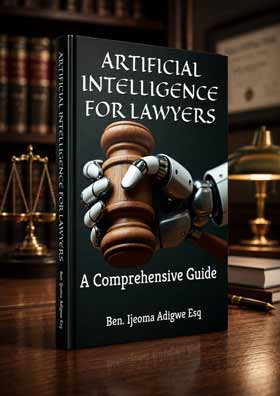 The book also examines Nigeria's legal ecosystem, focusing on the LPELR and NBA AI Guidelines. As a bonus, every purchase comes with a FREE eBook titled: How to Use the AI Features in LegalPedia and LawPavilion.
Ohio Books Ltd praises the publication, stating:
"....this is the only Nigerian book I know of on the topic."
How to Order:
📞 Call, Text, or WhatsApp: 08034917063 | 07055285878
📧 Email: benadigwe1@gmail.com
🌎 Website: www.benadigwe.com
Ebook Version: Access it directly online at https://selar.com/prv626
Authored by Ben Ijeoma Adigwe Esq., ACIarb (UK), LL.M, Dip. in Artificial Intelligence, Director at the Delta State Ministry of Justice, Asaba, Nigeria.
______________________________________________________________________
The book also examines Nigeria's legal ecosystem, focusing on the LPELR and NBA AI Guidelines. As a bonus, every purchase comes with a FREE eBook titled: How to Use the AI Features in LegalPedia and LawPavilion.
Ohio Books Ltd praises the publication, stating:
"....this is the only Nigerian book I know of on the topic."
How to Order:
📞 Call, Text, or WhatsApp: 08034917063 | 07055285878
📧 Email: benadigwe1@gmail.com
🌎 Website: www.benadigwe.com
Ebook Version: Access it directly online at https://selar.com/prv626
Authored by Ben Ijeoma Adigwe Esq., ACIarb (UK), LL.M, Dip. in Artificial Intelligence, Director at the Delta State Ministry of Justice, Asaba, Nigeria.
______________________________________________________________________