Says “Nigeria’s Political Class Is Among The Least Paid In The World”

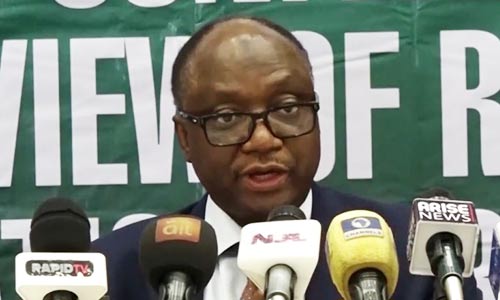
The Chairman of the Revenue Mobilisation Allocation and Fiscal Commission, Alhaji Mohammed Shehu, has said Nigeria’s political class is among the least paid in the world, arguing that the remuneration of public office holders needs to be reviewed.
Shehu, who spoke during a meeting with editors at the weekend, said salaries of political office holders have remained unchanged since 2008 despite three previous attempts to review them.
According to him, it is not ideal that the President of Nigeria earns about ₦1.5 million monthly, an amount he said is lower than what is earned by the Governor of the Central Bank of Nigeria and the Chairman of the Economic and Financial Crimes Commission.
He disclosed that the review of remuneration for executive and legislative office holders has reached an advanced stage, with an executive bill on the Political and Public Office Holders (Salaries and Allowances) Act, 2026 expected to be transmitted to the National Assembly.
Shehu said under the proposed review, the President’s remuneration would move closer to that of the Chief Justice of Nigeria, which he put at approximately ₦5.39 million monthly.
“We cannot place the executive above the judiciary,” he said.
Beyond remuneration, the RMAFC Chairman also spoke on the Commission’s constitutional role in Nigeria’s fiscal system, describing it as central to the operation of fiscal federalism.
He said RMAFC is constitutionally responsible for monitoring revenue accruals into the Federation Account, advising on revenue allocation formulas and overseeing the remuneration of public office holders.
“This Commission stands at the heart of fiscal federalism in Nigeria,” Shehu said.
“Every month, as revenues are shared among the federal, state and local governments, the work of this Commission directly influences national stability, development equity, and intergovernmental harmony.”
He, however, expressed concern that despite the importance of the Commission’s work, many Nigerians have limited understanding of its mandate.
“Too often, the Commission’s work is perceived as technical, distant, or misunderstood. In today’s democratic environment, that is no longer sufficient. Transparency must not only be practised; it must also be communicated clearly,” he said.
Shehu consequently unveiled the Commission’s Strategic Communications Blueprint 2026–2030, which he said is intended to improve transparency, public understanding and institutional accountability.
He noted that fluctuations in government revenues require stronger monitoring, while citizens are demanding greater accountability in public finance and states are seeking fairness and predictability in the distribution of national resources.
According to him, the reform strategy is built around institutional clarity, transparency through technology, structured media engagement, thought leadership in fiscal federalism, internal alignment and professional excellence, as well as the preservation of the Commission’s neutrality.
“We will clearly articulate who we are, what we do, and what we are not. RMAFC is not a revenue-generating agency. We are the constitutional custodians of revenue fairness and fiscal equity,” Shehu said.
He said the Commission would modernise its digital platforms, introduce accessible revenue allocation dashboards and improve public access to data to enable Nigerians to better understand how national resources are distributed.
“We will modernise our digital platforms, introduce accessible revenue allocation dashboards, and strengthen data accessibility so that Nigerians can better understand how resources are distributed,” he said.
Shehu also announced plans to institutionalise quarterly briefings, policy explainers and proactive engagement with the media to improve public understanding of revenue allocation processes and other matters within the Commission’s mandate.
He added that RMAFC intends to take a more visible role in national discussions on revenue diversification, allocation reform and remuneration governance.
On internal reforms, Shehu said commissioners and staff would operate under unified communication standards, strengthened operational discipline and enhanced performance transparency.
“Reform begins within. Our Commissioners and staff will operate under unified messaging standards, strengthened operational discipline, and enhanced performance transparency,” he said.
The RMAFC Chairman stressed that the initiative would not compromise the political neutrality of the Commission.
“Let me be clear: this initiative does not politicise the Commission. On the contrary, it reinforces our constitutional neutrality,” he said.
“Every communication under this reform will be anchored strictly within the provisions of the Constitution and our statutory mandate. Our loyalty is to the Federation of Nigeria, not to partisan interests. Fiscal equity is not a political slogan. It is a constitutional duty.”
Shehu expressed hope that the new initiative would strengthen public confidence in RMAFC, improve trust among the different tiers of government, enhance institutional credibility and raise Nigeria’s fiscal governance standards.
He said the long-term objective is to contribute to a more stable federation in which every tier of government understands not only what it receives from the Federation Account but also why it receives it.
Calling for broad institutional cooperation, Shehu urged the executive arm of government to provide policy support, the legislature to engage constructively, state governments to maintain sustained dialogue and the media to report responsibly.
He also called on civil society organisations and academia to participate in efforts to strengthen Nigeria’s revenue governance framework.
“Repositioning an institution of this stature requires collaboration. I therefore call on the executive arm for policy cooperation, the legislature for constructive engagement, state governments for sustained dialogue, the media for responsible reportage, and civil society and academia for informed participation,” he said.
“Together, we can strengthen the integrity of Nigeria’s revenue governance framework.”
Shehu said the reforms represented a new phase for the Commission, moving it from what he described as quiet constitutional oversight to more visible institutional leadership.
“Today, we begin a new chapter. We move from quiet constitutional oversight to visible institutional leadership, from technical obscurity to transparent clarity, from reactive communication to strategic engagement,” he said.
He stressed that the reform was not designed merely to improve RMAFC’s public image but to strengthen its responsibility to ensure that national revenues are properly monitored, fairly distributed and transparently accounted for.
“This reform is not about image. It is about responsibility. It is about ensuring that every naira due to the Federation is properly monitored, fairly allocated, and transparently accounted for,” Shehu said.
“With discipline, professionalism, and unwavering constitutional fidelity, we will reinforce the Commission’s role as a stabilising pillar of our federal democracy.”
“Order Justice Omolaye-Ajileye’s Electronic Evidence Books Now” — Essential Guides On Evidence Act, Case Law And Digital Proof
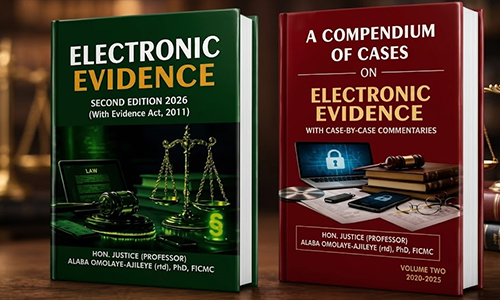
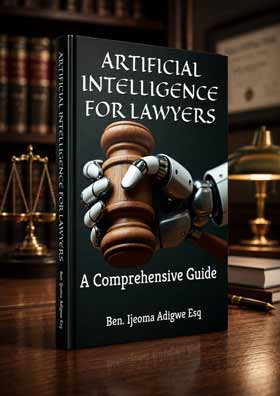 The book also examines Nigeria's legal ecosystem, focusing on the LPELR and NBA AI Guidelines. As a bonus, every purchase comes with a FREE eBook titled: How to Use the AI Features in LegalPedia and LawPavilion.
Ohio Books Ltd praises the publication, stating:
"....this is the only Nigerian book I know of on the topic."
How to Order:
📞 Call, Text, or WhatsApp: 08034917063 | 07055285878
📧 Email: benadigwe1@gmail.com
🌎 Website: www.benadigwe.com
Ebook Version: Access it directly online at https://selar.com/prv626
Authored by Ben Ijeoma Adigwe Esq., ACIarb (UK), LL.M, Dip. in Artificial Intelligence, Director at the Delta State Ministry of Justice, Asaba, Nigeria.
______________________________________________________________________
[A MUST HAVE] Evidence Act Demystified With Recent And Contemporary Cases And Materials
The book also examines Nigeria's legal ecosystem, focusing on the LPELR and NBA AI Guidelines. As a bonus, every purchase comes with a FREE eBook titled: How to Use the AI Features in LegalPedia and LawPavilion.
Ohio Books Ltd praises the publication, stating:
"....this is the only Nigerian book I know of on the topic."
How to Order:
📞 Call, Text, or WhatsApp: 08034917063 | 07055285878
📧 Email: benadigwe1@gmail.com
🌎 Website: www.benadigwe.com
Ebook Version: Access it directly online at https://selar.com/prv626
Authored by Ben Ijeoma Adigwe Esq., ACIarb (UK), LL.M, Dip. in Artificial Intelligence, Director at the Delta State Ministry of Justice, Asaba, Nigeria.
______________________________________________________________________
[A MUST HAVE] Evidence Act Demystified With Recent And Contemporary Cases And Materials

 Interested buyers are encouraged to place their orders and enquiries via:
0704 444 4777, 0704 444 4999, 0818 199 9888
Website: www.alexandernigeria.com
Interested buyers are encouraged to place their orders and enquiries via:
0704 444 4777, 0704 444 4999, 0818 199 9888
Website: www.alexandernigeria.com