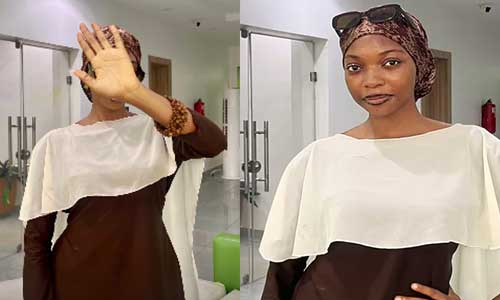
A Nigerian woman who says she was born without fingerprints has recounted years of difficulty navigating the country’s biometric identification systems, describing how the condition complicated her registration for the Joint Admissions and Matriculation Board examinations, participation in the National Youth Service Corps programme and routine banking transactions.

The woman, who identifies herself on Instagram as J for Jidds (@jidds.xo), shared her experience in a video posted on Saturday, saying she first became aware of the condition in 2017 while attempting to register for her first JAMB examination.
According to her, officials repeatedly tried but failed to capture her fingerprints, leaving her and her father at the registration centre for several hours while hundreds of other candidates completed their registrations.
“I was born without fingerprints, and for many years, I thought I was the only person with something like this in Nigeria,” she said.
She added that after recently making a joke about the condition on Instagram, nearly 100 people contacted her to say they had experienced similar difficulties.
Recalling the 2017 JAMB registration, she said the experience was emotionally distressing.
“I stayed there the whole day with my dad. I watched over 200 people register before me. It was—I cried,” she said.
Jidds said various unconventional methods were suggested in an effort to make her fingerprints detectable by the biometric equipment.
According to her, officials tried substances and materials including sand, spirit, methylated spirit, chalk and even watermelon.
“I had to scrub my hand on a stone at a point. And then I got to register,” she recalled.
View this post on Instagram
However, successfully completing the registration did not end her difficulties.
She said fingerprint authentication also became a problem when she eventually went to sit for the examination, with the biometric system sometimes recognising her fingers at one stage but failing at another.
“Sometimes I would be able to thumbprint in and I will not be able to thumbprint out,” she said.
Jidds said similar problems followed her into other areas of life where biometric verification is mandatory or routinely required.
“Living in Nigeria without fingerprints has been has been terrible, honestly. From NYSC to JAMB to the bank, to any other thing that needs biometrics. I always have anxiety. It has been frustrating,” she said.
During her NYSC programme, she said officials had to resort to using part of her foot for biometric verification because the ridges on her toes were also extremely faint.
She explained that toe prints had occasionally helped her complete biometric procedures but were not always reliable because the ridges were barely visible.
The woman also recounted dealing with misconceptions and stigma surrounding the condition.
According to her, some people had suggested that her absence of fingerprints resulted from involvement in rituals or from handling excessively hot objects.
“Some people will tell you that, ‘Oh, you are a ritualist.’ Some people will say, ‘Ah, this one is a ritualist.’ Some people will say, ‘Ah, you carry too much hot things,’” she said.
Jidds questioned why government institutions and other organisations that rely heavily on fingerprints for identification have not created clear alternative procedures for people whose fingerprints cannot be captured.
“If they have knowledge of this issue, why is it that there’s no provision for people like us?” she asked.
She identified her condition as adermatoglyphia.
According to MedlinePlus, a health information resource operated by the United States National Library of Medicine, adermatoglyphia involves the absence of the characteristic ridges normally found on the pads of the fingers and toes, palms of the hands and soles of the feet.
The condition is associated with genetic mutations affecting the normal development of epidermal ridge patterns, leaving affected individuals with smooth skin and making conventional fingerprint scanners ineffective or difficult to use.
Some forms may also be associated with reduced sweating or other mild skin differences, although the most noticeable feature is the absence or near-absence of fingerprints.
Jidds’ post attracted responses from other Nigerians who said they had encountered similar challenges with biometric identification.
One Instagram user, @ugothegogo, said her own condition affected her right hand and created problems while dealing with an embassy and during her NYSC programme.
“OMG TWINSSSSS! Mine was on my right hand! Going to the embassy was horrific. NYSC was a nightmare because of this 😭 I feel so seen!” she wrote.
Another social media user asked whether toe prints could serve as an alternative.
Responding, Jidds said the ridges on her toes were also faint, although toe prints had helped her on several occasions.
“The ridges are too faint, Toe print has saved me a lot of times tho,” she replied.
Another Instagram user, @sophie_akah, said she had also experienced problems during banking transactions.
“OMG I was literally talking to my friend today about this! I’ve suffered in the bank tooth their lazy customer reps,” she wrote.
A dermatologist, Dr. Folakemi Cole-Adeife, who joined the discussion, advised persons with the condition to obtain medical confirmation from a consultant dermatologist, particularly where institutions require fingerprint verification.
According to her, a dermatologist in a teaching hospital can confirm adermatoglyphia and issue documentation requesting exemption from fingerprint-based biometric procedures.
“Anyone with this medical condition can visit a consultant dermatologist in a teaching hospital for a review and once adermatoglyphia is confirmed, you can request a letter of exemption from fingerprint biometrics from the hospital to JAMB or any parastatal requiring it,” Cole-Adeife wrote.
She added that she had previously written such exemption letters for people with the condition.
“I have written exemption letters for a few people with this condition,” she said.
Jidds’ account has consequently renewed attention on the accessibility of Nigeria’s increasingly biometric-dependent identification systems and the difficulties faced by people whose physical conditions make conventional fingerprint verification impossible.
Her experience also raises broader questions about whether examination bodies, banks, government agencies and other institutions should establish clearly defined alternative verification methods so that people with conditions such as adermatoglyphia are not subjected to repeated delays, anxiety or exclusion when accessing essential services.
[A MUST HAVE] Evidence Act Demystified With Recent And Contemporary Cases And Materials

Available now for NGN 40,000 at ASC Publications, 10, Boyle Street, Onikan, Lagos. Beside High Court, TBS. Email publications@ayindesanni.com or WhatsApp +2347056667384. Purchase Link: https://paystack.com/buy/evidence-act-complete-annotation
______________________________________________________________________ “Enhance Legal Practice With Authoritative Reports” — Alexander Payne Offers Comprehensive Law Reports, Spanning Over A Century Of Nigerian Jurisprudence Interested buyers are encouraged to place their orders and enquiries via:
0704 444 4777, 0704 444 4999, 0818 199 9888
Website: www.alexandernigeria.com
Interested buyers are encouraged to place their orders and enquiries via:
0704 444 4777, 0704 444 4999, 0818 199 9888
Website: www.alexandernigeria.com