*Tens Of Thousands Celebrate On Budapest Streets

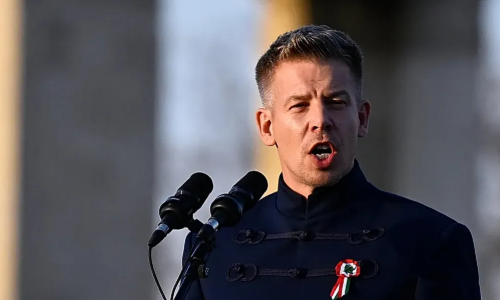
The 16-year rule of populist nationalist Viktor Orbán has come to a dramatic end after the centre-right pro-European opposition party Tisza, led by Péter Magyar, won a commanding two-thirds supermajority in Hungary’s parliamentary elections a result that sent tens of thousands of Hungarians pouring onto the streets of Budapest in wild celebration, drew silence from the White House after Vice President JD Vance’s unprecedented campaign intervention failed to deliver, and signalled a seismic shift in European politics.
With 98.74 per cent of votes counted, Tisza was projected to have won 138 of the 199 seats in the new Hungarian parliament, compared to just 55 for Orbán’s Fidesz party and 6 for the far-right Mi Hazánk party a result that gives Magyar’s government the constitutional supermajority required to reverse the sweeping changes Orbán made to Hungary’s legal and institutional framework during his decade and a half in power.
In a speech to supporters at the Bálna Centre in Budapest, Orbán conceded defeat swiftly and without challenging the result — a notable contrast to some of his international allies.
“The election result is painful for us, but clear,” Orbán stated.
However, the outgoing prime minister struck a defiant tone, pledging that his political career was far from over.
“I will never, never, never give up. We will serve our country and the Hungarian nation from the opposition,” Orbán declared, signalling that Fidesz intends to remain an active political force despite its devastating defeat.
The concession was delivered to supporters who had gathered expecting a different outcome, reflecting the scale of the electoral upset in a country where Fidesz had won every election since 2010 and had reshaped the media, judiciary, and political landscape to entrench its dominance.
In his victory speech, Magyar promised to bring Hungary back into the mainstream of European politics after years of isolation under Orbán, pledging a pro-EU and pro-NATO course for the country.
The commitment represents a fundamental reorientation of Hungary’s foreign policy. Under Orbán, Hungary became the EU’s most difficult member state maintaining close relations with Russia, publicly criticising Ukraine, blocking EU consensus on key issues, and cultivating a special relationship with Vladimir Putin that drew condemnation from European partners.
Magyar’s first foreign trip as prime minister is expected to be to Brussels, where he will seek to unlock billions of euros in EU funds that were frozen during the Orbán era over rule-of-law concerns and governance disputes.
The supermajority gives the new government the power to reverse many of Orbán’s most controversial constitutional and legal changes — including modifications to the judiciary, electoral system, and media regulation that critics described as democratic backsliding.
The result triggered scenes of jubilation across Budapest that observers compared to the fall of communism in 1989.
Tens of thousands of Hungarians took to the streets, flooding public squares, metro stations, and the areas around the parliament building on the banks of the Danube. Crowds on the Budapest metro were heard chanting “It’s over! It’s over!” as they made their way to Tisza’s victory celebration.
Revellers tore down Fidesz’s anti-Ukraine campaign posters that had been plastered across the city many of which had already been defaced during the final days of the campaign.
The celebrations were particularly emotional for younger Hungarians the generation that grew up entirely under Orbán’s rule. Many directly compared the moment to what 1989 meant for their parents, describing it as a once-in-a-generation turning point.
“It feels like history is being made,” one young voter said, echoing the sentiments reported during the build-up to the election.
The result posed immediate awkwardness for the United States, where Vice President JD Vance had made an “unprecedented” campaign trip to Budapest earlier in the week, openly admitting he was there to help Orbán win the election.
President Donald Trump, who had publicly backed Orbán, was posting on Truth Social after the results came in but made no mention of Hungary. Vance, who had so keenly campaigned for Orbán just days earlier, also offered no public comment.
The silence stood in stark contrast to the congratulations flowing from European leaders, highlighting the diplomatic sensitivity of the result for a White House that had invested political capital in Orbán’s continued rule.
Magyar had responded to Vance’s visit with diplomatic restraint, emphasising the importance of good US-Hungary relations and even floating the idea that Trump could visit Hungary for the 70th anniversary of the 1956 revolution in October a softer approach designed to avoid antagonising Washington while firmly rejecting its preferred candidate.
The election was being closely watched around the world as a test of the resilience of the MAGA movement and the global far right, many of whom had long looked to Orbán as an inspiration and sought to follow his playbook of democratic backsliding, media control, and nationalist populism.
Orbán’s defeat sends a powerful signal that even deeply entrenched populist leaders operating in systems they have extensively reshaped can be removed through democratic elections when opposition forces unite effectively.
The result also isolates Slovakia’s Robert Fico, who regularly teamed up with Orbán in the EU. The pair formed what was described as the EU’s “awkward squad,” publicly maintaining relations with Russia, criticising Ukraine, and blocking European consensus on key issues.
With a pro-EU government now in Budapest, Fico will be alone in the European Council, potentially giving EU leaders the opportunity to break deadlocks on Ukraine, energy policy, and institutional reform that the Orbán-Fico alliance had helped create.
Fico, who publicly praised Orbán in a pre-election post, had not publicly congratulated Magyar as of the early hours after the result — though his office noted he was in Vietnam in a different time zone.
The scale of Tisza’s victory is historic by any measure.
With 98 per cent of votes counted, the seat distribution stood at: Tisza — 138 seats (69.3 per cent of parliament), Fidesz — 55 seats (27.6 per cent), and Mi Hazánk — 6 seats (3 per cent).
The 138-seat total exceeds the 133 seats required for a two-thirds supermajority in the 199-seat parliament, giving the new government the constitutional power to amend fundamental laws, reverse Orbán-era constitutional changes, reform the judiciary, restructure media regulation, and reshape the electoral system.
Despite some pre-election concerns about how Orbán would respond to a defeat, the transition appeared orderly. Orbán conceded quickly, congratulated his rivals, and — unlike some of his international allies did not attempt to question the legitimacy of the vote.
The peaceful concession, while expected in a European democracy, was not taken for granted given the increasingly authoritarian direction of Orbán’s governance in recent years and the rhetoric of some of his supporters.
Magyar is expected to move quickly to form a government and begin the process of reversing Orbán’s most controversial policies.
Priority areas are likely to include unlocking frozen EU funds, restoring judicial independence, reforming media regulation, re-establishing Hungary’s position within EU and NATO decision-making processes, and resetting relations with Ukraine.
The supermajority gives Magyar the tools to achieve these goals, but the scale of institutional change required after 16 years of Fidesz reshaping every aspect of the Hungarian state means the process of democratic restoration will take years rather than months.
For Hungary, the election marks the end of an era and the beginning of an uncertain but hopeful new chapter. For Europe, it represents the removal of its most persistent internal obstacle at a time when the continent faces its greatest security challenges since the Cold War. And for the global populist movement, it stands as a reminder that democratic accountability, however delayed, ultimately prevails.
As the crowds on the Budapest metro chanted into the night: “It’s over! It’s over!”
[A MUST HAVE] Evidence Act Demystified With Recent And Contemporary Cases And Materials

Available now for NGN 40,000 at ASC Publications, 10, Boyle Street, Onikan, Lagos. Beside High Court, TBS. Email publications@ayindesanni.com or WhatsApp +2347056667384. Purchase Link: https://paystack.com/buy/evidence-act-complete-annotation
______________________________________________________________________ “Enhance Legal Practice With Authoritative Reports” — Alexander Payne Offers Comprehensive Law Reports, Spanning Over A Century Of Nigerian Jurisprudence Interested buyers are encouraged to place their orders and enquiries via:
0704 444 4777, 0704 444 4999, 0818 199 9888
Website: www.alexandernigeria.com
Interested buyers are encouraged to place their orders and enquiries via:
0704 444 4777, 0704 444 4999, 0818 199 9888
Website: www.alexandernigeria.com