The Federal Government has announced that petrol will be sold at a discount at the filling stations of the Nigerian National Petroleum Company Limited for the next thirty days, at a price of N1,350 per litre to be reviewed monthly, with priority given to public transporters.

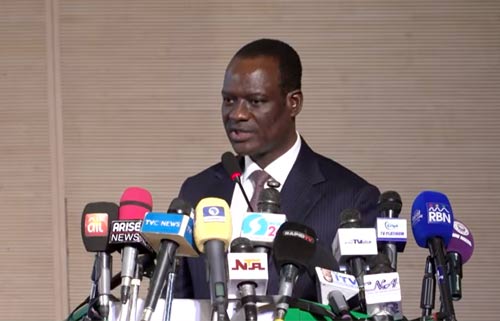
The announcement was made in Abuja by Mr. Taiwo Oyedele, who addressed journalists on the measure, and was confirmed by the Presidency as having the approval of President Bola Ahmed Tinubu.
It was immediately rejected by the presidential candidate of the African Democratic Congress, Alhaji Atiku Abubakar, by the national leadership of the Nigeria Democratic Congress, and by the ADC Presidential Campaign Council.
“We are offering a discount on petrol dispensed by NNPC Limited for the next 30 days in the first instance with priority for public transporters nationwide,” Oyedele said.
He said transporters would be given first priority, and that the measure was not a subsidy but an arrangement for government to sell petrol at a ceiling cost.
“So, it’s not a subsidy. The government is just saying we sell to you at cost,” he said.
He explained the mechanism: “Pump prices do not have to follow every swing in global crude prices or the exchange rate. Government is negotiating a ceiling price of N1,350 a litre on the ex-gantry or the landing cost of petrol to keep fuel prices stable.”
The price, he said, would be reviewed monthly.
On further measures to ease pressure on households, Oyedele said the government plans a forward sale of crude oil to domestic refiners, at a period and price yet to be determined.
“That preserves your budget, provides certainty to the refiners and price stability to consumers,” he said.
The Warning: N2,000 A Litre And N3,000 To The Dollar
Oyedele warned that the reintroduction of fuel subsidy, as proposed by some presidential candidates, could push the price of premium motor spirit to N2,000 per litre and send the exchange rate to as much as N3,000 to the dollar.
“Return subsidy and the sequence is familiar. Weaker revenue invites a sovereign credit downgrade, as the rating agencies have already signalled,” he said.
“That would put at risk the upgrades we have recently earned, including our first from S&P in 14 years. Borrowing becomes costlier. Capital leaves. Reserves fall. The naira weakens.”
“The progress on inflation, which has allowed the Central Bank to begin lowering interest rates, would be put at risk. Our estimate is that the exchange rate could approach N3,000 to the dollar within months, and so-called subsidised petrol would cost at least N2,000 a litre. That is well above what Nigerians pay today.”
“Removing The Subsidy Has Never Meant Doing Nothing”
Oyedele said the removal of subsidy had not left the government inactive.
“Removing the subsidy has never meant doing nothing. Over the past three years, government has acted to moderate prices in ways that are sustainable,” he said.
He said deregulation had made domestic refining viable, which was why supply had held while other countries scrambled for scarce cargoes, and that the Dangote refinery would not have been able to operate under a regime of fuel subsidy.
CNG, Electric Vehicles And Duty Waivers
Oyedele said efforts to provide cheaper transport alternatives formed part of the government’s response.
“More than 120,000 vehicles now run on CNG, served by over 400 conversion centres, 96 refuelling stations and 18 Liquefied-to-Compressed Natural Gas stations,” he said.
“Over 550 CNG buses have been deployed so far. Where they run, fares have fallen by 30 to 50 per cent. We have also removed taxes on electric vehicles and solar equipment, and cut import duties on all vehicles.”
“Customs data show that imports of CNG-powered vehicles including tricycles, electric vehicles and renewable energy equipment have more than doubled since May 2023, with duty waivers of over N100 billion. Some states plan to introduce CNG buses and electric tricycles at scale.”
“The Naira Was Not Devalued”
The minister disputed the common description of what happened to the currency.
“Naira was not devalued, rather Naira depreciated because we ran out of reserves to defend the artificial exchange rate which was only accessible by the highly connected while manufacturers and average Nigerians pay a huge premium for FX in the parallel market,” he said.
“Today, the gap between the official and parallel rates has narrowed from over 60 per cent to under five per cent. Reserves stand at about $55 billion, the highest level in eighteen years. This is the single biggest lever on pump prices, and one we cannot afford to lose.”
A National Strategic Fuel Reserve
Oyedele disclosed that the Federal Government is investing in a National Strategic Fuel Reserve to protect households and businesses from future energy shocks.
“Refined products will be released into the market under clear, published rules whenever a global disruption or hoarding threatens supply and price stability,” he said.
“This is not a subsidy and it does not fix prices, rather it secures supply and reduces price volatility. It will prevent artificial scarcity, deter market manipulation and anchor long-term energy security.”
The Presidency: “None Of These Measures Restores A Blanket Subsidy”
The Presidency said the measure the national oil company forgoing its petrol retail profit margin and selling to Nigerians at cost, to cushion the impact of global crude price shocks on vulnerable households has the approval of the President.
In a statement by the Special Adviser to the President on Information and Strategy, Mr. Bayo Onanuga, the Presidency said the step should not be read as a reversal of reform.
“To be clear, none of these measures restores a blanket subsidy. Doing so would create longer-term harm for a short-term cure. Each measure is designed to reach the people who need help, without putting the wider economy at risk,” it said.
“Removing the fuel subsidy came at a price. But the alternative has been tried. Nigeria has already lived through that cycle: scarcity, smuggling, a collapsing currency and a fiscal crisis. We cannot afford to live through it again, least of all in response to a temporary disruption, and at the very moment the results of reform are gathering pace.”
“Government is not out to reverse a necessary reform designed to set our country on the path towards sustained prosperity. It is to ensure its gains reach more Nigerians, faster and in more tangible ways.”
The statement added that the government is working on a comprehensive package of fiscal measures to bring inflation down to single digits sustainably in the near term.
On the mechanics, it said: “NNPC Retail, which already sells petrol at the lowest price in the market, will offer this new deal within the next 30 days. This means if NNPC’s landing cost is N1,300, it will sell fuel to Nigerians, especially commercial vehicles, at the same price.”
Atiku: “What Happens On Day 31?”
In a statement by his Director of Strategic Communication, Mr. Phrank Shaibu, the ADC presidential candidate said Nigerians who had endured years of soaring transport fares and food prices could not be expected to treat a one-month discount as a solution.
“Atiku totally rejects this calendar-scheduled, election-laced subsidy package. Nigerians are not fools to be offered a month of discounted fuel after years of punishing prices and then expected to forget the hardship when the discount expires. This is shameless and heartless,” the statement said.
“What happens on Day 31? Nigerians wake up to the same brutal prices, the same punishing transport fares and the same rising cost of food. The government cannot manufacture relief for one month and expect Nigerians to applaud while the hardship remains.”
He faulted the restriction of the discount to the national oil company’s stations, saying the government had not disclosed how much motorists would save per litre, nor guaranteed that transport operators would pass any savings on to passengers through lower fares.
He said the shift exposed the failure of the government’s earlier argument that meaningful relief was impossible.
“This volte-face proves that the production-support proposal I have advanced is workable, achievable and not complicated. The Tinubu government and its spin doctors have tried to make it sound impossible, yet they are now reaching for a temporary subsidy-style intervention because the pain has become impossible to ignore,” he said.
He reiterated his proposal for capped and budgeted production support tied to fuel refined in Nigeria, with safeguards to ensure consumers benefit while supporting local refining.
“Nigerians need lasting relief, not a countdown to the return of hardship. Tinubu’s government cannot spend years telling Nigerians to endure, then offer 30 days of relief and call it a solution,” he said, adding: “Tinubu made life expensive. I will make life affordable again.”
NDC: “A Greek Gift”
In a statement by its National Publicity Secretary, Mr. Osa Director, the Nigeria Democratic Congress described the discount as tokenism.
“This is nothing but tokenism and a Greek gift from a government that whimsically removed fuel subsidy without proper consideration, consultation, or cushions for Nigerians. Nigerians cannot be deceived,” it said.
“What happens to the millions of Nigerians who lost their jobs and whose businesses collapsed as a result of the callous and poorly planned removal of subsidy? What about those who lost their lives in poorly equipped government hospitals that have now become mortuaries?”
“It is clear that President Bola Tinubu and the All Progressives Congress government are desperate, and Nigerians must not be deceived. Emilokanomics has failed woefully.”
“The attempt to reintroduce petrol subsidy through the back door is not only mischievous but a sign of a government in free fall, ready to clutch at anything to survive.”
The party questioned the practicality of the arrangement. “Even the bogus promise to dispense discounted fuel at designated NNPC retail outlets is not pragmatic. How many such outlets exist in Nigeria to serve over 200 million Nigerians? Is this not the recipe for another stampede that could have many more Nigerians trampled to death at the filling stations?”
It concluded: “Several questions beg for answers, but the only answer staring Nigerians in the face is that the economy is in a tailspin and at a tipping point.” It called on Nigerians to vote for Mr. Peter Obi and other NDC candidates at the election it gave as holding on 16 January 2027.
ADC Campaign Council: “Nigerians Are Not For Sale”
The ADC Presidential Campaign Council, in a statement by its Director of Media and Publicity, Mr. Kola Ologbondiyan, described the measure as an attempted inducement.
“After over three years of subjecting Nigerians to excruciating pain through the reckless removal of fuel subsidy, the collapse of the naira and suffocating economic policies, the Tinubu administration now thinks it can bribe Nigerians with 30 days of cheaper fuel. Nigerians will reject your one-month bribe,” it said.
“What happens after 30 days? Will Nigerians return to buying petrol at over N1,400 per litre? This is not governance; this is deceit. It is a negotiated bribe designed to be reviewed monthly to suit the government’s political calendar.”
“Atiku was right all along. This half-hearted 30-day gimmick is proof that the government has finally acknowledged the truth, although it has done so too late and in a deceitful manner.”
“If the government can reduce the burden of fuel costs for 30 days, with priority given to public transport operators, why did it allow Nigerians to suffer for more than 800 days? This proves that the government has always had the capacity to make life easier for Nigerians but chose not to do so and only remembers the suffering masses when elections are around the corner.”
“No one-month palliative can buy the conscience of Nigerians. Nigerians are not for sale. You cannot buy their future with 30 days of cheaper fuel. They have seen through this fraud. They know the difference between genuine governance and a one-month electoral bribe.”
The announcement also came as the Nigeria Labour Congress issued a fourteen-day ultimatum to the Federal Government over petrol prices and wages.
What Nigerians Say The Campaign Should Be About
Six Nigerians spoke on what the 2027 presidential candidates should campaign on.
A journalist, Ms. Uche Ruth Ogbonnaya, said the campaign “must move past rhetoric to tackle Nigeria’s biting cost of living, insecurity, unemployment, and collapsing purchasing power,” and that discussions should also prioritise judicial independence, the electoral commission’s autonomy, and the abolition of state governors’ security votes.
An entrepreneur, Ms. Romoke Olisa, said candidates must go “beyond making promises” and explain “their implementation strategies, funding sources, and measurement metrics.”
An entrepreneur, Mr. Gbenga Komolafe, said the core challenge is the oil industry, that fixing the state refineries is vital, and that candidates must formalise “the massive informal economy — which employs 93 per cent of workers — by providing credit, social protection, and infrastructure.”
An entrepreneur, Mr. Endurance Ibhadore, said candidates must provide practical solutions for lowering the costs of food and energy and tackle insecurity, which “directly threatens Nigeria’s food security and employment.”
A journalist, Ms. Francisca Ogar, said the two most pressing issues are ending insecurity and easing economic hardship, and that any candidate without a clear template “needs to recalibrate their strategy.”
A communications expert, Mr. Oputa David, said the next president “must demonstrate the capacity to communicate honestly, take full responsibility, and unite a deeply divided nation.”
[A MUST HAVE] Evidence Act Demystified With Recent And Contemporary Cases And Materials

Available now for NGN 40,000 at ASC Publications, 10, Boyle Street, Onikan, Lagos. Beside High Court, TBS. Email publications@ayindesanni.com or WhatsApp +2347056667384. Purchase Link: https://paystack.com/buy/evidence-act-complete-annotation
______________________________________________________________________ “Enhance Legal Practice With Authoritative Reports” — Alexander Payne Offers Comprehensive Law Reports, Spanning Over A Century Of Nigerian Jurisprudence Interested buyers are encouraged to place their orders and enquiries via:
0704 444 4777, 0704 444 4999, 0818 199 9888
Website: www.alexandernigeria.com
Interested buyers are encouraged to place their orders and enquiries via:
0704 444 4777, 0704 444 4999, 0818 199 9888
Website: www.alexandernigeria.com