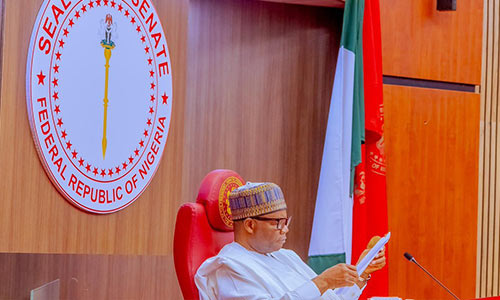
Senate President Godswill Akpabio and Senator Adams Oshiomhole, representing Edo North Senatorial District, clashed in a heated confrontation on the floor of the Senate on Wednesday, barely 24 hours after the Senate amended its Standing Orders to restrict eligibility for presiding and principal offices in the 11th Senate, with Akpabio warning Oshiomhole that “if you become unruly, we will use the rules to take you out of the Senate” after the former Edo State Governor repeatedly defied the Senate President’s rulings, ignored a clarification from former Chief Whip Orji Uzor Kalu, and persisted in disrupting proceedings despite a threat of disciplinary action from the Senate Whip.

The confrontation, which unfolded during the reading of the Votes and Proceedings of Tuesday’s sitting, is widely believed to be directly connected to the Senate’s amendment of its Standing Orders the previous day, which introduced eligibility requirements that effectively block Oshiomhole, a first-term senator, from contesting for the position of Senate President or other presiding offices in the 11th Senate after the 2027 elections.
The trouble began when Akpabio commenced reading the Votes and Proceedings of Tuesday’s session, the routine procedural exercise in which the Senate confirms the accuracy of the record of the previous day’s business.
Oshiomhole rose on a point of order, attempting to intervene during the reading. Akpabio reminded him that under the Senate Standing Orders 2023, as amended, a point of order is not permitted while the Votes and Proceedings are being considered.
The rule is straightforward: the reading of Votes and Proceedings is a procedural formality, and interventions are deferred until after the record is adopted. Any senator wishing to challenge the accuracy of the record can do so at the appropriate stage, but not through a point of order during the reading itself.
Despite Akpabio’s clarification, Oshiomhole ignored the Senate President and continued pressing his objection.
Akpabio then called on Senator Orji Uzor Kalu, the former Chief Whip of the Senate representing Abia North, to educate Oshiomhole on the applicable rules. Kalu confirmed Akpabio’s position, stating that no point of order could be raised during the consideration of Votes and Proceedings.
The intervention of a former Chief Whip, whose role involves expertise in Senate procedure, was intended to settle the matter with the authority of institutional knowledge. Under normal circumstances, a senator receiving confirmation of a procedural rule from both the Senate President and a former Chief Whip would accept the ruling and resume his seat.
Oshiomhole did not.
As Oshiomhole continued to press his objection, Senate Whip Senator Tahir Monguno, representing Borno North, intervened with a threat of disciplinary measures.
Monguno cautioned Oshiomhole against further disruption and warned that he would invoke his disciplinary powers if the proceedings continued to be obstructed.
Under the Senate’s Standing Orders, the Chief Whip has the authority to enforce discipline among senators and to invoke sanctions against members whose conduct disrupts the orderly functioning of the chamber. The warning from Monguno escalated the confrontation from a procedural disagreement to a potential disciplinary matter.
Despite the interventions of Kalu and the warning from Monguno, Oshiomhole attempted to interrupt yet again. Akpabio, having exhausted the procedural options for managing the disruption, responded with a public warning that left no room for ambiguity.
“We should not just go home, buy forms and come here without knowing the rules,” Akpabio stated, a remark that some interpreted as a reference to the perception that some senators enter the chamber without adequate understanding of parliamentary procedure.
He then directed his warning specifically at Oshiomhole: “Oshiomhole, if you become unruly, we will use the rules to take you out of the Senate.”
The threat to “take you out of the Senate” using the rules refers to the Senate’s power to suspend or exclude a member for disorderly conduct under the Standing Orders, a sanction that, while rarely invoked, is available to the presiding officer when a senator’s behaviour disrupts proceedings.
Following the warning, the session continued without further incident. Senator Adamu Aliero, representing Kebbi Central, moved for the adoption of the Votes and Proceedings, and the motion was seconded by Senate Minority Leader Senator Abba Moro of Benue South.
The confrontation cannot be understood outside the context of the Senate’s amendment of its Standing Orders on Tuesday, the day before the clash.
Under the new rules, a senator seeking to contest for presiding office, including Senate President or Deputy Senate President, must have served at least one complete term of four years in the Senate. For principal offices such as Chief Whip, Deputy Whip, and Minority Whip, a senator must have served two consecutive terms immediately preceding the nomination.
The amendment has been widely interpreted as a move to consolidate the position of ranking senators and current Senate leaders ahead of the leadership contest that will follow the 2027 elections, while simultaneously narrowing the field of potential challengers.
The amendment’s most immediate and visible target is Oshiomhole himself.
As a first-term senator who was elected in 2023, Oshiomhole would be serving his first four-year term when the 11th Senate convenes after the 2027 elections. Under the old rules, nothing prevented a first-term senator from contesting for Senate President if he could secure the votes. Under the amended rules, he is categorically barred from seeking the position until he completes at least one full term.
Oshiomhole, a former national chairman of the APC and two-term governor of Edo State, has been widely regarded as having ambitions for a leadership position in the Senate. His political experience, national profile, and combative personality made him a potential contender for Senate President in the 11th Senate, a prospect that the amendment effectively forecloses.
The timing of the amendment, coming during the same Senate session in which the 2027 electoral activities are being prepared, suggests it was designed to lock in the current leadership structure’s advantages before the next election cycle reshuffles the Senate’s membership.
The clash between Akpabio and Oshiomhole exposes deeper power dynamics within the Senate and the ruling APC.
Akpabio, as Senate President, controls the chamber’s proceedings, determines committee assignments, influences legislation, and wields significant patronage power. The amendment to the Standing Orders strengthens his position by ensuring that potential challengers from the incoming class of senators cannot immediately contest for his position or that of his allies in the leadership.
Oshiomhole, despite being a first-term senator, brings to the chamber the political weight of a former party national chairman and two-term governor. His willingness to publicly defy the Senate President, ignore procedural rulings, and persist despite warnings from the Chief Whip reflects a political calculation that the confrontation serves his interests by establishing his reputation as an independent voice who will not be cowed by institutional authority.
The invocation of Orji Kalu as an intermediary adds another dimension. Kalu, himself a former governor and a senator whose own certificate controversies have been well documented, was called upon to educate Oshiomhole, a former party chairman, on Senate procedure. The dynamics of seniority, power, and institutional knowledge in the exchange reflect the complex hierarchies within the Senate.
Akpabio’s comment that senators “should not just go home, buy forms and come here without knowing the rules” was interpreted by observers as a broader message that extends beyond the immediate procedural dispute.
The remark suggests that some senators treat their election as sufficient qualification for legislative work without investing the effort to understand the rules, procedures, and conventions that govern the institution. In the context of the Oshiomhole confrontation, it implies that the former governor’s defiance of procedural rules reflects unfamiliarity with Senate procedure rather than principled dissent.
However, Oshiomhole’s supporters might argue the opposite: that the former governor understands the rules perfectly well and chose to defy them as a deliberate protest against an amendment that he believes was designed to unfairly restrict his political options.
The confrontation foreshadows what promises to be an intense struggle for the leadership of the 11th Senate after the 2027 elections.
If the amended Standing Orders remain in force, the race for Senate President will be limited to senators who are serving at least their second term, giving an inherent advantage to incumbent senators who return after 2027 and excluding any newcomers, however prominent, who enter the Senate for the first time.
For Oshiomhole, the amendment represents a structural barrier that can only be overcome in one of three ways: by getting the amendment reversed before the 11th Senate convenes, by securing a leadership position that falls below the presiding officer threshold, or by building sufficient political capital to challenge the rules from within.
His confrontation with Akpabio on the Senate floor may be the opening salvo in a longer campaign to resist what he and his allies may view as an attempt by the current leadership to perpetuate its control beyond its natural lifespan.
The Akpabio-Oshiomhole clash, while ostensibly about a procedural point during the reading of Votes and Proceedings, is fundamentally about power, succession, and the rules that determine who gets to lead.
The amendment to the Standing Orders changes the playing field for the 11th Senate before the game has even begun. By requiring tenure-based qualifications for leadership positions, it creates a system where institutional incumbency matters more than political experience, popular mandate, or national profile.
For Oshiomhole, who brought to the Senate the credentials of a former party national chairman and two-term governor, the message is clear: your experience outside the Senate does not count. Only time served inside the chamber qualifies you for leadership.
For Akpabio, the amendment and the confrontation reinforce his authority and his ability to control the institutional framework within which future leadership contests will be conducted.
And for the Nigerian public watching the spectacle of two APC heavyweights clashing on the Senate floor over procedural rules, the episode confirms that the real battles in Nigerian politics are often fought not over policy or legislation but over the rules that determine who gets to make the decisions.
As Akpabio warned: “If you become unruly, we will use the rules to take you out of the Senate.”
The rules, it appears, are the ultimate weapon. And those who control them control everything.
[A MUST HAVE] Evidence Act Demystified With Recent And Contemporary Cases And Materials

Available now for NGN 40,000 at ASC Publications, 10, Boyle Street, Onikan, Lagos. Beside High Court, TBS. Email publications@ayindesanni.com or WhatsApp +2347056667384. Purchase Link: https://paystack.com/buy/evidence-act-complete-annotation
______________________________________________________________________ “Enhance Legal Practice With Authoritative Reports” — Alexander Payne Offers Comprehensive Law Reports, Spanning Over A Century Of Nigerian Jurisprudence Interested buyers are encouraged to place their orders and enquiries via:
0704 444 4777, 0704 444 4999, 0818 199 9888
Website: www.alexandernigeria.com
Interested buyers are encouraged to place their orders and enquiries via:
0704 444 4777, 0704 444 4999, 0818 199 9888
Website: www.alexandernigeria.com